Increasingly Confident GDPNow Estimate Way Too High

On Monday, following construction spending and ISM reports, GDPNow upped its estimate of second-quarter GDP from 2.7% to 3.0%.
I am increasingly confident that its estimate is way too high. Let’s take a look at my reasons starting with the latest GDPNow forecast.
GDPNow Latest forecast: 3.0 percent — July 3, 2017
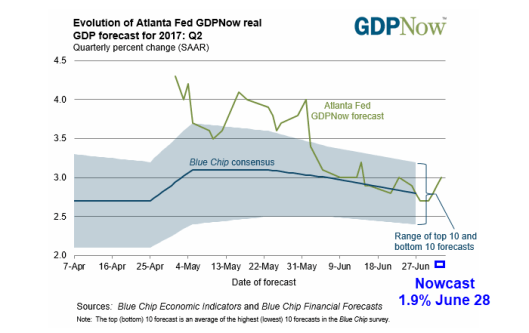
"The GDPNow model forecast for real GDP growth (seasonally adjusted annual rate) in the second quarter of 2017 is 3.0 percent on July 3, up from 2.7 percent on June 30. The forecasts of second-quarter real nonresidential structures and residential investment declined from 1.6 and 2.5 percent to 0.6 and 0.1 percent, respectively, after this morning’s construction spending release from the U.S. Census Bureau. The forecasts of second-quarter real consumer spending and nonresidential equipment investment growth increased from 3.1 and 3.0 percent to 3.5 and 4.7 percent, respectively, after this morning’s Manufacturing ISM Report On Business from the Institute for Supply Management."
Soft Data Silliness
GDPNow, as does the Federal Reserve Bank of New York Nowcast, places way too much faith in soft data reports that are not worth a hoot.
On July 3, I commented ISM vs Markit PMI Divergence Widens Again: Believe Markit.
Had GDPNow been following Markit’s PMI instead of ISM it would not have added 0.3 percentage points to its forecast.
Construction Bump
GDPNow started off its initial forecast on May 1, at an unbelievable 4.3% largely due to huge construction spending revisions for the fisrt quarter.
Although actual hard data never matched that initial forecast, the model only corrected slightly.
Contributions to GDPNow Forecast
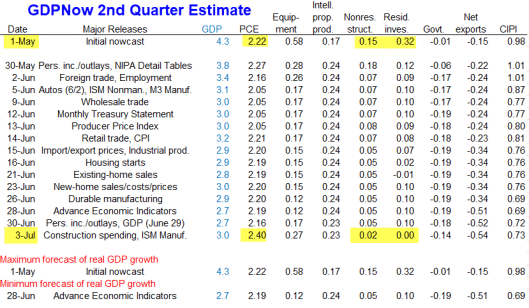
On May 1, GDPNow estimated Personal Consumption Expenditures (PCE) as adding 2.22 percentage points to second quarter GDP.
Total the numbers horizontally to arrive at the GDP forecast in blue.
Despite poor retail sales figures and terrible auto sales, the GDPNow model actually added to its PCE contribution estimate.
GDPNOW PCE Contribution vs Historical PCE Contribution vs Change in PCE
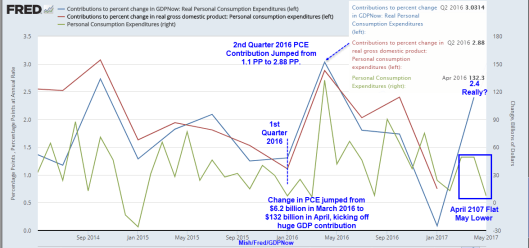
The second quarter of 2017 looks nothing like second quarter of 2016. Retail spending reports have been weak and yesterday we had another weak auto report. Ford and GM sales in June were down four five percent from a year ago and essentially flat from May.
There is no sign of a huge rebound in PCE.
Residential Construction
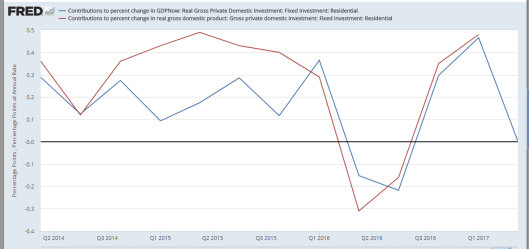
GDPNow has a good track record of estimating residential construction contribution to GDP. Its forecast is headed in the right direction.
However, I have both residential and commercial subtracting from second quarter GDP based on the latest construction spending report. Fred does not have GDPNow’s nonresidential data, so I can offer no chart of historical performance.
Mish Estimate
I have PCE adding 0 to 1.0 percentage points to second quarter GDP. A negative number would not be surprising. I have construction and residential investment subtracting 0.2 percentage points each.
I have construction and residential investment subtracting 0.2 percentage points each.
That would put my estimate 1.8 to 2.8 percentage points lower than GDPNow (a range of 0.2 to 1.2).
I also have considerable doubts about Change in Private Inventories (CIPI) as auto inventories are stacking up at what should be decreasing valuations in my way of thinking.
I suspect the BEA will see things differently. But if CIPI is negative, and my other estimates are correct, we will see negative second quarter GDP.
One more month of data remains, and construction spending can be revised in any direction.
To pick as a single number for now, I will estimate second quarter GDP at 0.8%.
Author

Mike “Mish” Shedlock's
Sitka Pacific Capital Management,Llc
Mike “Mish” Shedlock is a registered investment advisor for SitkaPacific Capital Management.