In the absence of hard US data, markets turn to market responses to institutional stuff


Outlook
In the absence of hard US data, markets turn to market responses to institutional stuff. The big one in institutional is central bank policy, but now that is over, political stuff takes over. The dollar benefits from risk-off (despite Trump) but the spotlight is on the pound and the yen.
We have seen the UK pound frog starting to grasp it’s in a pan of boiling water. The press has been agitating against Chancellor Reeves and the wimpy-seeming PM Starmer for months because fiscal reality doesn’t match election promises. The budget is not due until later in Nov but it’s a rock and a hard place. Somebody’s taxes have to go up. The BoE meets next week with very few expecting a rate cut.
So far the yields on Gilts have fallen as buyers rush in and sterling is down against the dollar and euro, where it’s reaching a 2-year low.
The other political focus is Japan, in part because of the long-standing refusal to accept conventional monetary policy standards but also TreasSec Bessent interfering. For the Oct month, the dollar/yen has gained 4% so far and hit a record low against the euro.
Overnight we got more: new FinMin Katayama said she is walking away from old comments that the dollar/yen should be 120-130. She said “the government has been monitoring foreign exchange movements with a high sense of urgency, but was still heading for its weakest monthly performance against the dollar since July” (Reuters).
The difference between central banks is stupendous. Fed chief Powell is hawkish (Dec rate cut by no means certain) and the dollar gains across the board. Bank of Japan Ueda is hawkish (the possibility of a hike in December) but the yen gets weaker. See the tidbit below about the yen…
As noted yesterday, Reuter’s Dolan thinks the Trump goal of devaluing the dollar, with the goal of improving the trade balance, is just starting. Bessent’s call for Japan to raise rates is just a shot across the bow. We don’t know what’s coming next.
Logically, it’s downright bizarre that the dollar is in favor against falling yields, a government shutdown, a gigantic fiscal deficit, creeping inflation and a central bank that just cut rates. You’d think the one string holding up the puppet would be Powell saying don’t count on a Dec rate cut.
But it’s more than that. It’s acknowledgement that the dollar is the numeraire for trade and the main reserve currency, even if others and gold are gnawing at the edges. It’s the stock market rally and decent earnings by the leading names. It’s robust and resilient growth. It’s the US-China trade deal, even if that is mostly wallpaper. It’s even the expectation that courts will permit the fictitious “emergency” that underlies both tariffs and putting troops into American cities. Bottom line, it’s a crowd watching the emperor go by actually wearing clothes. Markets don’t care if the US Congress is basically brain-dead. The US could become a Mussolini dictatorship and as long as the S&P and Nasdaq are booming, so can the dollar.
Forecast
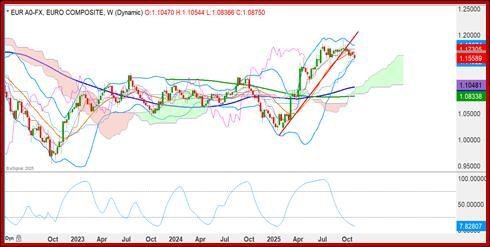
We wrote yesterday that for multiple reasons, we expect the dollar gain to be short-lived, and the same goes for the gold retreat. We are shifting that view to a longer-lasting dollar gain. If we widen the chart to weekly, we see the move could potentially go much further. The 200-week level, for example, is 1.0826. The 200-week is meaningless in its own right. Nobody looks at it. But it’s also the reversal point for the cloud.
Tidbit: We got verbal intervention in the dollar/yen from TreasSec Bessent this week. He urged the BoJ to hike rates to get the yen stronger. A better term would be “interference with sovereign decisions.”
We don’t pretend to understand Japanese psychology (they have no native word for “risk” or “in love”), but at a guess, for the US TreasSec to interfere is deeply insulting.
One thing we do know is the endless politeness of the Japanese. Back in 2003/04, then TreasSec Snow visited Japan and complained about intervention, Japan bowed and said, “yes, we understand.” Snow took it as a commitment to stop intervening. He got it wrong. Japan resumed intervention the minute Snow’s plane left Japanese airspace.
It’s possible Japan learned a lesson from an earlier event. Fed chief Volcker, who sought US friendship with Japan, asked Japan, the UK and the Europeans to revalue their currencies because the dollar was too strong. This was the Plaza Accord in 1986. Japan was the only country to take action—it raised rates.
Volcker wrote a book about it with a Japanese co-author, Tyoo Gyohten, Changing Fortunes and later in his bio, Keeping At It: The Quest for Sound Money and Good Government.
Never mind that the Plaza Accord worked too well. A year later, the US wanted to reverse the dollar decline. Then it was the Louvre Accord (1987). It’s interesting that in both Accords, it was the announcement effect that worked. We already had the concept of announcement effect, but these two events proved the point, in spades.
The US has a short memory. Japan has a long one. But this time is different because the bully in the White House is different from all other US leadership—crude, brutish, childish, vindictive. Trump no doubt misinterprets classic Japanese courtesy as actual respect and deference. Japanese leadership may feel they better not trick him as they did Mr. Snow.
We bet they are talking about alternatives to raising rates in Tokyo.
This is an excerpt from “The Rockefeller Morning Briefing,” which is far larger (about 10 pages). The Briefing has been published every day for over 25 years and represents experienced analysis and insight. The report offers deep background and is not intended to guide FX trading. Rockefeller produces other reports (in spot and futures) for trading purposes.
To get a two-week trial of the full reports plus traders advice for only $3.95. Click here!
This is an excerpt from “The Rockefeller Morning Briefing,” which is far larger (about 10 pages). The Briefing has been published every day for over 25 years and represents experienced analysis and insight. The report offers deep background and is not intended to guide FX trading. Rockefeller produces other reports (in spot and futures) for trading purposes.
To get a two-week trial of the full reports plus traders advice for only $3.95. Click here!
Author
Barbara Rockefeller
Rockefeller Treasury Services, Inc.
Experience Before founding Rockefeller Treasury, Barbara worked at Citibank and other banks as a risk manager, new product developer (Cititrend), FX trader, advisor and loan officer. Miss Rockefeller is engaged to perform FX-relat