Huge political disconnect over the state of the economy

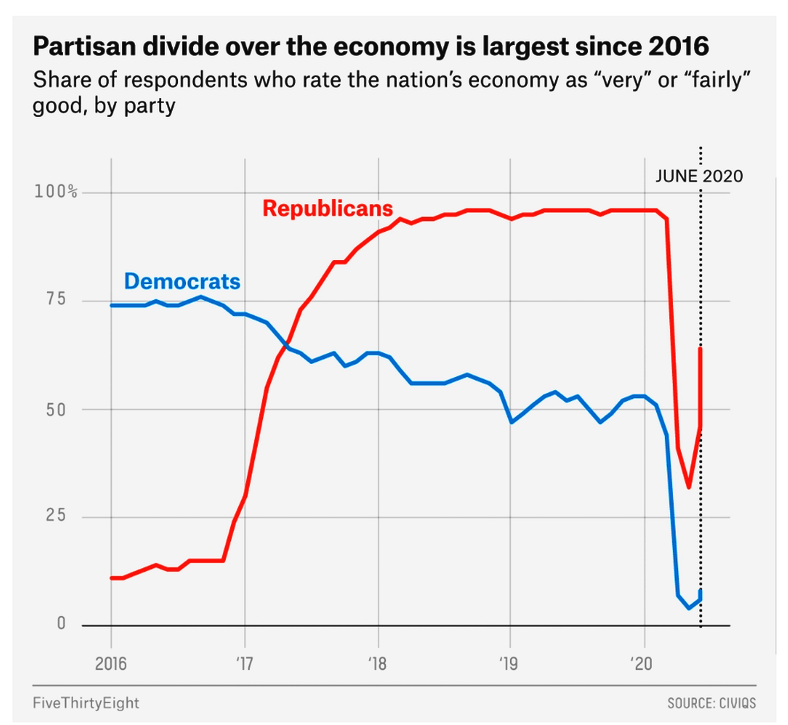
FiveThirtyEight discusses how politics shapes how people perceive the economy.
The U.S. economy is objectively awful right now. The unemployment rate is at levels not seen since the Great Depression and this quarter’s decline in gross domestic product is expected to be the worst on record. Most economists believe it will take years to recover from this recession.
In the most recent Quinnipiac University national survey, 69 percent of Republicans described the U.S. economy as “excellent” or “good.” Similarly, nearly two-thirds of Republicans in both Civiqs’s daily tracking polls and in a June 11-15 Associated Press/NORC Poll said that the nation’s current economy is at least leaning toward good. By contrast, only around 10 percent of Democrats thought that the national economy was doing well in those surveys.
Of course, the difficulty is that these attitudes aren’t just partisanship either. After eight years of Obama’s presidency, racial and economic anxiety became increasingly intertwined to the point that racial resentment was a much stronger predictor of economic pessimism under Obama than it had been under George W. Bush. That is, white people — especially white Trump voters — believed that Black people were getting ahead while they were left behind.
Take the 2016 American National Election Studies survey. Before Trump took office, the more racial discrimination white people thought their own group faced, the more likely they were to say that the economy was worse than it had been a year earlier.
Greatest Economy in History

China's Fault

Great Day for George Floyd
Trump even said Jobs Numbers 'Great day' for George Floyd.
Trump Approval Rating
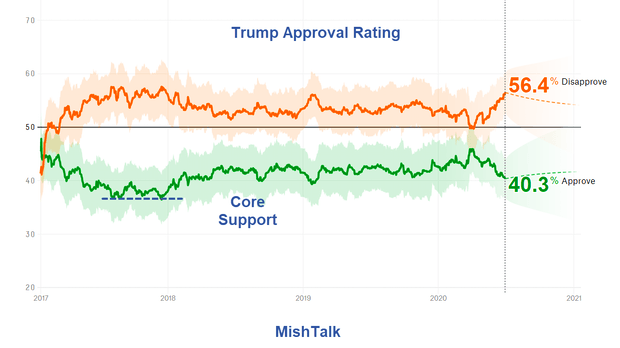
Approval rating chart from FiveThirtyEight, anecdotes are mine.
Core Support
When Trump makes a Tweet or a claim, no matter what it is, his core supporters tend to believe it.
Core support is roughly 36-38% of the country and perhaps 80-90% of Republicans.
They will back Trump no matter what he says or does. And in the case of the economy they believe what he says as well.
Independents Will Decide the Election
Similarly, there is a huge percentage of core Democrats who will automatically disagree with anything Trump says or does.
The core voters in neither party will not decide the election. The independents and swing voters will.
Each dip in favorability ratings represents a dip in how independents will vote. And that shows up in the polls as well.
Florida Polls
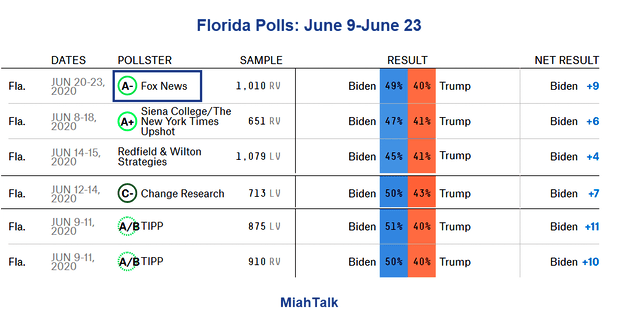
Going back a bit further, Trump is behind in 14 consecutive polls.
I discussed the setup in Trump is Trailing Badly in All Recent Florida Polls: Why?
Key Reasons
- Independents go for Biden by 22 points (40-18 percent); however, a large number, 42 percent, are undecided or voting for a third-party candidate.
- By wide margins, Florida voters prefer Biden to Trump to manage immigration (50-40 percent), coronavirus (49-36 percent), and race relations (52-34 percent).
- By a 4-point spread, they trust Trump (47 percent) over Biden (43 percent) on the economy.
- Defections among core supporters are part of the president’s problem: 9 percent of Republicans, 8 percent of those who approve of Trump, and 8 percent of 2016 Trump voters back Biden in the matchup.
So Trump can appeal to the base all he wants, but he better do something about independents, race relations, and immigration.
Instead, Trump has been going backwards.
If Trump does not win Florida, the election is over.
Think about the economy for a bit. How does "greatest economy ever" sound to 20 million people out of work?
The core may be convinced, but that won't matter anyway. What about the independents?
Author
Mike “Mish” Shedlock's
Sitka Pacific Capital Management,Llc