How will the government shutdown impact Gold prices?

The federal government remains closed (kind of). How will this affect the price of gold?
It will depend on how long the budget stalemate drags out, but from a historical perspective, the impact of government shutdowns has been relatively short-lived and contained.
As the shutdown deadline approached, gold rallied, and it continued to climb during the first day of the federal closure. The yellow metal scaled as high as $3,923 an ounce in early trading Thursday but abruptly sold off later in the morning as investors took profits and panic-buying eased.
Gold in past government shutdowns
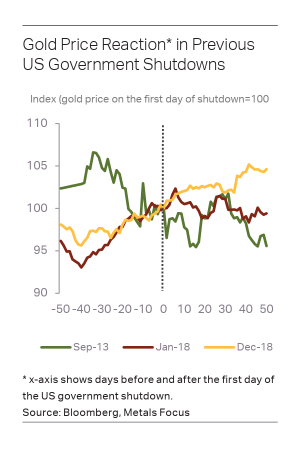
Looking at the trajectory of gold in past government shutdowns can give us some clues about how gold might behave during this latest round of political theater.
This is the 11th government shutdown since 1980. The longest (and most recent) was during Trump’s first term, lasting 35 days from December 2018 into January 2019.
The impact of federal closures on GDP growth has tended to be minimal and short-lived, according to analysis by Metals Focus.
“Largely because essential government services continued to operate and resolutions were typically reached swiftly.”
Generally, gold has tended to weaken into and out of short government shutdowns. However, we’ve seen rallies averaging 2 percent during longer shutdowns, with that strength holding for a couple of months.
There have been three shutdowns since 2000. Gold traded sideways during the first two. It charted a modest 2 percent gain during the most recent federal closure, but Metals Focus noted “this was largely a continuation of an existing rally rather than a direct response to the shutdown itself.”
What about this time?
Looking at the current situation, Metals Focus analysts said, “investor risk sentiment has so far remained resilient, as evidenced by continued strength of U.S. equity markets at all-time highs.”
“However, given the elevated policy uncertainty since President Trump’s inauguration, it is entirely possible that this shutdown could prove more disruptive than initially anticipated.”
The biggest question is how long the shutdown will last. At this point, there doesn't seem to be much interest in compromise on either side of the aisle. However, we have no idea what's going on in back rooms, and these situations tend to shift quickly.
Metals Focus noted that the shutdown will delay some key economic reports. For instance, we won’t get the employment report on Oct. 3. That means the markets won’t have any bogus job numbers to react to before they’re revised a month from now.
As questionable as these government numbers are, Metals Focus pointed out that the lack of any data could increase uncertainty, and “Investors are also increasingly worried that the economy may be slowing more than official figures suggest.”
Metals Focus analysts said they maintain “a constructive outlook for gold well into 2026,” even if Congress hammers out a bipartisan deal.
“This view is based on expectations of continued interest rate cuts by the Fed at a time when inflation is likely to remain sticky. Persistent macroeconomic uncertainty is also expected to support further portfolio diversification, especially amid growing concerns about the Fed’s independence and doubts over the long-term sustainability of U.S. debt.”
In fact, the debt is the bogyman hiding behind the curtain as this political theater plays out. Investors should be more concerned about what happens when the government reopens than they are about the shutdown itself.
Once the government is open for business again, spending will increase even more.
And it’s already out of control.
What does this mean for you?
Inflation.
That’s why you should hold gold – not as a hedge against the government shutdown, but to shield yourself from the impact of the spending that will come out of whatever “compromise” they come up with.
To receive free commentary and analysis on the gold and silver markets, click here to be added to the Money Metals news service.
To receive free commentary and analysis on the gold and silver markets, click here to be added to the Money Metals news service.
Author

Mike Maharrey
Money Metals Exchange
Mike Maharrey is a journalist and market analyst for MoneyMetals.com with over a decade of experience in precious metals. He holds a BS in accounting from the University of Kentucky and a BA in journalism from the University of South Florida.