Goldman warns the world is running out of safe routes for Oil
- Goldman Sachs keeps its $80 Brent forecast for 2026Q4, but sees near-term risks tilted higher.
- Nearly 9 million barrels per day have recently moved through Bab-al-Mandab, with roughly 4 million barrels potentially difficult to reroute under simultaneous disruption.
- Lower inventories, slower strategic reserve releases and stronger summer demand leave less room to absorb another shock.
- Goldman’s $120 Brent scenario is not the base case, but it captures the market’s growing logistical tail risk.
Upside risks
Goldman Sachs is not forecasting an oil crisis, well not yet anyway. That is precisely what makes its latest research worth reading, given the numerous upside risks!
Goldman’s commodity team lead, Daan Struyven, keeps their Brent forecast unchanged at $80 for 2026Q4, assuming geopolitical tensions ease and Middle East production begins to recover later in the year. Yet beneath that calm headline forecast, the balance of risk has shifted. Goldman now sees near-term upside risks building around Red Sea shipping disruptions, weaker exports from Kazakhstan, and the growing possibility that several critical oil routes come under pressure simultaneously.
The market has spent years asking whether the world has enough barrels. The more pressing question now may be whether the world still has enough reliable routes to move them.
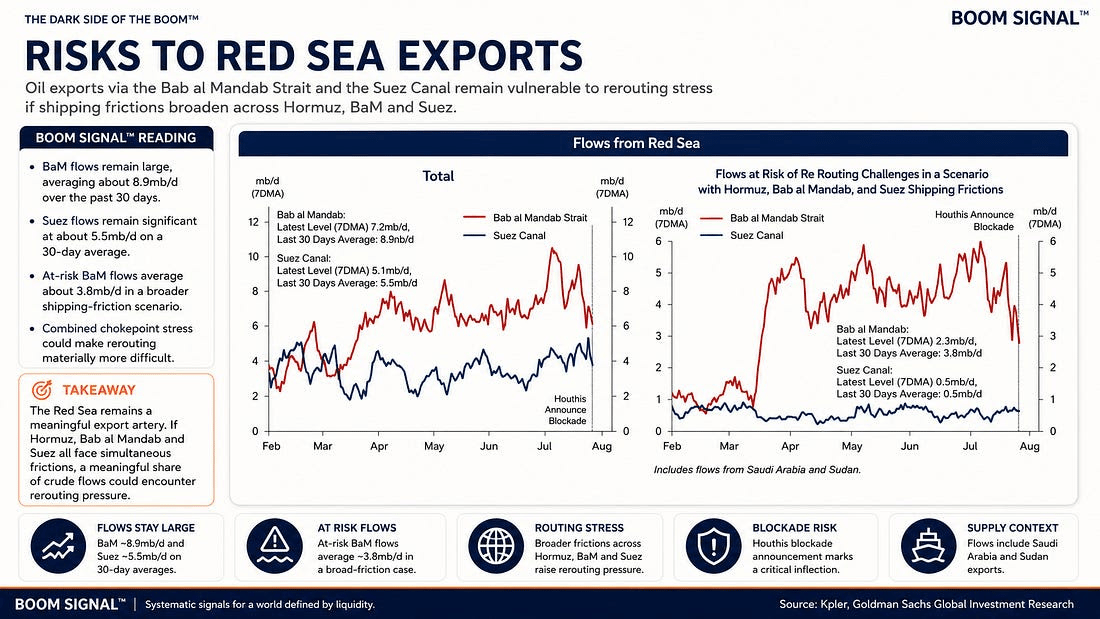
Goldman estimates that oil flows through the Bab-al-Mandab Strait have averaged nearly 9 million barrels per day over the past month. More importantly, almost 4 million barrels per day could prove difficult to reroute if shipping friction emerged simultaneously across the Strait of Hormuz, Bab el-Mandeb, and the Suez Canal.
That is the key shift in the risk story. The system can usually absorb trouble at one chokepoint through longer voyages, higher insurance costs and alternative routes. It becomes far more fragile when several exits narrow together.
One blocked bridge creates congestion. Three can stop the city.
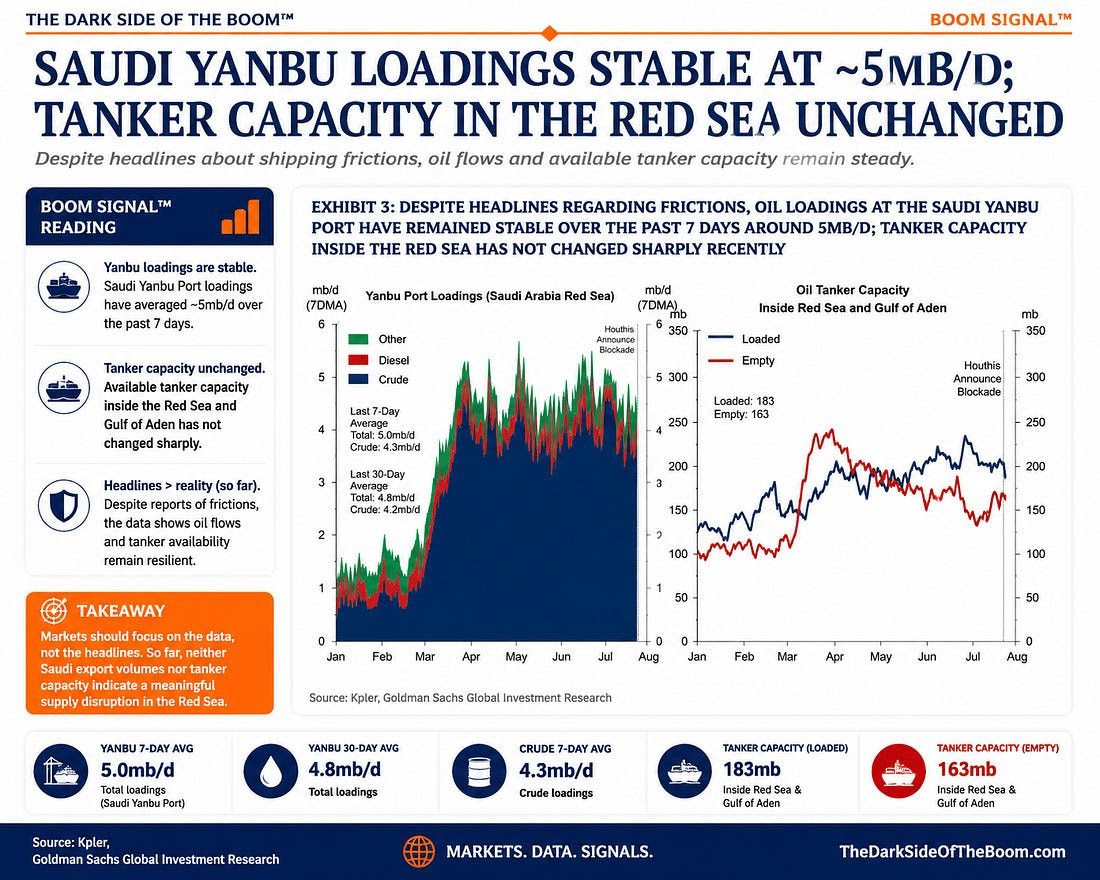
Saudi Arabia has so far shown considerable flexibility. Goldman notes that loadings at Yanbu on the Red Sea have remained stable around a high 5 million barrels per day, supported by the East-West pipeline.
That provides an important workaround to Hormuz risk, but contingency capacity should not be confused with unlimited capacity. Alternative pipelines and ports are the energy equivalent of emergency generators: useful in a blackout, but not designed to power the entire system indefinitely.
Yanbu reduces dependence on the Gulf. If Red Sea shipping becomes more dangerous, however, the workaround begins to inherit the same problem it was meant to solve.
Goldman also points to weaker exports through the Caspian Pipeline Consortium after strikes linked to the Russia-Ukraine escalation. The geography is different, but the implication is similar. Supply risks are no longer confined to one theatre.
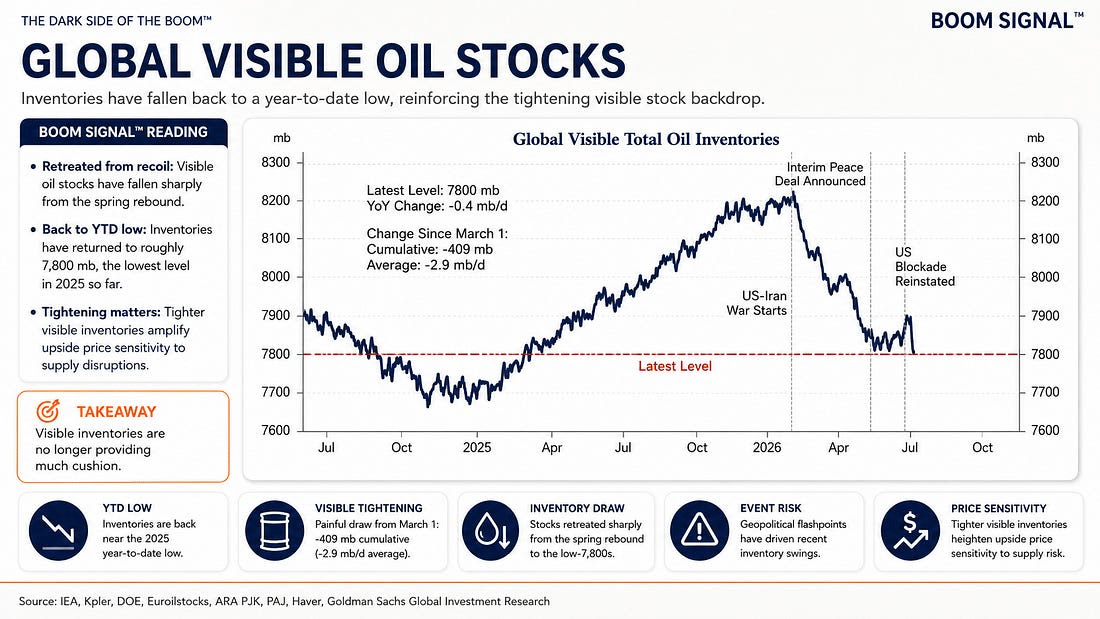
The timing is awkward because inventories are already tightening.
Goldman’s data shows global visible oil stocks at a year-to-date low. The team expects further tightening through July and August as Middle East output remains constrained, summer travel lifts demand and strategic reserve releases slow after heavy second-quarter draws.
The bank estimates that normal seasonality could raise global demand by roughly 800,000 barrels per day in Q3 compared with Q2, while its broader balance points to a 2.1 million-barrel-per-day global deficit in 2026Q3.
At the same time, OECD strategic petroleum reserve releases have slowed sharply, with South Korea and Japan beginning to replenish stocks. The emergency cushion has not disappeared, but it is no longer being deployed as aggressively.
Goldman has downgraded its demand forecasts for China, South Korea and the Middle East after weaker realized data, which helps explain why the team has not raised its $80 fourth-quarter base case.
But softer demand only lowers the starting point. It does not remove the risk that transport disruptions overwhelm the remaining buffer.
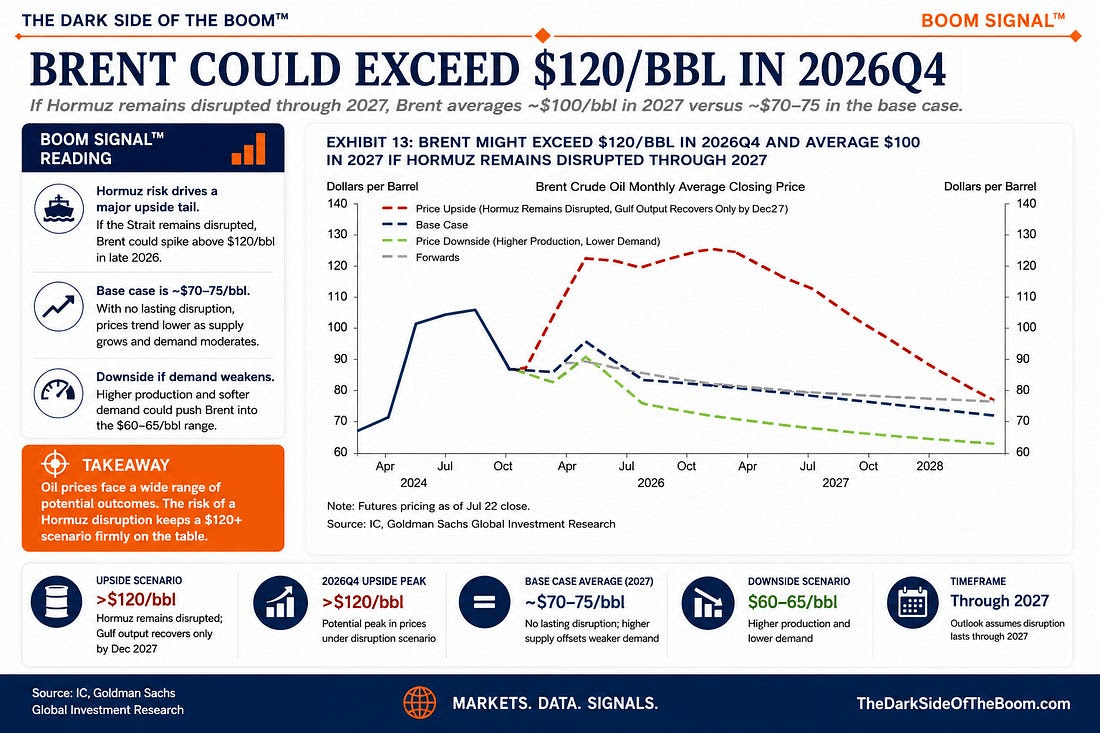
Goldman estimates Brent could exceed $120 per barrel in 2026Q4 and average around $100 per barrel in 2027 if disruptions through the Strait of Hormuz persist into next year. The team adds that sustained friction across Hormuz, Bab-al-Mandeb, and Suez could create an additional $25 in upside relative to that scenario.
This is not Goldman’s central forecast.
The base case remains $80 Brent in 2026Q4 and an average of $75 in 2027, assuming the Hormuz remains open and the market moves into a sizeable 3.2 million-barrel-per-day surplus next year. Stronger UAE supply, solid Latin American production and weaker global demand would then pull prices lower.
The important point is the asymmetry.
For oil to fall materially, several things need to go right: Middle East production must recover, the Strait of Hormuz must stay open, supply growth must remain firm, and weaker demand must persist.
For oil to break higher, one critical artery may only need to remain impaired.
That is why the $120 scenario matters even if it never becomes the forecast. It shows how quickly a logistical problem can turn into a global pricing event.
Dark side of the boom view
Goldman’s research reinforces why oil remains one of the most asymmetric markets in the global macro complex.
The base case is still manageable. If tensions ease and shipping lanes remain broadly functional, Brent can drift back toward the $70s and settle around Goldman’s $80 fourth-quarter target.
But the tail has become heavier.
Lower inventories, slower reserve releases and rising pressure across several transport routes leave the market with less room for another shock. A renewed oil surge would also quickly ripple through inflation expectations, Treasury yields, consumer spending, and broader financial conditions.
The next oil shock may not begin with the world losing barrels. It may begin with the world losing the ability to move them cheaply.
Author

Stephen Innes
SPI Asset Management
With more than 25 years of experience, Stephen has a deep-seated knowledge of G10 and Asian currency markets as well as precious metal and oil markets.