Gold Weekly Forecast: Eyes on Powell’s testimony, US inflation data after another record-setting rally
- Gold touches yet another all-time high, boosted by falling US T-bond yields.
- Fed Chair Jerome Powell’s testimony, January US inflation data, and political headlines could drive Gold’s action next week.
- The near-term technical outlook points to overbought conditions for XAU/USD.

Gold (XAU/USD) preserved its bullish momentum and extended its uptrend to a new record high above $2,880 this week. Federal Reserve (Fed) Chair Jerome Powell’s testimony before Congress, January inflation data from the US, and fresh developments surrounding US President Donald Trump’s trade policy will be watched closely by market participants next week.
Gold rally continues full steam ahead
Markets adopted a cautious stance at the beginning of the week after United States (US) President Donald Trump announced over the weekend that they will impose sweeping 25% tariffs on Mexican and Canadian imports and 10% on Chinese goods entering the US. Although the US Dollar (USD) gathered strength against its major rivals on this development, Gold benefited from safe-haven flows and closed in positive territory on Monday.
On Tuesday, data from the US showed that JOLTS Job Openings declined to 7.6 million in December, coming in below the market expectation of 8 million and weighing on the USD. In the meantime, the decisive rebound seen in Wall Street’s main indexes caused the USD to weaken further, opening the door for another leg higher in XAU/USD.
US Treasury Secretary Scott Bessent said on Wednesday that their focus is on bringing down 10-year Treasury yields rather than the Federal Reserve’s benchmark short-term interest rate. The benchmark 10-year US yield lost nearly 2% midweek and touched its lowest level since December 18 at 4.4%. In turn, Gold climbed above $2,880 and set a new all-time high. Meanwhile, the ISM Services Purchasing Managers Index (PMI) declined to 52.8 in January from 54.0 in December.
In the absence of high-tier data releases, XAU/USD corrected lower on Thursday. During the American trading hours, Bessent hit the wires again, stating that the US administration was not particularly concerned about the Fed's trajectory on interest rates.
The US Bureau of Labor Statistics (BLS) reported on Friday that Nonfarm Payrolls (NFP) rose by 143,000 in January. This reading came in below the market expectation of 170,000 and the USD struggled to hold its ground, allowing Gold to regain its traction following Thursday’s decline.
Gold investors await US inflation data, Powell testimony
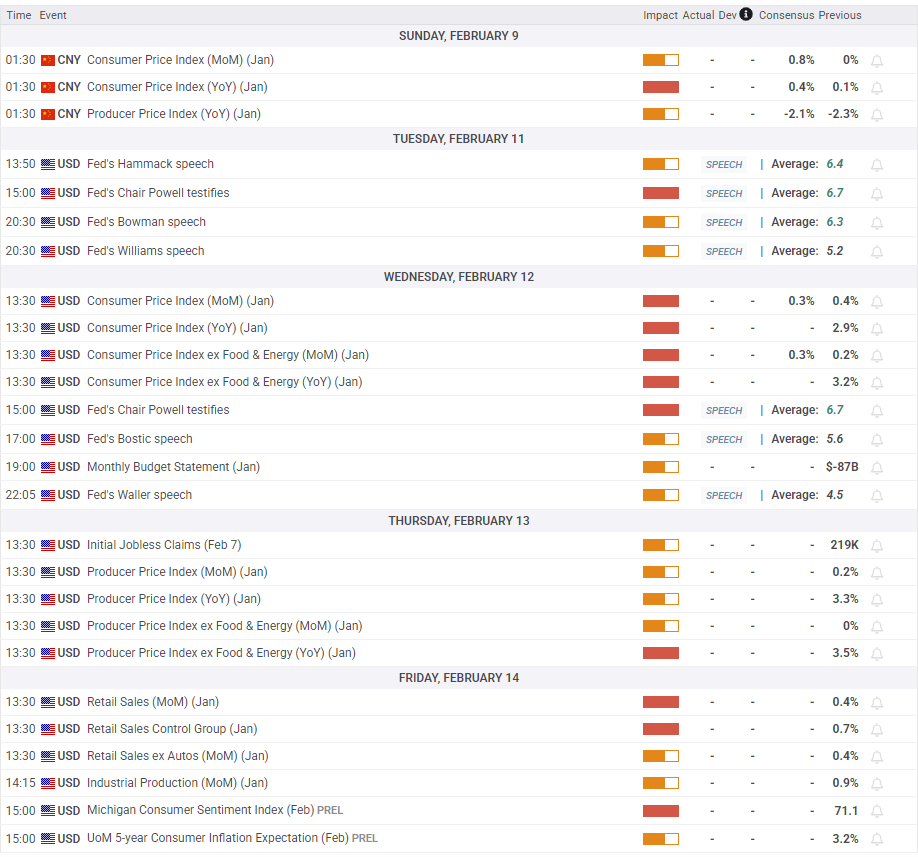
The economic calendar will not offer any high-impact data releases at the beginning of the week.
Fed Chair Jerome Powell will testify about the semiannual Monetary Policy Report before Congress on Tuesday and Wednesday. Powell’s comments about the broad overview of the economy and monetary policy could shape the Fed's interest rate outlook and drive Gold price. If Powell reiterates the need for a cautious approach to policy easing, Gold could have a difficult time gathering bullish momentum.
On Wednesday, the BLS will publish the Consumer Price Index (CPI) data for January.
According to the CME FedWatch Tool, markets are currently pricing in about a 15% probability of a 25 basis points (bps) rate reduction in March. For investors to reassess the possibility of a policy move in March, they would likely need to see a significant downward surprise in inflationary pressures. Hence, a monthly core CPI reading of 0.1% or lower could trigger a USD selloff as an immediate reaction and help XAU/USD push higher. On the other hand, an increase of 0.2% or bigger could reaffirm another Fed policy hold in March and limit Gold’s upside in the near term.
Investors will continue to assess political headlines from the US next week. In response to the US decision to impose tariffs on Chinese imports, the Chinese Commerce Ministry said they will definitely take necessary measures against “unilateral bullying measures.” Still, it noted that China won't proactively provoke trade disputes and is willing to resolve issues through dialogue and consultation. In case markets remain optimistic about the US-China trade war not deepening, Gold’s losses could remain limited. On the flip side, geopolitical developments that point to a potential resolution in the Israel-Gaza conflict or the Russia-Ukraine war could weigh on XAU/USD in the near term.
Gold technical analysis
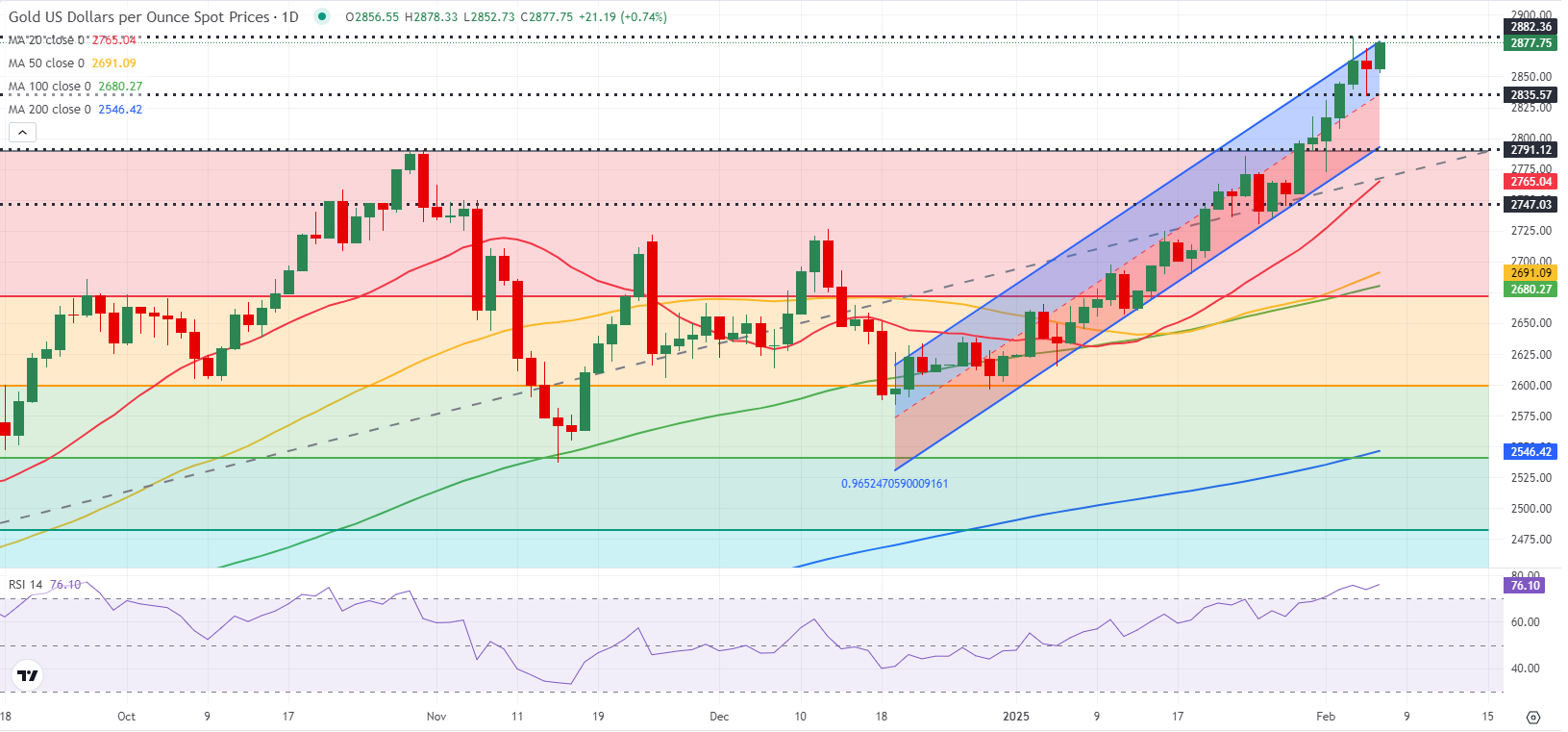
The near-term technical outlook points to overbought conditions and suggests that Gold could stage a downward correction before extending its uptrend. The Relative Strength Index (RSI) indicator on the daily chart holds above 70 and Gold trades near the upper limit of the seven-week-old ascending regression channel.
On the downside, $2,835 (mid-point of the ascending channel) aligns as immediate support before $2,790 (former resistance, static level, lower limit of the ascending channel). A daily close below the latter could attract technical sellers and open the door for additional losses toward $2,765, where the 20-day Simple Moving Average (SMA) is located.
Looking north, the first resistance could be spotted at $2,880-$2,882 (upper limit of the ascending channel, all-time high) before $2,900 (round level). If Gold manages to stabilize above $2,900 and confirms that level as support, $3,000 (psychological level) could be seen as the next resistance.
Gold FAQs
Gold has played a key role in human’s history as it has been widely used as a store of value and medium of exchange. Currently, apart from its shine and usage for jewelry, the precious metal is widely seen as a safe-haven asset, meaning that it is considered a good investment during turbulent times. Gold is also widely seen as a hedge against inflation and against depreciating currencies as it doesn’t rely on any specific issuer or government.
Central banks are the biggest Gold holders. In their aim to support their currencies in turbulent times, central banks tend to diversify their reserves and buy Gold to improve the perceived strength of the economy and the currency. High Gold reserves can be a source of trust for a country’s solvency. Central banks added 1,136 tonnes of Gold worth around $70 billion to their reserves in 2022, according to data from the World Gold Council. This is the highest yearly purchase since records began. Central banks from emerging economies such as China, India and Turkey are quickly increasing their Gold reserves.
Gold has an inverse correlation with the US Dollar and US Treasuries, which are both major reserve and safe-haven assets. When the Dollar depreciates, Gold tends to rise, enabling investors and central banks to diversify their assets in turbulent times. Gold is also inversely correlated with risk assets. A rally in the stock market tends to weaken Gold price, while sell-offs in riskier markets tend to favor the precious metal.
The price can move due to a wide range of factors. Geopolitical instability or fears of a deep recession can quickly make Gold price escalate due to its safe-haven status. As a yield-less asset, Gold tends to rise with lower interest rates, while higher cost of money usually weighs down on the yellow metal. Still, most moves depend on how the US Dollar (USD) behaves as the asset is priced in dollars (XAU/USD). A strong Dollar tends to keep the price of Gold controlled, whereas a weaker Dollar is likely to push Gold prices up.
Author

Eren Sengezer
FXStreet
As an economist at heart, Eren Sengezer specializes in the assessment of the short-term and long-term impacts of macroeconomic data, central bank policies and political developments on financial assets.

















