Gold Weekly Forecast: Bulls remain in control as focus shifts to key US economic data
- Gold climbed to a fresh monthly high above $3,400.
- The technical outlook suggests that the bullish bias remains intact.
- The US economic calendar will offer key data releases that could make or break the uptrend.

Gold (XAU/USD) preserved its bullish momentum and climbed to its highest level since late July above $3,400. Upcoming macroeconomic releases from the United States (US), such as business activity and employment data, could influence the market pricing of the Federal Reserve’s (Fed) policy outlook and drive XAU/USD near-term action.
Gold benefits from dovish Fed expectations, escalating geopolitical tensions
The US Dollar (USD) staged a rebound on Monday after suffering large losses against its rivals following Fed Chairman Jerome Powell’s dovish remarks at his speech at Jackson Hole on August 22. In turn, Gold found it difficult to build on the previous week’s gains at the start of the week. Nevertheless, renewed USD weakness and escalating geopolitical tensions allowed XAU/USD to gather bullish momentum.
Growing concerns over the Fed’s independence made it difficult for the USD to extend its recovery. During the Asian session on Tuesday, US President Donald Trump announced on Truth Social that he had fired Federal Reserve (Fed) Governor Lisa Cook by sharing a letter addressed to her. "I have determined that there is sufficient cause to remove you from your position," Trump’s letter read. In a statement shared by her attorneys as a response, “President Trump purported to fire me ‘for cause’ when no cause exists under the law, and he has no authority to do so,” Cook said.
Meanwhile, Trump’s renewed tariff threats further supported Gold. While speaking at a cabinet meeting late Tuesday, President Trump urged China to supply the US with magnets or face tariffs of up to 200%.
In addition, Russia launched its second-biggest aerial attack since its full-scale invasion of Ukraine, reportedly killing 23 people, including four children, and damaging European Union (EU) offices on Thursday. This development dimmed market expectations for a Russia-Ukraine peace agreement, allowing Gold to capitalize on safe-haven flows.
Later on Thursday, the US Bureau of Economic Analysis (BEA) announced that it revised the annualized Gross Domestic Product (GDP) growth for the second quarter to 3.3% from 3% in the initial estimate. The USD found support late Thursday and capped XAU/USD’s upside in the first half of the day on Friday.
The last important data release of the week from the US showed that annual inflation in the US, as measured by the change in the Personal Consumption Expenditures (PCE) Price Index, held steady at 2.6% in July. The core PCE Price Index, which excludes volatile food and energy prices, rose 2.9% in the same period, following June's increase of 2.8% and matching analysts' estimate. These figures failed to trigger a noticeable market reaction and Gold continued to stretch higher in the American session on Friday.
Following Monday’s choppy action, XAU/USD registered gains for four consecutive days and reached its highest level since July 23 above $3,430.
Gold investors shift focus to US PMI, NFP data
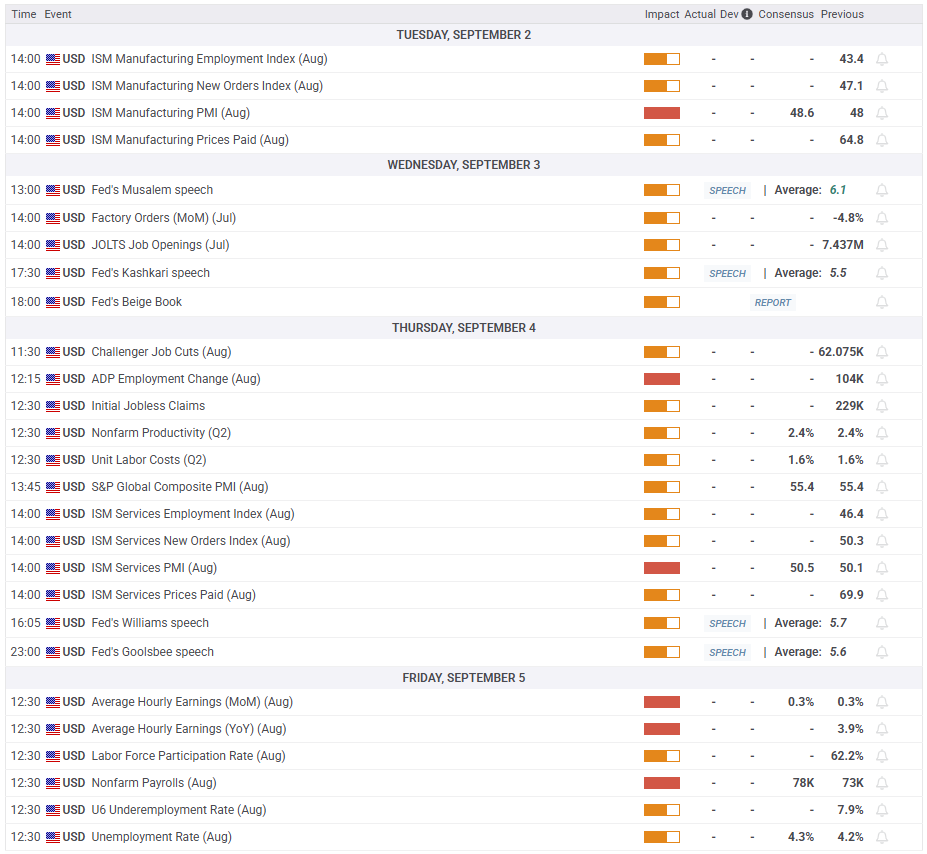
Financial markets in the US will remain closed in observance of the Labor Day holiday on Monday. On Tuesday, the Institute for Supply Management (ISM) will publish the Manufacturing Purchasing Managers’ Index (PMI) data. The headline PMI is forecast to improve slightly to 48.6 in August from 48 in July. A reading above 50 could support the USD and weigh on XAU/USD with the immediate reaction.
On Thursday, ADP Employment Change and ISM Services PMI will be featured in the US economic calendar. The market reaction to these releases could be straightforward and remain short-lived, with investors refraining from taking large positions ahead of Friday’s critical employment report.
According to the CME FedWatch Tool, markets are currently pricing in a nearly 85% probability of 25 basis points (bps) Fed rate cut in September. This market positioning suggests that the USD doesn’t have a lot of room left on the downside, even if a disappointing Nonfarm Payrolls (NFP) print for August reaffirms a Fed rate cut in September. Nevertheless, investors could assess weak NFP data as a factor that could pave the way for multiple Fed rate cuts in the last quarter of the year. The CME FedWatch Tool shows that there is a less-than-40% chance of three 25 bps Fed rate cuts in 2025. Hence, the USD could come under persistent selling pressure even though a September rate cut is largely priced in.
Conversely, a stronger-than-expected NFP growth, combined with an unchanged Unemployment Rate of 4.2%, could cause market participants to lean toward two rate cuts this year, allowing the USD to outperform its rivals and triggering a bearish action in XAU/USD heading into the weekend.
In the meantime, market participants will continue to assess the geopolitical developments. In case tensions between Russia and Ukraine remain high, Gold could hold its ground at least until the US employment report becomes the primary market driver.
Gold technical analysis
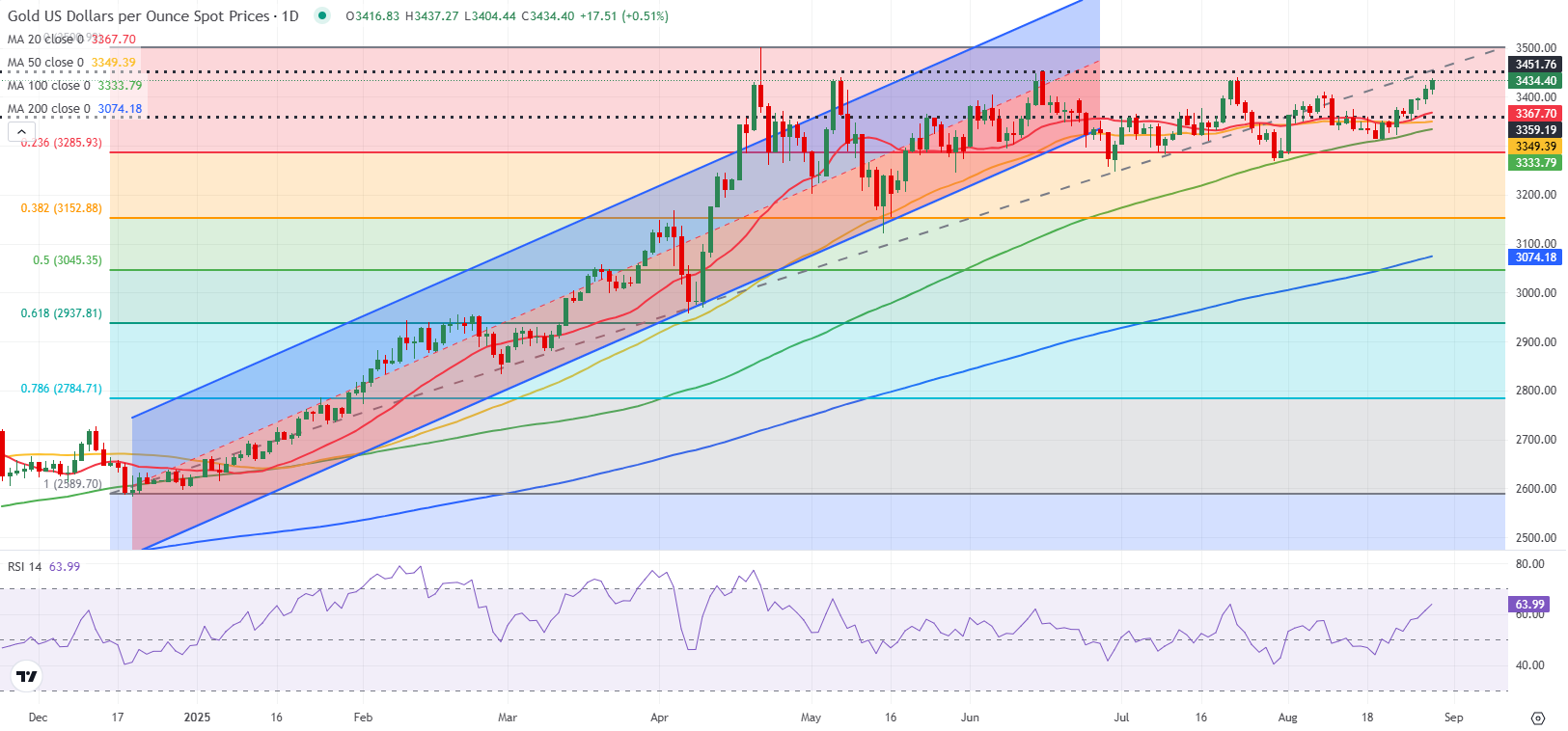
The Relative Strength Index (RSI) indicator on the daily chart climbed above 60, and Gold continued to pull away from the 20-day, 50-day and 100-day Simple Moving Averages (SMAs), highlighting a bullish bias.
On the upside, $3,450 (static level) aligns as an interim resistance before $3,500 (record high). In case Gold rises above that level and starts using it as support, $3,600 (round level) could be seen as the next hurdle.
Looking south, the first support area could be spotted at $3,345-$3,335 (50-day SMA, 100-day SMA) ahead of $3,285 (Fibonacci 23.6% retracement of the January-June uptrend) and $3,200 (static level, round level).
Gold FAQs
Gold has played a key role in human’s history as it has been widely used as a store of value and medium of exchange. Currently, apart from its shine and usage for jewelry, the precious metal is widely seen as a safe-haven asset, meaning that it is considered a good investment during turbulent times. Gold is also widely seen as a hedge against inflation and against depreciating currencies as it doesn’t rely on any specific issuer or government.
Central banks are the biggest Gold holders. In their aim to support their currencies in turbulent times, central banks tend to diversify their reserves and buy Gold to improve the perceived strength of the economy and the currency. High Gold reserves can be a source of trust for a country’s solvency. Central banks added 1,136 tonnes of Gold worth around $70 billion to their reserves in 2022, according to data from the World Gold Council. This is the highest yearly purchase since records began. Central banks from emerging economies such as China, India and Turkey are quickly increasing their Gold reserves.
Gold has an inverse correlation with the US Dollar and US Treasuries, which are both major reserve and safe-haven assets. When the Dollar depreciates, Gold tends to rise, enabling investors and central banks to diversify their assets in turbulent times. Gold is also inversely correlated with risk assets. A rally in the stock market tends to weaken Gold price, while sell-offs in riskier markets tend to favor the precious metal.
The price can move due to a wide range of factors. Geopolitical instability or fears of a deep recession can quickly make Gold price escalate due to its safe-haven status. As a yield-less asset, Gold tends to rise with lower interest rates, while higher cost of money usually weighs down on the yellow metal. Still, most moves depend on how the US Dollar (USD) behaves as the asset is priced in dollars (XAU/USD). A strong Dollar tends to keep the price of Gold controlled, whereas a weaker Dollar is likely to push Gold prices up.
Author

Eren Sengezer
FXStreet
As an economist at heart, Eren Sengezer specializes in the assessment of the short-term and long-term impacts of macroeconomic data, central bank policies and political developments on financial assets.