Gold Weekly Forecast: Gold surges as US-China tensions and US inflation data loom
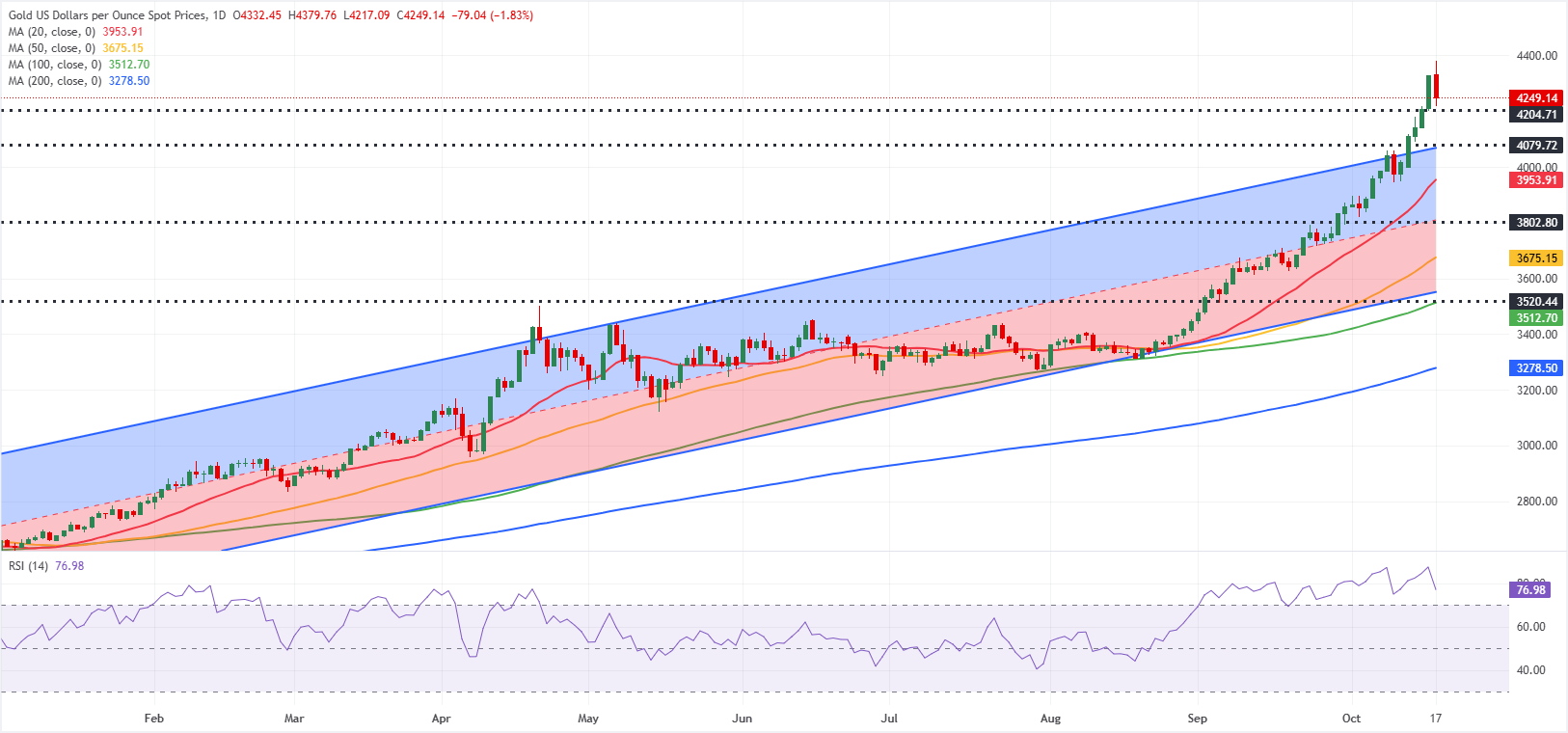
- Gold extended its parabolic rally, hitting fresh all-time highs above $4,370.
- Gold staged a sharp correction heading into the weekend.
- US-China news and US inflation data will be closely watched by investors.

Gold’s (XAU/USD) parabolic rally showed no signs of slowing down and lifted the price to a new record-high above $4,370 on Friday before correcting lower. Looking ahead, markets will remain focused on discussions surrounding the trade conflict between the United States (US) and China, as well as scrutinize the September inflation data from the US.
Gold remains the favorite safe-haven asset
Gold started the week on a bullish note and gained more than 2% on Monday as markets reacted to a potential re-escalation of the US-China trade conflict. US President Donald Trump said on Truth Social that they will impose 100% tariffs on Chinese imports, “over and above any tariff that they are currently paying,” citing China’s newly taken aggressive position on trade with the intent to impose large-scale export controls on “virtually every product they make.”
Late Monday, US Treasury Secretary Scott Bessent adopted a softer tone, saying that he believes China is open to discussions and that the 100% tariff doesn’t have to happen. Nevertheless, China's Commerce Ministry responded and said that the US needs to correct its “wrong practices” as soon as possible and added that the US cannot have talks while threatening to intimidate and introduce new restrictions. Furthermore, US President Trump accused China of not buying soybeans from the US purposefully and said that they could terminate some trade elements as retribution. As markets remained risk-averse, Gold continued to push higher on Tuesday.
Meanwhile, Federal Reserve (Fed) Chairman Jerome Powell adopted a neutral tone in his speech before the National Association for Business Economics (NABE) Annual Meeting in Philadelphia on Tuesday. Powell acknowledged that downside risks to the labor market had risen, while noting that there was also a risk that the slow pass-through of tariffs could start to look like persistent inflation. "The future path of monetary policy will be driven by data and risk assessments," he reiterated.
Although there were no fresh developments midweek, investors saw no reason to back away from the safe-haven Gold, given the uncertainty surrounding the US-China relations, the potential negative impact of the ongoing US government shutdown on the economy, and growing expectations for two more Fed rate cuts this year.
On Thursday, Gold rose nearly 3% and climbed above $4,300. Resurfacing fears over the lending practices of the regional banks in the US weighed heavily on Wall Street’s main indexes, allowing Gold to shine as the best refuge in the current market environment. Additionally, the sharp decline seen in US Treasury bond yields further boosted XAU/USD. The benchmark 10-year US T-bond yield broke below 4% on Thursday and touched its lowest level since early April.
As US stock index futures suffered heavy losses early Friday, Gold extended its upsurge toward $4,400. Later in the day, the modest recovery seen in US T-bond yields, and possibly profit-taking ahead of the weekend, triggered a sharp correction that saw the price return below $4,300.
Gold investors will assess US-China news, US inflation data
US Treasury Secretary Scott Bessent said last week that President Trump was still on track to meet with Chinese President Xi Jinping in South Korea later this month. As the key meeting approaches, headlines surrounding the US-China trade relations will be scrutinized by investors.
In case the US and China signal that they are willing to de-escalate the situation, markets could see that as an opportunity to book some more profits and open the door for a leg lower in Gold. On the other hand, investors are unlikely to steer away from Gold if sides cling to aggressive rhetoric and ramp up the conflict further.
The US Bureau of Labor Statistics (BLS) announced that it will publish the September Consumer Price Index (CPI) data on Friday, October 24, to be able to calculate the annual Social Security cost-of-living adjustment (COLA). Markets expect the core CPI, which excludes volatile food and energy prices, to rise 0.3% on a monthly basis. According to the CME FedWatch Tool, markets are currently nearly fully pricing in two additional 25 basis-points Fed rate cuts this year. A noticeable upside surprise in inflation, with a reading of 0.5% or higher, could cause investors to reassess the possibility of a rate cut in December, boosting the US Dollar (USD) with the immediate reaction. In this scenario, XAU/USD is likely to come under bearish pressure. Conversely, a reading at or below the market forecast should have little to no impact on the market pricing of the Fed rate outlook.
Investors will also pay close attention to developments surrounding the US regional bank loans and a potential increase in money market stress. Unless investors’ fears over a liquidity crunch ease, Gold could preserve its bullish momentum.
Gold technical analysis
It is a difficult task to analyze Gold from a technical perspective, given the fact that the daily, weekly and monthly timeframes all point to extremely overbought conditions. Additionally, setting bullish targets is another challenge because XAU/USD has set new record-highs for five consecutive days. Hence, round levels could be seen as potential profit-taking thresholds at $4,400, $4,500 and $4,600.
On the downside, the upper limit of a broken ascending channel could be seen as the first support level at $4,080 before $3,960 (20-day Simple Moving Average) and $3,800 (mid-point of the ascending channel).
Gold FAQs
Gold has played a key role in human’s history as it has been widely used as a store of value and medium of exchange. Currently, apart from its shine and usage for jewelry, the precious metal is widely seen as a safe-haven asset, meaning that it is considered a good investment during turbulent times. Gold is also widely seen as a hedge against inflation and against depreciating currencies as it doesn’t rely on any specific issuer or government.
Central banks are the biggest Gold holders. In their aim to support their currencies in turbulent times, central banks tend to diversify their reserves and buy Gold to improve the perceived strength of the economy and the currency. High Gold reserves can be a source of trust for a country’s solvency. Central banks added 1,136 tonnes of Gold worth around $70 billion to their reserves in 2022, according to data from the World Gold Council. This is the highest yearly purchase since records began. Central banks from emerging economies such as China, India and Turkey are quickly increasing their Gold reserves.
Gold has an inverse correlation with the US Dollar and US Treasuries, which are both major reserve and safe-haven assets. When the Dollar depreciates, Gold tends to rise, enabling investors and central banks to diversify their assets in turbulent times. Gold is also inversely correlated with risk assets. A rally in the stock market tends to weaken Gold price, while sell-offs in riskier markets tend to favor the precious metal.
The price can move due to a wide range of factors. Geopolitical instability or fears of a deep recession can quickly make Gold price escalate due to its safe-haven status. As a yield-less asset, Gold tends to rise with lower interest rates, while higher cost of money usually weighs down on the yellow metal. Still, most moves depend on how the US Dollar (USD) behaves as the asset is priced in dollars (XAU/USD). A strong Dollar tends to keep the price of Gold controlled, whereas a weaker Dollar is likely to push Gold prices up.
Author

Eren Sengezer
FXStreet
As an economist at heart, Eren Sengezer specializes in the assessment of the short-term and long-term impacts of macroeconomic data, central bank policies and political developments on financial assets.














