Gold Weekly Forecast: Gold fails to benefit from safe-haven flows amid gloomy demand outlook
- Gold lost more than 3% on a weekly basis.
- The technical outlook suggests there could be a correction before the next leg lower.
- Inflation data from the US will be watched closely by investors next week.


Gold suffered heavy losses in the first half of the week and dropped to its weakest level since September 2021. The broad-based dollar strength amid growing recession fears and the worsening demand outlook for the yellow metal caused XAUUSD to close the fourth straight week in negative territory.
What happened last week?
In the absence of high-impact macroeconomic data releases, gold stayed relatively quiet at the start of the week and closed virtually unchanged on Monday. The Independence Day holiday in the US caused the market action to remain subdued throughout the day.
With American investors returning from the three-day weekend on Tuesday, safe-haven flows started to dominate markets and provided a boost to the safe-haven dollar. Reports suggesting that China could start imposing lockdowns in the face of rising coronavirus infections and the worsening global economic outlook weighed heavily on sentiment. International Monetary Fund (IMF) Managing Director Kristalina Georgieva told Reuters that the global economy has “darkened significantly” since April and noted that they couldn’t rule out a global recession next year given the elevated risks.
India, the world’s second-biggest consumer of gold, announced that it has raised the basic import duty on the precious metal to 12.5% from 7.5%, further clouding gold’s demand outlook.
In its Gold Mid-Year Outlook 2022, “we expect widespread economic slowdown to pressure consumer demand for gold, particularly with many markets seeing notably higher local gold prices,” said the World Gold Council.
Assessing the Indian government’s action, “high local inflation, uncertainty about the economic outlook and the surprise increase of the import duty for gold – aimed in part to mitigate the impacts of rupee weakness – will likely weigh on the recovery of gold consumer demand,” the organization explained.
Meanwhile, the minutes of the FOMC’s June policy meeting revealed that participants concurred that high inflation warranted restrictive interest rates, with the possibility of a more restrictive stance' if inflation persists. On Wednesday, the ISM Services PMI survey showed that the business activity in the service sector continued to expand at a robust pace in June but the Employment component dropped below 50, pointing to a contraction in service sector employment.
Boosted by the Fed’s hawkish tone and the intense flight to safety, the US Dollar Index reached its highest level in nearly 20 years above 107.00, forcing XAUUSD to stay on the back foot.
On Friday, the US Bureau of Labor Statistics (BLS) announced Nonfarm Payrolls rose by 372,000 in June, compared to the market expectation of 268,000. Annual wage inflation declined to 5.1% from 5.3% in the same period and the Labor Force Participation Rate edged lower to 62.2% from 62.3%. Although the dollar lost some strength after this report, gold failed to gain traction amid rising US Treasury bond yields.
Next week
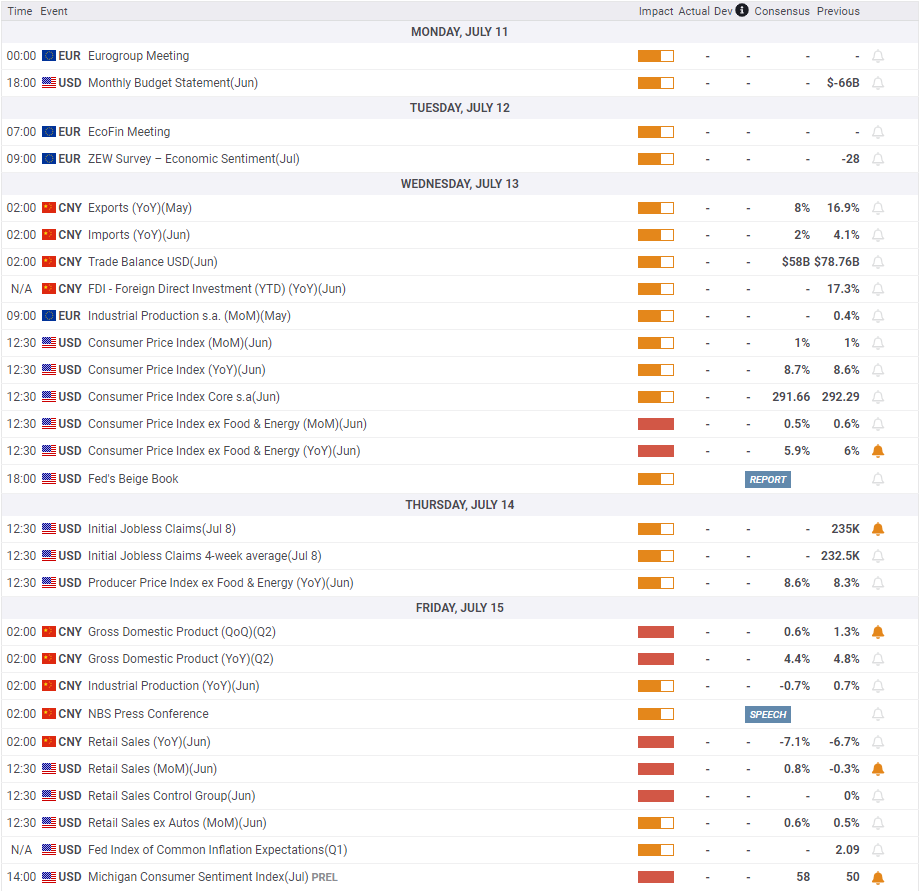
On Wednesday, the BLS will release the Consumer Price Index (CPI) data for June. Markets expect annual CPI to edge higher to 8.7% from 8.6% in May. Core CPI, which excludes volatile food and energy prices, is forecast to decline to 5.9% from 6%. As it currently stands, markets are nearly fully pricing in a 75 basis points (bps) rate hike in July and inflation figures are unlikely to change that. According to the CME Group’s FedWatch Tool, there is only a 30% probability of one more 75 bps rate increase in September. Hence, there is room for additional dollar strength in case inflation prints surpass analysts’ estimates. On the other hand, a soft inflation report should trigger a downward correction in the greenback and allow XAUUSD to stage a rebound.
On Friday, the Fed will publish its Index of Common Inflation Expectations. Earlier in the week, Bloomberg reported that the US central bank was paying close attention to this indicator when setting its monetary policy. Consequently, market pricing of the Fed’s rate outlook could be affected by this data ahead of the weekend.
June Retail Sales data and the University of Michigan’s Consumer Sentiment Index for July will also be featured in the US economic docket on Friday.
In the current market environment, investors might have a difficult time finding a good enough reason to bet on a steady rebound in gold. Gold’s demand outlook is unlikely to improve in the near term and market participants are likely to refrain from committing to a risk rally. In case inflation data from the US revive hopes of the Fed taking its foot off the gas pedal in the last quarter of the year, it wouldn’t be surprising to see XAUUSD reverse its direction but recovery attempts are likely to remain limited.
Gold technical outlook
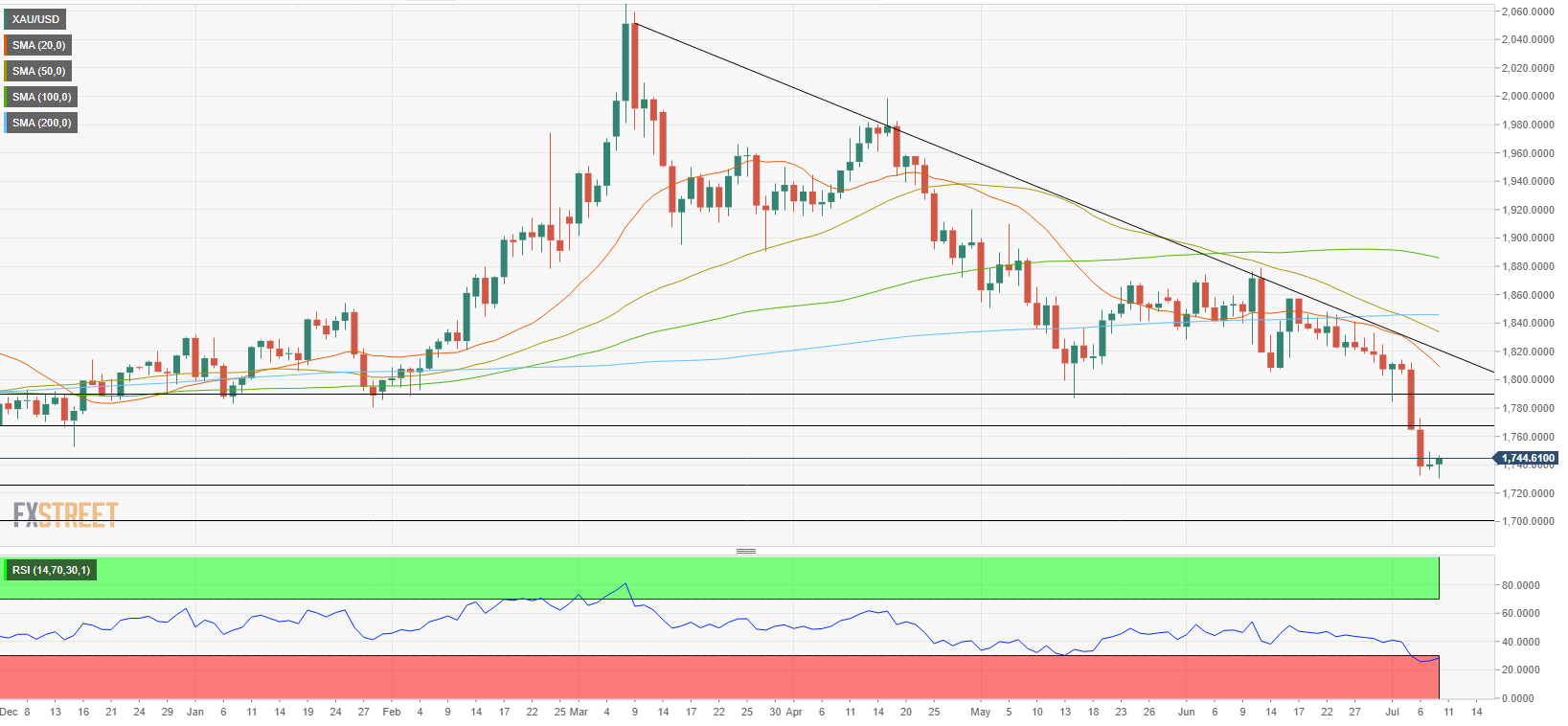
Following this week's price action, the Relative Strength Index (RSI) indicator on the daily chart dropped into the oversold territory below 30. The last time the daily RSI fell below in August 2021, XAUUSD staged a technical correction and a similar action could be expected in the short term.
On the upside, $1,765 (former support, static level) aligns as first technical resistance ahead of $1,790 (former support, static level). A daily close above the latter could open the door for an extended recovery toward $1,800, where the descending trend line coming from early March and the 20-day SMA is located. As long as this level stays intact, however, sellers are likely to dominate the pair's action following the correction.
On the downside, $1,730 (July 8 low) forms interim support ahead of $1,720 (static level) and $1,700 (psychological level).
Gold sentiment poll
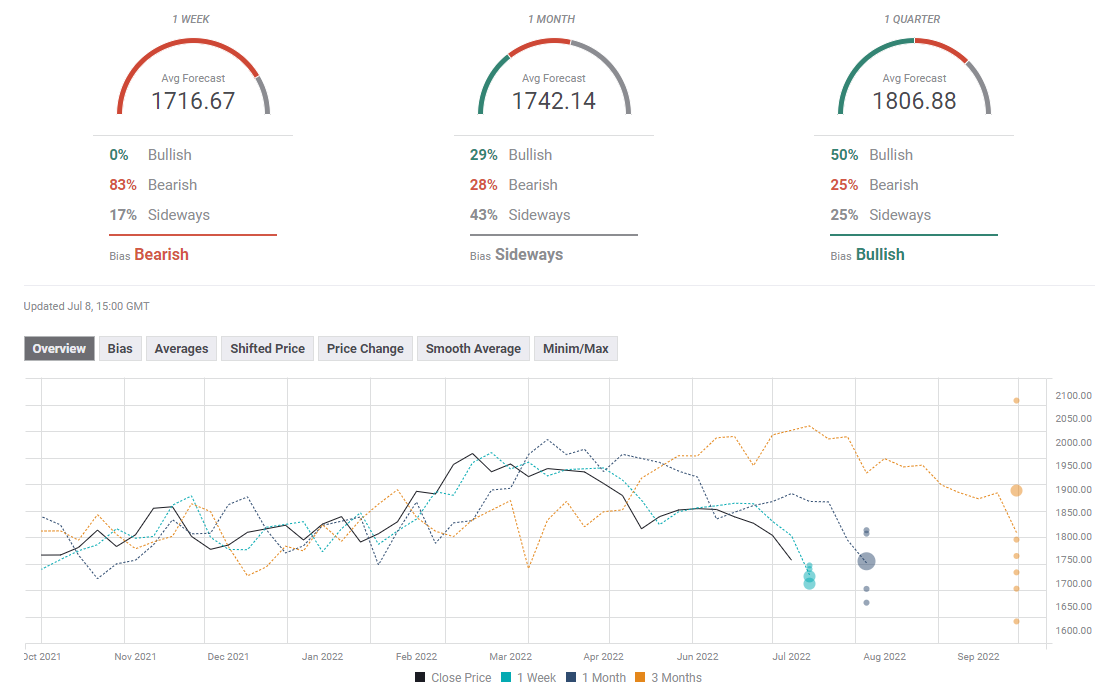
FXStreet Forecast Poll shows that experts remain overwhelmingly bearish on gold in the short term with the average target on the one-week view sitting at $1,716.
Premium
You have reached your limit of 3 free articles for this month.
Start your subscription and get access to all our original articles.
Author
Eren Sengezer
FXStreet
As an economist at heart, Eren Sengezer specializes in the assessment of the short-term and long-term impacts of macroeconomic data, central bank policies and political developments on financial assets.