Gold Weekly Forecast: Will investors continue to disregard overbought conditions?
- Gold hit yet another all-time high above $4,000.
- Easing geopolitical tensions triggered a correction in XAU/USD on Thursday.
- September inflation data from the US could be delayed if the government shutdown continues.

Gold (XAU/USD) continued to ignore overbought conditions this week and extended its rally to a new record-high above $4,000. Key inflation data from the United States (US) could be postponed next week unless the government reopens, allowing risk perception and comments from Federal Reserve (Fed) officials to continue driving XAU/USD’s performance in the short term.
Gold shines as the preferred safe-haven asset
Gold benefited from several developments in the first half of the week and notched a new record-high near $4,060 on Wednesday.
Sanae Takaichi, who is known to be a fiscal dove that could oppose further monetary tightening by the Bank of Japan (BoJ), won the leadership race of Japan's ruling Liberal Democratic Party (LDP) over the weekend. Growing market expectations for pro-stimulus policies triggered a selloff in the Japanese Yen (JPY). The XAU/JPY pair opened with a huge bullish gap on Monday and gained nearly 8% in a three-day rally, showing a strong capital outflow out of the JPY into Gold.
Moreover, France’s newly appointed Prime Minister Sébastien Lecornu announced his resignation on Monday, reviving fears over a deepening political crisis in Europe’s second-biggest economy. In turn, capital fleeing the Euro moved to Gold, with the XAU/EUR pair rising nearly 5% in the first half of the week.
Meanwhile, lawmakers in the United States (US) failed to agree on a funding bill to end the government shutdown, causing postponements in data releases and feeding into the uncertainty surrounding the economic outlook, which in turn clouded the visions of Fed policymakers. Although the US Dollar (USD) Index, which gauges the USD’s performance against a basket of six major currencies, gathered bullish momentum throughout the week, it had little to no impact on the XAU/USD’s rally.
On Thursday, easing geopolitical tensions limited Gold’s strength after US President Donald Trump announced that Israel and Hamas had agreed on a peace plan and that Israeli hostages could be released by next Monday. XAU/USD lost more than 1.5% and closed below $4,000 on Thursday before going into a consolidation phase on Friday.
Gold investors will assess political developments and Fed speeches
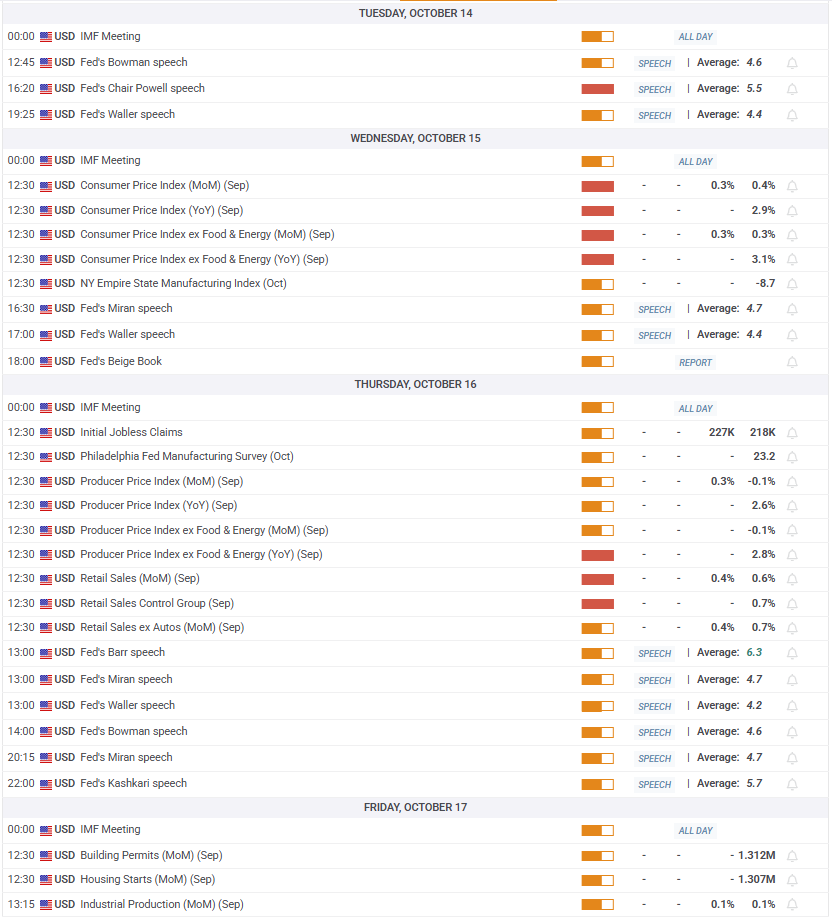
The US Bureau of Labor Statistics (BLS) is scheduled to release the Consumer Price Index (CPI) and the Producer Price Index (PPI) data for September on Wednesday and Thursday, respectively, although it remains uncertain whether the data will be released.
Democrats and Republicans failed to make any progress in reopening the government after the funding bill was rejected with a 54-45 vote on Thursday. The Senate will return next Tuesday and there won't be any other votes on the bill until then. Meanwhile, The New York Times reported early Friday that the BLS is calling back a limited number of staff from furlough to complete the September Consumer Price Index (CPI) report.
“The decision reflects the importance of September inflation data in determining the annual Social Security cost-of-living adjustment (COLA), which is calculated using third-quarter CPI figures. A prolonged delay would risk postponing the COLA announcement that affects millions of retirees,” the report explained. Still, it’s unclear whether the data will be made public. In case it’s published, the market reaction is likely to be focused on the monthly core CPI figure, which is forecast to rise by 0.3%. A reading below market expectations could hurt the USD and allow XAU/USD to continue to stretch higher. Conversely, investors could reassess the probability of a 25-basis-point (bps) rate cut in December and cause Gold to turn south if the data surprises to the upside. According to the CME FedWatch Tool, markets are currently fully pricing in a 25 bps reduction in the policy rate in October and see about an 80% probability of one more 25 bps cut in December.
Comments from Fed officials will also be watched closely by market participants, especially if the shutdown continues. If Fed officials hint that they will need to adopt a cautious approach to further policy easing, citing a lack of data and the heightened uncertainty, Gold could have a hard time gathering bullish momentum. On the other hand, the USD could come under renewed selling pressure and allow XAU/USD to hold its ground if Fed officials suggest that policy easing could be the preferred route in the case of a prolonged government shutdown and its potential negative impact on employment and consumer spending.
Gold technical analysis
Gold remains technically overbought in the near term, with the Relative Strength Index (RSI) indicator on the daily chart holding well above 70 despite declining sharply from near 90 on Thursday. Additionally, XAU/USD continues to hold above the upper limit of the 10-month-old ascending regression channel, currently located at $3,970, after closing the last four days above this level.
Looking south, the first support level can be spotted at $3,900 (round level, static level) before $3,820 (20-day Simple Moving Average) and $3,750 (mid-point of the ascending regression channel). On the upside, an interim resistance level seems to have formed at $4,060 (static level) ahead of $4,100 (round level) and $4,200 (round level).
Gold FAQs
Gold has played a key role in human’s history as it has been widely used as a store of value and medium of exchange. Currently, apart from its shine and usage for jewelry, the precious metal is widely seen as a safe-haven asset, meaning that it is considered a good investment during turbulent times. Gold is also widely seen as a hedge against inflation and against depreciating currencies as it doesn’t rely on any specific issuer or government.
Central banks are the biggest Gold holders. In their aim to support their currencies in turbulent times, central banks tend to diversify their reserves and buy Gold to improve the perceived strength of the economy and the currency. High Gold reserves can be a source of trust for a country’s solvency. Central banks added 1,136 tonnes of Gold worth around $70 billion to their reserves in 2022, according to data from the World Gold Council. This is the highest yearly purchase since records began. Central banks from emerging economies such as China, India and Turkey are quickly increasing their Gold reserves.
Gold has an inverse correlation with the US Dollar and US Treasuries, which are both major reserve and safe-haven assets. When the Dollar depreciates, Gold tends to rise, enabling investors and central banks to diversify their assets in turbulent times. Gold is also inversely correlated with risk assets. A rally in the stock market tends to weaken Gold price, while sell-offs in riskier markets tend to favor the precious metal.
The price can move due to a wide range of factors. Geopolitical instability or fears of a deep recession can quickly make Gold price escalate due to its safe-haven status. As a yield-less asset, Gold tends to rise with lower interest rates, while higher cost of money usually weighs down on the yellow metal. Still, most moves depend on how the US Dollar (USD) behaves as the asset is priced in dollars (XAU/USD). A strong Dollar tends to keep the price of Gold controlled, whereas a weaker Dollar is likely to push Gold prices up.
Author

Eren Sengezer
FXStreet
As an economist at heart, Eren Sengezer specializes in the assessment of the short-term and long-term impacts of macroeconomic data, central bank policies and political developments on financial assets.














