Gold Weekly Forecast: Fed commentary and US data to drive XAU/USD action in near term
- Gold extended its downward correction into a second consecutive week.
- The technical outlook is yet to reflect a convincing bearish reversal.
- Comments from Fed officials and US economic data will be watched closely.

Gold (XAU/USD) remained under bearish pressure and touched its weakest level since early October, below $4,000, pressured by the Federal Reserve (Fed) Chairman Jerome Powell’s cautious remarks on policy easing and a de-escalation in the United States (US) - China trade conflict. Upcoming macroeconomic data releases from the US and comments from Fed officials could influence Gold’s valuation in the near term.
Gold extends correction from record-high
Gold started the week under heavy bearish pressure and lost more than 3% on Monday. Growing optimism about the US and China reaching a trade truce allowed risk flows to dominate markets, making it difficult for Gold to find demand as a safe haven. Following a high-level meeting with Chinese officials, US Treasury Secretary Scott Bessent said over the weekend that China was ready to make a trade deal to avert a new 100% tariff on Chinese imports, and added that a framework was prepared for the meeting between US President Donald Trump and Chinese President Xi Jinping.
As Trump signed framework trade agreements with multiple nations, including South Korea, during his Asia tour, Gold remained on the back foot and fell to its lowest level since early October, below $3,900, on Tuesday.
Following a recovery attempt in the first half of the day on Wednesday, Gold turned south in the American session and closed the fourth consecutive day in negative territory.
The Fed decided to cut the policy rate by 25 basis points (bps) to the range of 3.75%-4% following the October policy meeting, as anticipated. The US central bank also announced that it will conclude the aggregate balance sheet drawdown on December 1. While responding to questions in the post-meeting press conference, Fed Chair Jerome Powell noted that another rate cut in December is "far from assured" and explained that the outlook for employment and inflation has not changed much since the September meeting. Powell further reiterated that the central bank needs to manage the risk of more persistent inflation. The benchmark 10-year US Treasury bond yield climbed above 4% following Powell’s cautious remarks on policy easing, and the US Dollar (USD) gathered strength, weighing on XAU/USD.
On Thursday, the negative shift seen in the risk sentiment helped Gold stage a rebound. After recovering above $4,000, the precious metal went into a consolidation phase on Friday.
Gold investors await US data, Fed commentary
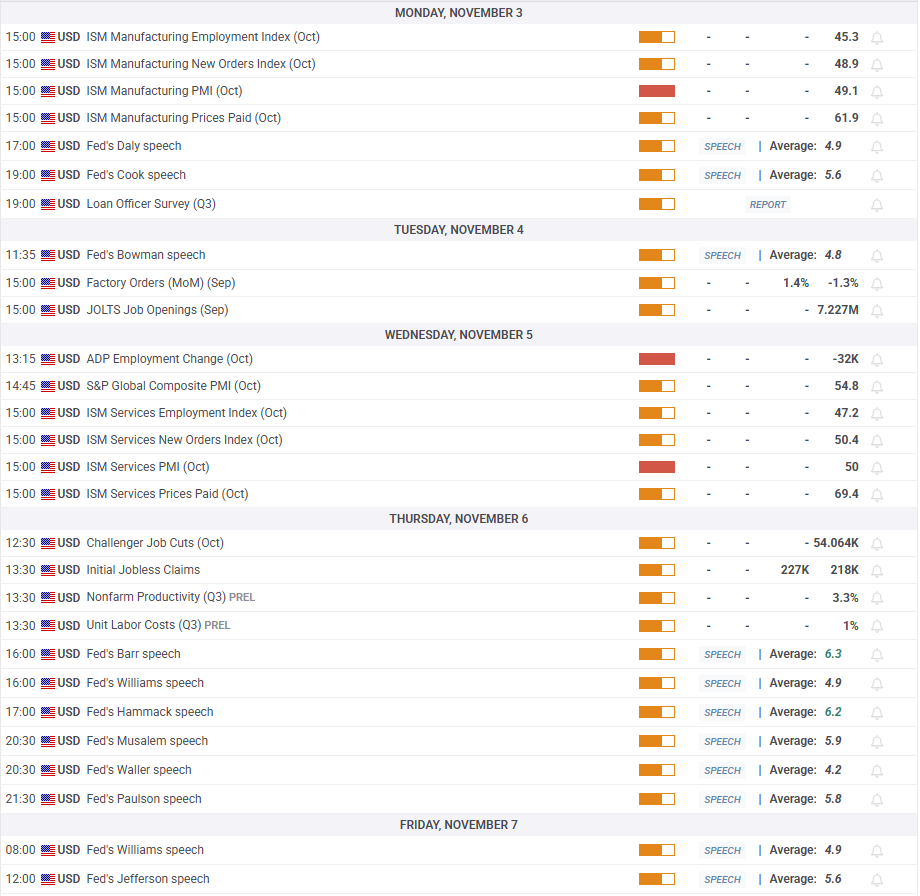
The US economic calendar will feature several macroeconomic data releases that could provide valuable insights into the labor market conditions and the overall economic situation, given the postponed or cancelled releases due to the ongoing government shutdown.
On Monday, the Institute for Supply Management (ISM) will publish the Manufacturing Purchasing Managers’ Index (PMI) data for October. A significant improvement in the headline PMI, and/or the Employment component of the survey, could support the USD with the immediate reaction and cause XAU/USD to stretch lower.
On Wednesday, Automatic Data Processing (ADP) will release the private sector payroll data for October. Earlier in the week, the ADP reported on Tuesday that private payrolls increased by an average of 14,250 jobs in the four weeks ending October 11, and announced that it will start publishing a weekly preliminary estimate, which will present a four-week moving average of the total employment change in the private sector. Hence, the market reaction to the upcoming ADP data could remain short-lived. Later in the day, the ISM Services PMI data for October could trigger a straightforward reaction, with the better-than-forecast headline PMI reading and a noticeable recovery in the Employment component boosting the USD while weighing on XAU/USD and vice versa.
Investors will also pay close attention to comments from Fed officials. According to the CME FedWatch Tool, the probability of one more Fed rate cut in December declined below 70% on Friday from 90% ahead of the Fed meeting.
In case policymakers echo Powell’s tone by refraining from committing to another interest rate reduction before the end of the year, the USD could continue to gather strength alongside rising T-bond yields, opening the door for another leg lower in Gold. Conversely, XAU/USD could hold its ground if Fed officials hint that they are on track to ease the policy rate further unless they see a convincing sign of tariffs lifting inflation.
Gold technical analysis
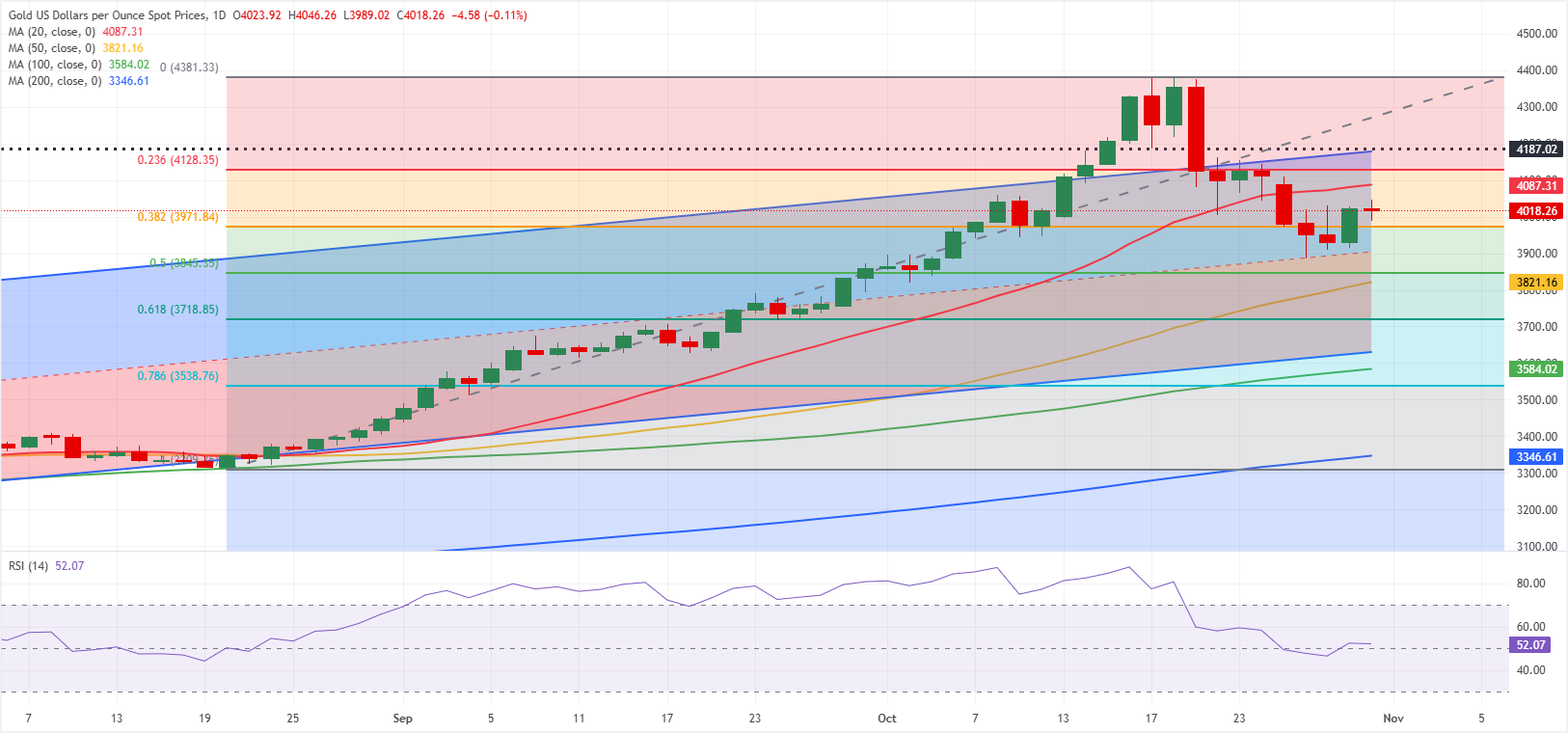
The Relative Strength Index (RSI) indicator on the daily chart stays near 50 and Gold continues to trade below the 20-day Simple Moving Average (SMA), while holding in the upper half of an ascending regression channel coming from the beginning of the year.
On the downside, $3,970 (Fibonacci 38.2% retracement of the August-October rally) aligns as an interim support level before $3,900 (mid-point of the ascending channel, round level) and $3,850-$3,820 (Fibonacci 50% retracement, 50-day SMA).
In case Gold rises above $4,090 (20-day SMA) and stabilizes there, $4,130 (Fibonacci 23.6% retracement) could be seen as the next resistance level before $4,200 (round level).
Gold FAQs
Gold has played a key role in human’s history as it has been widely used as a store of value and medium of exchange. Currently, apart from its shine and usage for jewelry, the precious metal is widely seen as a safe-haven asset, meaning that it is considered a good investment during turbulent times. Gold is also widely seen as a hedge against inflation and against depreciating currencies as it doesn’t rely on any specific issuer or government.
Central banks are the biggest Gold holders. In their aim to support their currencies in turbulent times, central banks tend to diversify their reserves and buy Gold to improve the perceived strength of the economy and the currency. High Gold reserves can be a source of trust for a country’s solvency. Central banks added 1,136 tonnes of Gold worth around $70 billion to their reserves in 2022, according to data from the World Gold Council. This is the highest yearly purchase since records began. Central banks from emerging economies such as China, India and Turkey are quickly increasing their Gold reserves.
Gold has an inverse correlation with the US Dollar and US Treasuries, which are both major reserve and safe-haven assets. When the Dollar depreciates, Gold tends to rise, enabling investors and central banks to diversify their assets in turbulent times. Gold is also inversely correlated with risk assets. A rally in the stock market tends to weaken Gold price, while sell-offs in riskier markets tend to favor the precious metal.
The price can move due to a wide range of factors. Geopolitical instability or fears of a deep recession can quickly make Gold price escalate due to its safe-haven status. As a yield-less asset, Gold tends to rise with lower interest rates, while higher cost of money usually weighs down on the yellow metal. Still, most moves depend on how the US Dollar (USD) behaves as the asset is priced in dollars (XAU/USD). A strong Dollar tends to keep the price of Gold controlled, whereas a weaker Dollar is likely to push Gold prices up.
Author

Eren Sengezer
FXStreet
As an economist at heart, Eren Sengezer specializes in the assessment of the short-term and long-term impacts of macroeconomic data, central bank policies and political developments on financial assets.














