Gold Weekly Forecast: Bulls dominate as US Treasury Department intervenes in bond market
- Gold extended its uptrend to a fresh three-month high above $4,500.
- The US Treasury Department announced a plan to increase long-term bond buybacks.
- The technical outlook suggests that the bullish bias remains intact in the short term.

Following the previous week’s choppy action, Gold (XA/USD) gathered bullish momentum and advanced to its highest level since late May and touched $4,600. While XAU/USD’s technical outlook highlights buyers’ dominance in the near term, next week will feature key events that could ramp up market volatility.
Gold surges after US Treasury Department’s unexpected bond buyback announcement
The US Dollar (USD) started the week under bearish pressure and Gold rose nearly 1% on Monday as investors continued to scale back bets for a Federal Reserve (Fed) rate hike in September following the previous week’s disappointing economic data releases.
With tensions in the Middle East coming back under the spotlight on Tuesday, Gold lost its bullish momentum and closed the day deep in negative territory. US President Donald Trump said late that the US administration is not seeking an extension of the Memorandum of Understanding. Additionally, Trump reportedly told Fox News that they will bomb Oman if it gets in the way of his administration's negotiations with Iran.
In the meantime, the UK Maritime Trade Operations (UKMTO) reported early Tuesday that a vessel was struck by an "unknown projectile" while attempting to pass through the Strait of Hormuz. In the meantime, the yield on the 30-year Treasury bond climbed to its highest level in nearly two decades as investors reacted to heightened uncertainty surrounding the crisis in the Middle East.
In the second half of the day on Wednesday, the USD sold off sharply as the US Treasury Department unexpectedly announced that it will double the size of some long-dated debt buyback operations to support market liquidity. With US Treasury bond yields correcting sharply lower, Gold broke out of its range and climbed above $4,500 for the first time since early June.
According to TD Securities, the announcement that the US Treasury is increasing the size of liquidity-support buyback operations has "given metals a jolt of life," providing a fresh catalyst for precious metals. The firm notes that "while the fierce bid has faded in recent days, the flows could quickly return amid Treasury liquidity support, a Fed willing to look through an energy shock, and a growing stagflation narrative, which should all ultimately see lower real rates." In their view, this combination of policy support and macro concerns sets the stage for renewed upside in Gold and the broader metals complex.
Following Wednesday’s volatile action, Gold entered a consolidation phase on Thursday and closed flat. US President Trump announced late Wednesday that they will launch an unprecedented "crushing economic operation" against Iran and warned that any countries offering support to Tehran will also face severe financial retaliation, causing investors to adopt a cautious stance and capping XAU/USD’s upside for the time being.
As the USD failed to stage a meaningful recovery early Friday, Gold regained its traction and extended its rally to a fresh 12-week high above $4,600. Heading into the weekend, the USD managed to limit its losses after the preliminary August Purchasing Managers’ Index (PMI) surveys highlighted healthy business activity in the private sector and capped Gold’s upside.
Gold investors to look for clarity on Fed policy outlook, Middle East crisis
US Treasury chief Scott Bessent said that the US will impose "the toughest sanctions in history" on Iran and added that he will share more details at a press conference on Monday. A sharp increase in Crude Oil prices in response to this announcement could weigh on Gold with the initial reaction. Conversely, a pullback in energy prices could have a positive impact on the precious metal’s action.
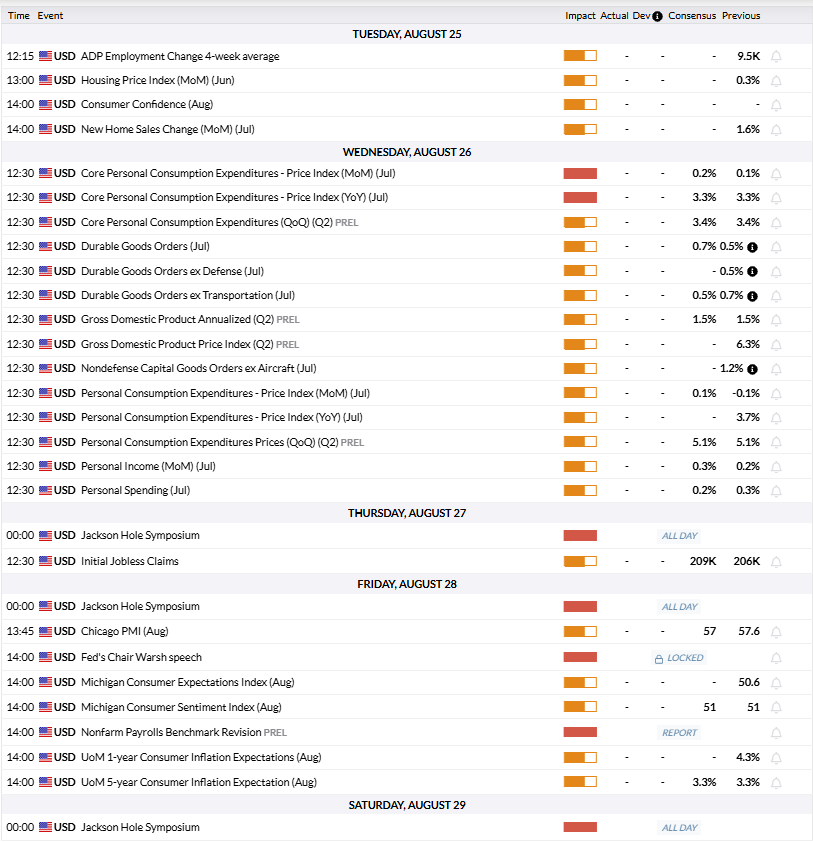
On Wednesday, the US Bureau of Economic Analysis (BEA) will publish its second estimate of the annualized Gross Domestic Product (GDP) growth for the second quarter and release Personal Consumption Expenditures (PCE) Price Index figures for July.
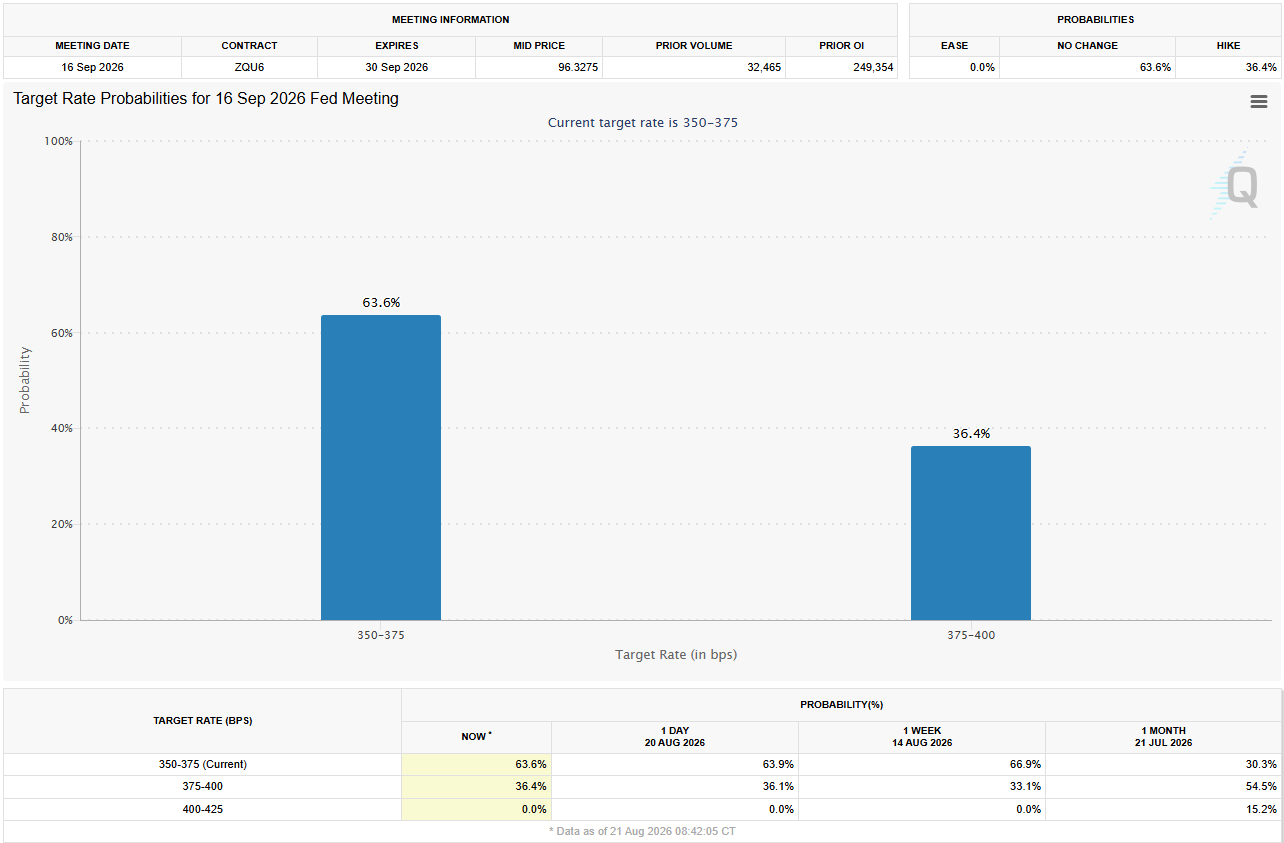
On a monthly basis, investors expect the core PCE Price Index, the Fed’s preferred gauge of inflation, to increase by 0.2%. A stronger increase could cause investors to have second thoughts about a Fed policy hold in September and open the door to a downward correction in Gold. According to the CME FedWatch Tool, markets currently price in about a 35% probability of a 25 basis points (bps) interest rate hike next month. On the other hand, a softer-than-forecast monthly core PCE inflation print could help XAU/USD stretch higher.
Fed Chair Kevin Warsh will deliver a speech at the annual Jackson Hole Symposium on Friday. Since replacing Jerome Powell, Warsh made it clear that he is against forward guidance. Hence, it wouldn’t be a surprise if Warsh refrains from delivering any comments on the policy outlook. Still, markets are eager to know whether Warsh will be able to do what is necessary to tame inflation. If Warsh reaffirms that they are uncomfortable with current inflation dynamics and downplays the latest signs of a cooldown in the labor market, the USD could hold its ground heading into the weekend and cap XAU/USD’s upside.
St. Louis Fed President Alberto Musalem (non-voter) delivered a hawkish speech on Thursday, with an FXS Speechtracker score of 7/10. The emphasis on strong growth, accommodative financial conditions, underlying inflation stuck around 2.5%-3%, and the notion that hiking rates now could avert more aggressive action later underscored a bias toward pre-emptive tightening even as Fed credibility and policy independence are reaffirmed. References to potential supply shocks from a “super El Nino,” high input costs, and some credit crowding out reinforced an inflation-focused narrative, while the refusal to prejudge the September FOMC kept near-term rate expectations data-dependent.
Analysts at BNY Mellon argue that recent US Treasury actions have succeeded in stabilising the bond market, but they also warn that “bond markets have calmed, which is meaningful, but the next test is whether managing the yield curve begins to conflict with monetary-policy objectives.”
In their view, if Treasury measures effectively “loosen conditions while inflation remains above target, the Fed may eventually need to offset some of that impulse,” a tension that is already being reflected in alternative assets, with “Gold pushing through $4,500/oz. and Bitcoin briefly touching $70,000” suggesting “markets don’t view the move as costless.”
Gold technical analysis: Bulls retain control
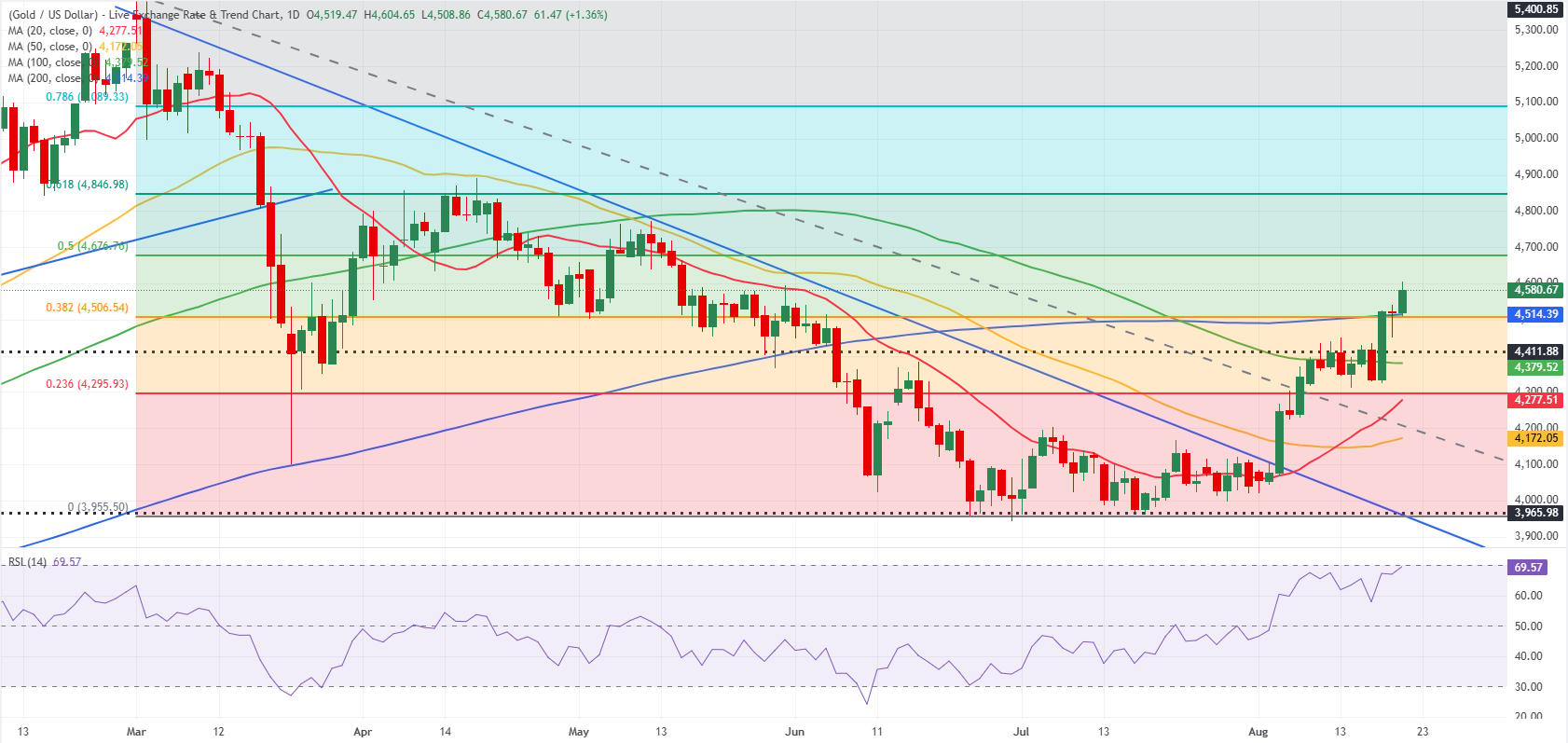
Gold broke above the key $4,500 resistance, which was reinforced by the 200-day Simple Moving Average (SMA) and the Fibonacci 38.2% retracement of the March-August downtrend. Additionally, the Relative Strength Index (RSI) indicator on the daily chart climbed toward 70, highlighting a buildup in bullish momentum.
While Gold holds above $4,500, technical buyers could remain interested. On the upside, $4,675-$4,700 (Fibonacci 50% retracement, round level) aligns as the next resistance area before $4,850 (Fibonacci 61.8% retracement).
If Gold drops back below $4,500 and fails to reclaim that level, buyers could move to the sidelines and pave the way for an extended downward correction. Looking south, next support levels could be spotted at $4,410-$4,400 (static level, round level) and $4,300-$4,280 (Fibonacci 23.6% retracement, Fibonacci 23.6% retracement, 20-day SMA).
Gold FAQs
Gold has played a key role in human’s history as it has been widely used as a store of value and medium of exchange. Currently, apart from its shine and usage for jewelry, the precious metal is widely seen as a safe-haven asset, meaning that it is considered a good investment during turbulent times. Gold is also widely seen as a hedge against inflation and against depreciating currencies as it doesn’t rely on any specific issuer or government.
Central banks are the biggest Gold holders. In their aim to support their currencies in turbulent times, central banks tend to diversify their reserves and buy Gold to improve the perceived strength of the economy and the currency. High Gold reserves can be a source of trust for a country’s solvency. Central banks added 1,136 tonnes of Gold worth around $70 billion to their reserves in 2022, according to data from the World Gold Council. This is the highest yearly purchase since records began. Central banks from emerging economies such as China, India and Turkey are quickly increasing their Gold reserves.
Gold has an inverse correlation with the US Dollar and US Treasuries, which are both major reserve and safe-haven assets. When the Dollar depreciates, Gold tends to rise, enabling investors and central banks to diversify their assets in turbulent times. Gold is also inversely correlated with risk assets. A rally in the stock market tends to weaken Gold price, while sell-offs in riskier markets tend to favor the precious metal.
The price can move due to a wide range of factors. Geopolitical instability or fears of a deep recession can quickly make Gold price escalate due to its safe-haven status. As a yield-less asset, Gold tends to rise with lower interest rates, while higher cost of money usually weighs down on the yellow metal. Still, most moves depend on how the US Dollar (USD) behaves as the asset is priced in dollars (XAU/USD). A strong Dollar tends to keep the price of Gold controlled, whereas a weaker Dollar is likely to push Gold prices up.
Author

Eren Sengezer
FXStreet
As an economist at heart, Eren Sengezer specializes in the assessment of the short-term and long-term impacts of macroeconomic data, central bank policies and political developments on financial assets.