Gold Weekly Forecast: Focus shifts to Fed after new record-high is set
- Gold capitalized on safe-haven flows and set a new record high above $3,000.
- The Fed’s policy announcements, alongside the revised dot plot, could influence Gold’s valuation.
- The near-term technical outlook suggests that the bullish bias remains intact.

Following a bearish opening to the week, Gold (XAU/USD) reversed its direction and climbed to a new record high above $3,000 on Friday. Markets will take a break from politics and focus on the Federal Reserve’s (Fed) policy decisions.
Gold rebounds from below $2,900 on broad USD weakness
Gold started the week under bearish pressure and closed in negative territory on Monday. The risk-averse market atmosphere amid growing concerns over an economic downturn in the US and deepening global trade conflicts, however, allowed risk-averse flows to dominate the action in financial markets in the first half of the week, helping XAU/USD regain its traction.
When asked whether his policies could weigh on economic activity in an interview over the weekend, US President Donald Trump acknowledged that there will be a "period of transition." Wall Street’s main indexes suffered heavy losses on Monday. On Tuesday, markets experienced heightened volatility while assessing the latest headlines surrounding the Trump administration’s trade policy.
Trump announced on Tuesday that he will impose an additional 25% tariff, on top of the previously announced 25%, on steel and aluminum imports from Canada. In response, Ontario Premier Doug Ford said that they will place a 25% surcharge on the electricity they supply to more than 1 million homes in the US. Trump backed off following this development, and the White House said that only the previously planned 25% tariffs on steel and aluminum products from Canada and all other countries would go into effect on Wednesday, with no exceptions or exemptions.
Early Wednesday, European Commission President Ursula von der Leyen said that the European Union (EU) had launched “swift and proportionate countermeasures” on US imports in response to steel tariffs. Similarly, UK Trade Minister Jonathan Reynolds said that it is disappointing that the US has decided to go ahead with global tariffs on steel and aluminum, adding that they will keep all options on the table and won't hesitate to respond in the national interest. Heightened fears over a trade war involving many nations helped Gold find demand as a safe-haven midweek.
Meanwhile, the US Bureau of Labor Statistics reported on Wednesday that annual inflation in the US, as measured by the change in the Consumer Price Index (CPI), softened to 2.8% in February from 3% in January. The core CPI, which excludes volatile food and energy prices, rose 3.1% on a yearly basis. This print followed the 3.3% increase recorded in January and came in below analysts' estimate of 3.2%. On a monthly basis, the core CPI rose 0.2%. These prints failed to trigger a noticeable market reaction and Gold continued to push higher above $2,900.
After breaking above the previous record-high of $2,956 late Thursday, Gold attracted technical buyers and climbed above $3,000 on Friday. Additionally, market chatter about the People's Bank of China (PBoC) looking to cut the reserve requirement ratio (RRR) by either 25 or 50 basis points (bps) helped the precious metal extend its rally.
Gold investors await Fed decision, revised economic outlook and Powell’s comments
The Federal Reserve will announce its monetary policy decisions and publish the revised Summary of Economic Projections (SEP), also known as the dot-plot, following its two-day meeting on Wednesday.
According to the CME FedWatch Tool, markets virtually see no chance of a rate cut in March. Hence, investors will scrutinize the policy statement, the dot-plot and pay close attention to comments from Chairman Jerome Powell in the post-meeting press conference.
In December, the dot-plot showed that policymakers were projecting a total of 50 basis point (bps) reduction in the policy rate in 2025, while forecasting an annual Gross Domestic Product (GDP) growth of 2.1% and seeing an annual Personal Consumption Expenditure (PCE) inflation of 2.5% at year-end. In case the revised SEP shows no change in the interest rate projections but highlights a downward revision to growth expectations, the immediate reaction could trigger a US Dollar (USD) selloff and help XAU/USD push higher. On the flip side, an upward revision to inflation forecasts, without a noticeable change in the GDP estimates, could support the USD and cause the Gold price to turn south.
Any changes to interest rate projections, regardless of the GDP and inflation forecasts, could influence the USD’s valuation significantly. If policymakers lean toward three 25 bps rate cuts in the remainder of the year, the USD could come under heavy bearish pressure. Conversely, the USD could stage a decisive rebound and open the door for a deep downward correction in XAU/USD in case the majority of officials put down only one rate cut in 2025.
Powell’s comments could also drive Gold’s valuation. If he downplays concerns over an economic downturn and puts more emphasis on the uncertainty surrounding the inflation outlook, citing Trump’s administration’s tariffs, the USD is likely to outperform its rivals in the near term.

Gold technical analysis
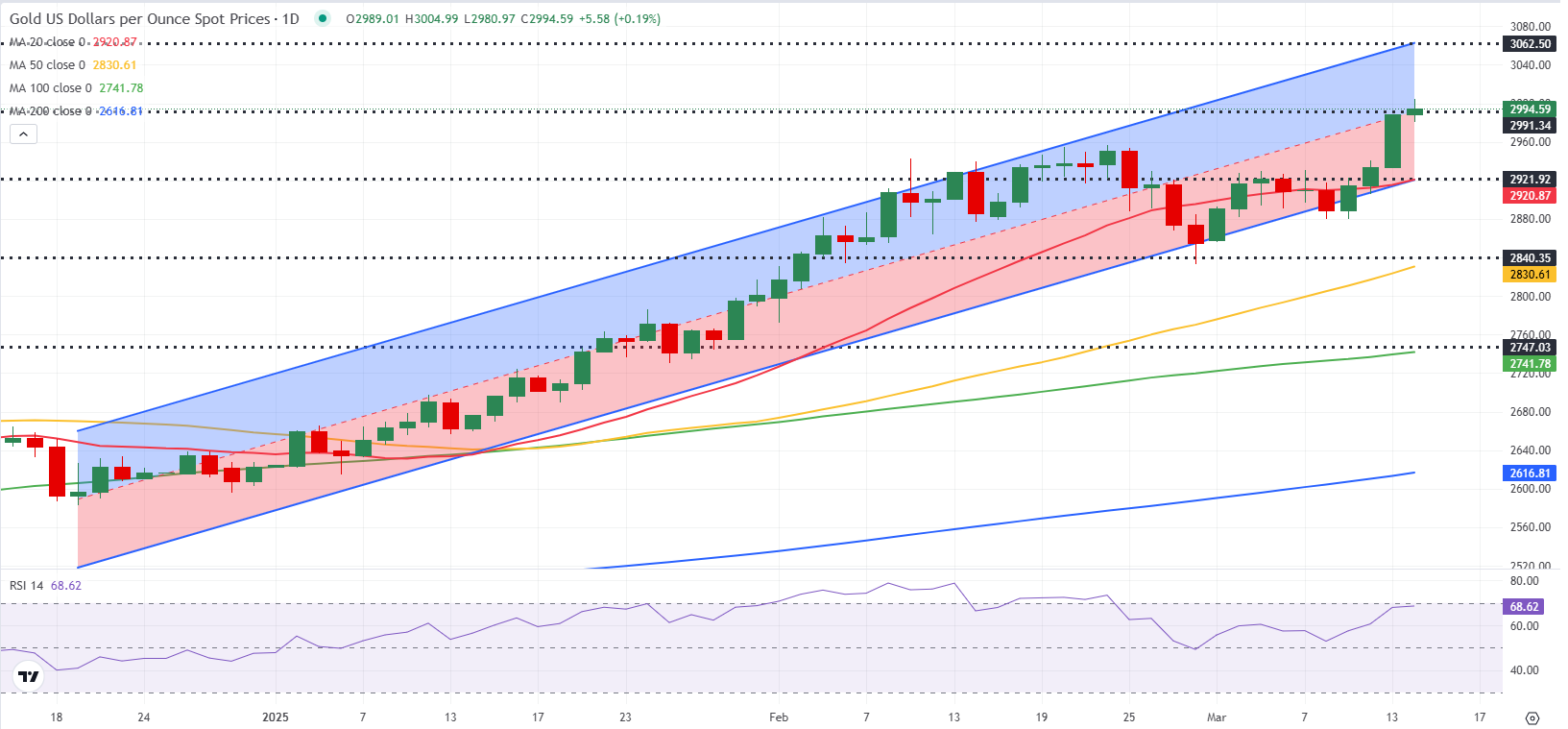
Gold remains within a three-month-old ascending regression channel and the Relative Strength Index (RSI) indicator on the daily chart stays near 70, suggesting that the bullish bias remains intact.
Once Gold stabilizes above $3,000 (round level, mid-point of the ascending channel) and confirms this level as support, $3,060 (upper limit of the ascending channel) could be set as the next bullish target before $3,100 (round level). However, technical buyers could be discouraged if XAU/USD fails to flip $3,000 into support. In this scenario, $2,920 (20-day Simple Moving Average, lower limit of the ascending channel) and $2,900 (round level, static level) could be seen as next support levels.
Gold FAQs
Gold has played a key role in human’s history as it has been widely used as a store of value and medium of exchange. Currently, apart from its shine and usage for jewelry, the precious metal is widely seen as a safe-haven asset, meaning that it is considered a good investment during turbulent times. Gold is also widely seen as a hedge against inflation and against depreciating currencies as it doesn’t rely on any specific issuer or government.
Central banks are the biggest Gold holders. In their aim to support their currencies in turbulent times, central banks tend to diversify their reserves and buy Gold to improve the perceived strength of the economy and the currency. High Gold reserves can be a source of trust for a country’s solvency. Central banks added 1,136 tonnes of Gold worth around $70 billion to their reserves in 2022, according to data from the World Gold Council. This is the highest yearly purchase since records began. Central banks from emerging economies such as China, India and Turkey are quickly increasing their Gold reserves.
Gold has an inverse correlation with the US Dollar and US Treasuries, which are both major reserve and safe-haven assets. When the Dollar depreciates, Gold tends to rise, enabling investors and central banks to diversify their assets in turbulent times. Gold is also inversely correlated with risk assets. A rally in the stock market tends to weaken Gold price, while sell-offs in riskier markets tend to favor the precious metal.
The price can move due to a wide range of factors. Geopolitical instability or fears of a deep recession can quickly make Gold price escalate due to its safe-haven status. As a yield-less asset, Gold tends to rise with lower interest rates, while higher cost of money usually weighs down on the yellow metal. Still, most moves depend on how the US Dollar (USD) behaves as the asset is priced in dollars (XAU/USD). A strong Dollar tends to keep the price of Gold controlled, whereas a weaker Dollar is likely to push Gold prices up.
Author

Eren Sengezer
FXStreet
As an economist at heart, Eren Sengezer specializes in the assessment of the short-term and long-term impacts of macroeconomic data, central bank policies and political developments on financial assets.