Gold Weekly Forecast: Bulls remain in control as focus shifts to US inflation data
- Gold climbed to a fresh record-high near $3,600.
- The technical outlook points to overbought conditions for XAU/USD.
- August inflation data from the US will be watched closely by market participants.
Gold (XAU/USD) broke out of its four-month-old trading range and rallied to a new record-high near $3,600, fuelled by safe-haven flows and renewed US Dollar (USD) weakness. As the Federal Reserve (Fed) enters the blackout period ahead of the September policy meeting, August inflation data from the United States (US) could be the next significant catalyst for XAU/USD.
Gold gathers bullish momentum and sets new record peak
After rising more than 2% in the previous week, Gold preserved its bullish momentum on Monday and ended the day in positive territory. Although the financial markets in the US were closed in observance of the Labor Day holiday, Gold benefited from escalating geopolitical tensions as Russia carried out an attack on 14 regions of Ukraine over the weekend and Ukraine responded by striking Russian oil refineries.
While safe-haven flows dominated the action in financial markets early Tuesday, Gold extended its rally and climbed above $3,500. The heavy selling pressure surrounding the United Kingdom Gilts, on growing fears over the fiscal health, triggered a sharp selloff in global Bond markets, forcing investors to seek refuge.
Following a technical correction early Wednesday, XAU/USD turned north once again in the second half of the day and notched a new record-high above $3,570 as the US Dollar came under selling pressure after the data from the US showed that the JOLTS Job Openings declined to 7.18 million in July from 7.35 million in June.
A modest improvement in risk mood caused Gold to decline back toward $3,500 early Thursday. Nevertheless, disappointing data releases from the US made it difficult for the USD to gather strength and opened the door for a rebound in XAU/USD in the American session. The number of first-time applications for unemployment benefits climbed to 237,000 in the week ending August 30 from 229,000 in the previous week, and Automatic Data Processing (ADP) announced that private sector payrolls rose by 54,000 in August, compared to the market expectation of 65,000.
Gold fluctuated in a relatively tight channel in the first half of the day on Friday before gathering bullish momentum and renewing its all-time high in the American session. The US Bureau of Labor Statistics (BLS) reported that Nonfarm Payrolls rose by 22,000 in August. This print followed the 79,000 (revised from 73,000) increase recorded in July and missed the market expectation of 75,000 by a wide margin. Additionally, “the change in total Nonfarm Payroll employment for June was revised down by 27,000, from +14,000 to -13,000,” the BLS noted in its press release. Other details of the report showed that the Unemployment Rate edged higher to 4.3% from 4.2% in July, as anticipated. The yield on the benchmark 10-year US Treasury bond declined sharply after the disappointing labor market data and the USD came under heavy selling pressure, fuelling another leg higher in Gold heading into the weekend.
Gold investors await US inflation data
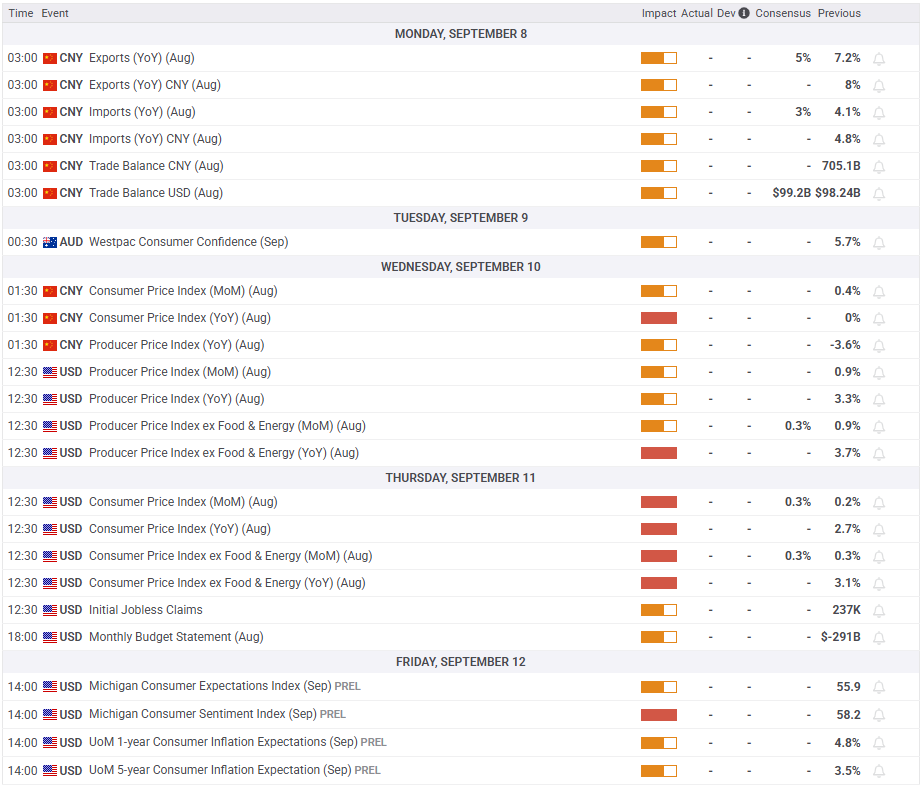
The Fed will be in the blackout period ahead of the September 16-17 policy meeting. Hence, investors will scrutinize macroeconomic data releases from the US for fresh insights into the policy outlook.
On Wednesday, the BLS will publish the Producer Price Index (PPI) figures for August. Ahead of Thursday’s Consumer Price Index (CPI) data, the market reaction to PPI readings could remain short-lived. Nevertheless, in case the monthly core PPI rises at a faster pace than the market expectation of 0.3%, the USD could hold its ground and cap XAU/USD’s upside.
The CPI and the core CPI are both forecast to increase 0.3% on a monthly basis in August. Latest comments from Fed policymakers highlighted a difference of opinion regarding the inflation outlook.
Chicago Fed President Austan Goolsbee argued that inflation might be picking back up, and Minneapolis Fed President Neel Kashkari said that goods inflation is rising because of tariffs and added that they need to watch tariff-related price developments to see if they lead to persistent inflation. On the other hand, San Francisco Fed President Mary Daly noted that she thinks tariff-related price increases will be a one-off and that policymakers will be ready to cut rates soon. Similarly, Fed Governor Christopher Waller said that they know there will be a “a blip of inflation” but it won't be permanent, with inflation returning closer to 2% in about six months.
A significant upside surprise in the monthly core CPI increase, with a reading of 0.5% or more, could cause investors to reassess the probability of multiple rate cuts this year and support the USD with the immediate reaction. Conversely, a reading at or below the market consensus of 0.3% could make it difficult for the USD to attract buyers and allow XAU/USD to cling to its bullish stance.
Market participants will continue to pay close attention to headlines surrounding the Russia-Ukraine conflict. Unless there is a de-escalation in the conflict, Gold’s downward corrections could remain limited, even if the US economic data have a positive impact on the USD’s valuation initially.
Gold technical analysis
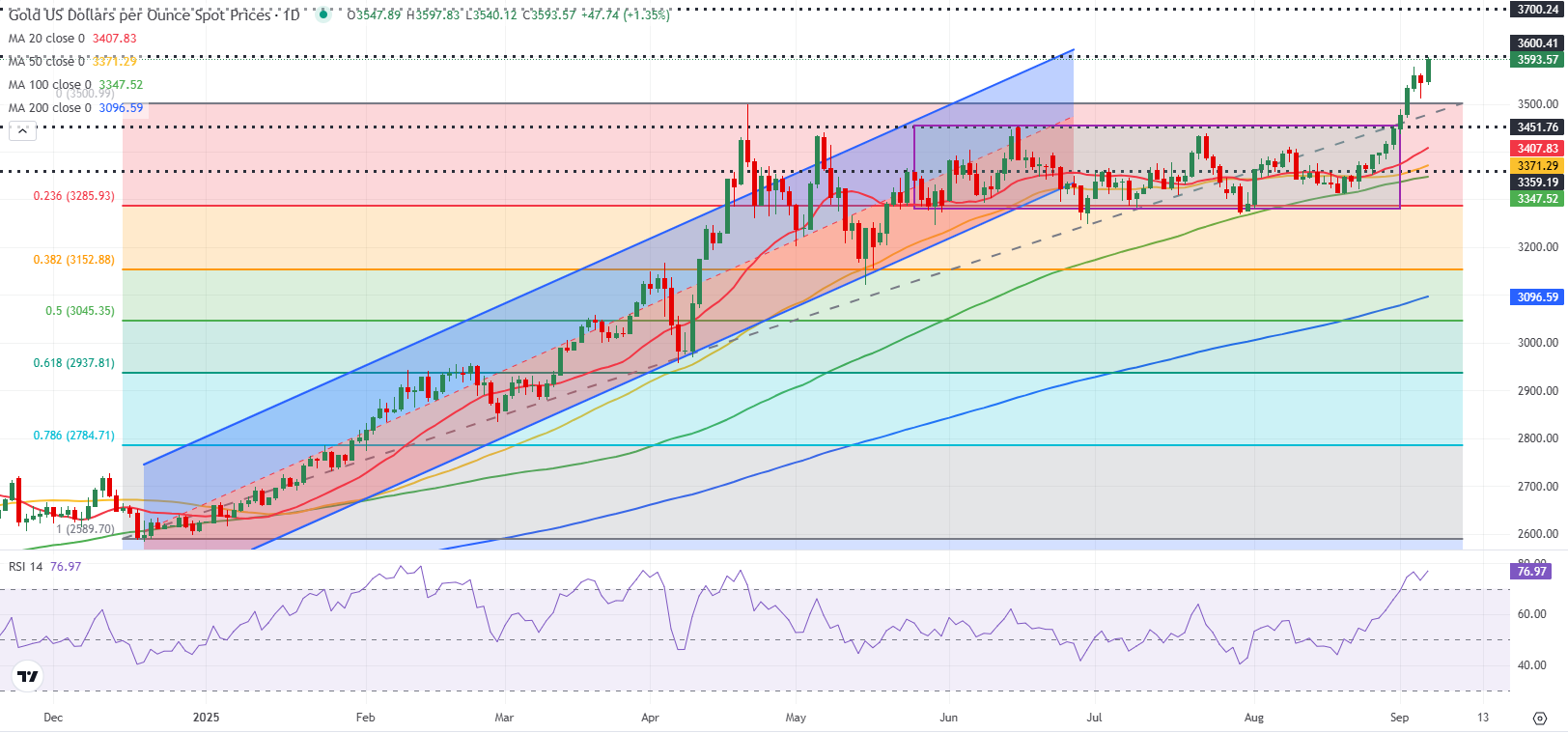
The Relative Strength Index (RSI) indicator on the daily chart stays above 70, suggesting that Gold is technically overbought and that there could be a technical correction before the uptrend continues.
At this point, it’s a difficult task to determine technical targets for Gold on the upside because it remains within a touching distance of the record-highs. Hence, the next psychological level at $3,700 could be seen as next resistance once Gold stabilizes above $3,600 (round level) and confirms that level as support.
Looking south, $3,500 (former resistance, previous record-high) could be seen as the first support level ahead of $3,450 (static level, former resistance) and $3,405-$3,400 (20-day Simple Moving Average, round level).
Inflation FAQs
Inflation measures the rise in the price of a representative basket of goods and services. Headline inflation is usually expressed as a percentage change on a month-on-month (MoM) and year-on-year (YoY) basis. Core inflation excludes more volatile elements such as food and fuel which can fluctuate because of geopolitical and seasonal factors. Core inflation is the figure economists focus on and is the level targeted by central banks, which are mandated to keep inflation at a manageable level, usually around 2%.
The Consumer Price Index (CPI) measures the change in prices of a basket of goods and services over a period of time. It is usually expressed as a percentage change on a month-on-month (MoM) and year-on-year (YoY) basis. Core CPI is the figure targeted by central banks as it excludes volatile food and fuel inputs. When Core CPI rises above 2% it usually results in higher interest rates and vice versa when it falls below 2%. Since higher interest rates are positive for a currency, higher inflation usually results in a stronger currency. The opposite is true when inflation falls.
Although it may seem counter-intuitive, high inflation in a country pushes up the value of its currency and vice versa for lower inflation. This is because the central bank will normally raise interest rates to combat the higher inflation, which attract more global capital inflows from investors looking for a lucrative place to park their money.
Formerly, Gold was the asset investors turned to in times of high inflation because it preserved its value, and whilst investors will often still buy Gold for its safe-haven properties in times of extreme market turmoil, this is not the case most of the time. This is because when inflation is high, central banks will put up interest rates to combat it. Higher interest rates are negative for Gold because they increase the opportunity-cost of holding Gold vis-a-vis an interest-bearing asset or placing the money in a cash deposit account. On the flipside, lower inflation tends to be positive for Gold as it brings interest rates down, making the bright metal a more viable investment alternative.
Author

Eren Sengezer
FXStreet
As an economist at heart, Eren Sengezer specializes in the assessment of the short-term and long-term impacts of macroeconomic data, central bank policies and political developments on financial assets.

















