Gold Weekly Forecast: US-China trade talks, Fed rate decision to drive next directional move
- Gold failed to stabilize above $3,400 after bullish breakout.
- The technical outlook highlights bulls’ hesitancy in the near term.
- The Fed’s policy announcements, US-China trade talks could trigger the next big action in Gold.

Following a bullish start to the week, Gold (XAU/USD) reversed its direction and retreated below $3,400. Key macroeconomic data releases from the United States (US), the Federal Reserve’s (Fed) monetary policy decisions and fresh developments surrounding the US-China relations could ramp up XAU/USD’s volatility and provide important directional clues.
Gold fails to stabilize above $3,400
After spending the previous week in a tight consolidation channel, Gold broke out of its range on Monday and attracted technical buyers. Additionally, the US Dollar (USD) came under renewed selling pressure amid a deepening feud between US President Donald Trump and the Fed, allowing XAU/USD to gather further bullish momentum.
Citing a letter sent to the Department of Justice (DoJ), Fox News reported late Monday that Republican Representative Anna Paulina Luna has referred Fed Chairman Jerome Powell to the DoJ for criminal charges, accusing him of perjury on two occasions. Moreover, Treasury Secretary Scott Bessent told CNBC that they need to review the entire Fed institution and its performance, citing the Fed's "fear-mongering over tariffs" despite a lack of significant signs of inflation as justification. As a result, Gold gained more than 1% both on Monday and Tuesday to rise above $3,400 for the first time in about a month.
As risk flows started to dominate the action in financial markets, Gold reversed its direction and staged a deep correction midweek. Trump announced early Wednesday that he completed a "massive deal" with Japan, explaining that Japan will invest $550 billion into the US and pay 15% reciprocal tariffs, down from 25%, to the US. Reflecting the upbeat market mood, Japan's Nikkei 225 Index gained more than 4% and reached its highest level since July 2024. Later in the day, Wall Street’s main indexes opened on a bullish note and made it difficult for Gold to find demand as a safe haven.
The USD benefited from upbeat macroeconomic data releases on Thursday, forcing XAU/USD to stay on the back foot. The US Department of Labor announced that the number of first-time applications for unemployment benefits declined to 217,000 in the week ending July 19 from 221,000 in the previous week. This reading came in better than the market expectation of 227,000. Other data from the US showed that the business activity in the private sector expanded at an accelerating pace in early July, with the S&P Global preliminary Composite Purchasing Managers Index (PMI) rising to 54.6 from 52.9 in June.
In the meantime, growing optimism about improving US-China trade relations helped the risk mood remain upbeat on Friday, causing Gold to extend its slide to below $3,350. US Treasury Secretary Scott Bessent told Fox Business late Thursday that the US is in a “pretty good place with China on trade.” Moreover, the Wall Street Journal reported that the Trump administration is preparing for a new round of trade talks with China next week, with a focus on securing an economic agreement that will increase the US's access to Chinese markets, particularly in business and technology.
Gold investors shift attention to US-China talks, Fed interest rate decision
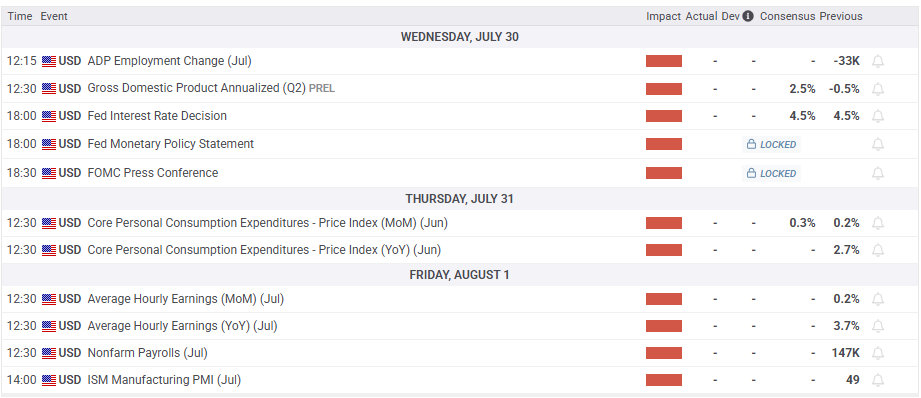
The economic calendar will offer multiple high-impact data releases and the Fed will announce monetary policy decisions following the July 29-30 policy meeting.
According to the CME FedWatch Tool, markets see virtually no chance of a rate cut in July and price in a probability of about 40% for another rate hold in September, up from roughly 10% a month before. Hence, investors will scrutinize the statement language and Fed Chairman Powell’s remarks in the post-meeting press conference for fresh hints at the timing of the next rate cut.
Ahead of the Fed event, the US Bureau of Economic Analysis will release its first estimate of the annualized Gross Domestic Product (GDP) growth for the second quarter. Following the 0.5% contraction recorded in the first quarter, the GDP is expected to rebound. A negative GDP print could feed into expectations for a rate reduction in September and trigger a USD selloff with the immediate reaction, pushing XAU/USD higher. Conversely, a reading near the market expectation could cause investors to refrain from taking large positions in Gold.
In case Powell leaves the door open for a rate cut in September, citing alleviated uncertainty from recently announced trade deals, US Treasury bond yields could turn south with the immediate reaction, opening the door for a leg higher in Gold. On the flip side, XAU/USD could stretch lower if Powell avoids committing to a rate cut at the next meeting, citing the latest uptick seen in inflation readings.
On Friday, the US Bureau of Labor Statistics will publish the employment report for July. An increase of more than 100,000 in Nonfarm Payrolls (NFP) could suggest that labor market conditions are good enough for the Fed to prioritize controlling inflation in policy-making and support the USD. If the NFP disappoints with a print at or below 70,000, the USD could struggle to find demand heading into the weekend and help XAU/USD gather bullish momentum.
Meanwhile, market participants will pay close attention to headlines coming out of the US-China talks. If sides make further progress in trade and economic relations, risk flows could dominate the action in financial markets and make it difficult for Gold to find demand.
Gold technical analysis
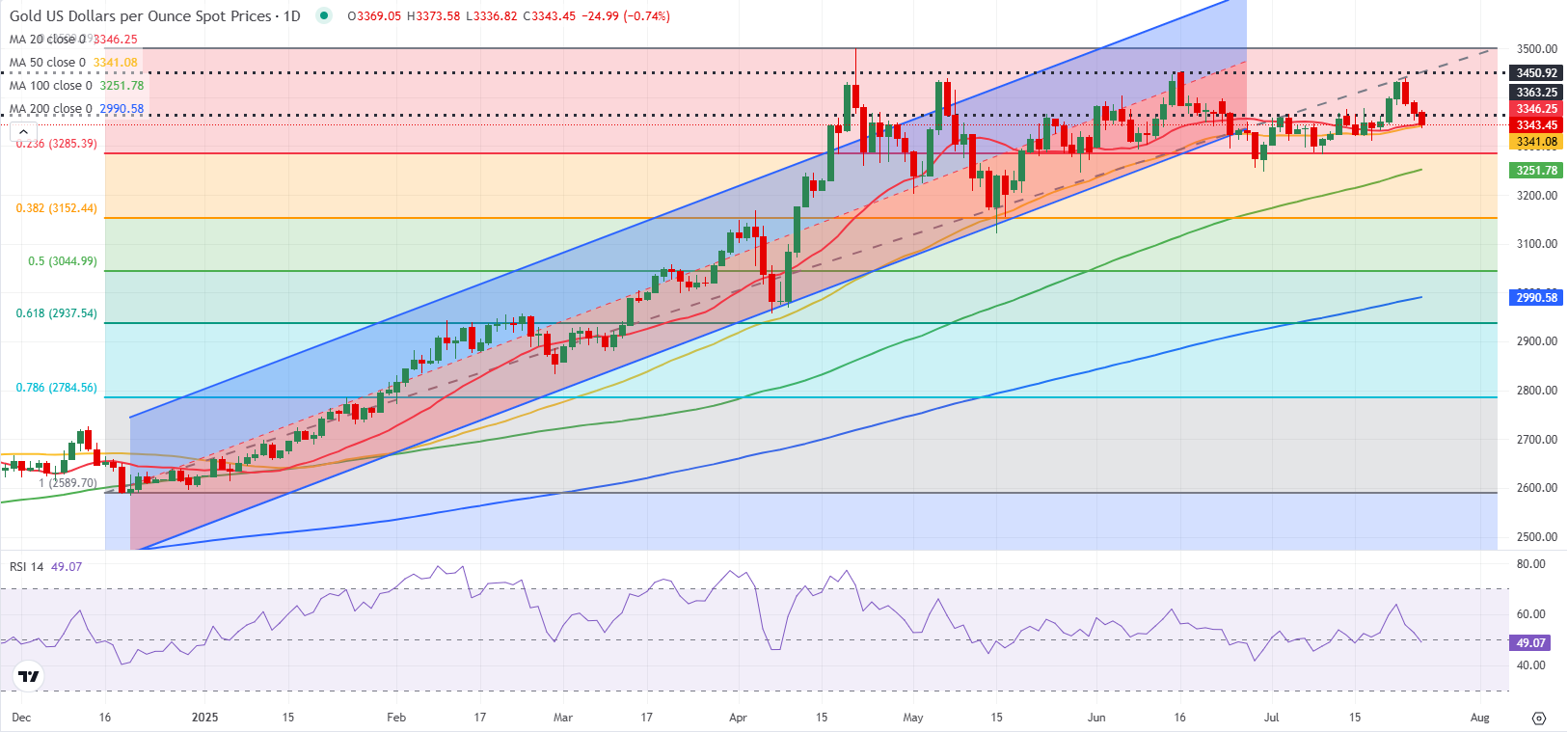
The near-term technical outlook highlights buyers’ hesitancy. The Relative Strength Index (RSI) indicator on the daily chart stays slightly below 50, and XAU/USD struggles to pull away from the 20-day and the 50-day Simple Moving Averages (SMAs) after clearing these levels earlier in the week.
On the upside, $3,400 (static level, round level) aligns as an interim resistance before $3,450 (static level) and $3,500 (all-time high, end-point of the January-June uptrend).
If Gold confirms $3,340 (20-day SMA, 50-day SMA) as resistance, technical sellers could remain interested. In this scenario, $3,285 (Fibonacci 23.6% retracement) could be seen as the next support level ahead of $3,250 (100-day SMA) and $3,150 (Fibonacci 38.2% retracement).
Gold FAQs
Gold has played a key role in human’s history as it has been widely used as a store of value and medium of exchange. Currently, apart from its shine and usage for jewelry, the precious metal is widely seen as a safe-haven asset, meaning that it is considered a good investment during turbulent times. Gold is also widely seen as a hedge against inflation and against depreciating currencies as it doesn’t rely on any specific issuer or government.
Central banks are the biggest Gold holders. In their aim to support their currencies in turbulent times, central banks tend to diversify their reserves and buy Gold to improve the perceived strength of the economy and the currency. High Gold reserves can be a source of trust for a country’s solvency. Central banks added 1,136 tonnes of Gold worth around $70 billion to their reserves in 2022, according to data from the World Gold Council. This is the highest yearly purchase since records began. Central banks from emerging economies such as China, India and Turkey are quickly increasing their Gold reserves.
Gold has an inverse correlation with the US Dollar and US Treasuries, which are both major reserve and safe-haven assets. When the Dollar depreciates, Gold tends to rise, enabling investors and central banks to diversify their assets in turbulent times. Gold is also inversely correlated with risk assets. A rally in the stock market tends to weaken Gold price, while sell-offs in riskier markets tend to favor the precious metal.
The price can move due to a wide range of factors. Geopolitical instability or fears of a deep recession can quickly make Gold price escalate due to its safe-haven status. As a yield-less asset, Gold tends to rise with lower interest rates, while higher cost of money usually weighs down on the yellow metal. Still, most moves depend on how the US Dollar (USD) behaves as the asset is priced in dollars (XAU/USD). A strong Dollar tends to keep the price of Gold controlled, whereas a weaker Dollar is likely to push Gold prices up.
Author

Eren Sengezer
FXStreet
As an economist at heart, Eren Sengezer specializes in the assessment of the short-term and long-term impacts of macroeconomic data, central bank policies and political developments on financial assets.