Gold trade idea analysis: A strong market, but not a clean trade yet

Gold is at an important decision point
Gold is trading around the $4,146–$4,148 area, which leaves it in a slightly uncomfortable position from a trade idea perspective. The market has bounced from the $3,900–$4,000 support zone, so there is clearly some demand lower down. At the same time, price is still sitting below major daily and weekly resistance, which means the recovery has not yet become a confirmed bullish reversal.
That makes gold interesting, but not clean.
The current setup is not strong enough to justify chasing a long position, but it is also not weak enough to justify selling aggressively at current levels. The better approach is to treat gold as a conditional trade idea. The next high-quality opportunity is likely to come from how price reacts around the $4,240–$4,360 area.
If gold breaks and holds above that zone, the bullish case becomes much stronger. If it rejects that area and loses $4,070, the bearish case starts to look more attractive.
Fundamental backdrop
Gold remains heavily tied to the direction of the US dollar, Treasury yields, real yields, inflation expectations, and Federal Reserve policy. That has not changed.
A weaker dollar and falling real yields would support gold, especially if markets begin to price a more dovish Federal Reserve. Gold does not pay a yield, so when real yields fall, the opportunity cost of holding it becomes less painful. That is usually a more favourable environment for gold buyers.
The opposite is also true. If US inflation stays sticky, Treasury yields rise, and the dollar strengthens, gold may struggle to build on the recent bounce. A stronger dollar would make gold more expensive for non-US buyers, while higher yields would reduce the appeal of holding a non-yielding asset.
There is also the safe-haven element. Geopolitical risk, fiscal concerns, central bank reserve diversification, and wider concerns around currency debasement can all support gold over the longer term. These themes give gold a structural bid, but they do not remove the need for good timing. A strong long-term story can still produce poor short-term entries if price is sitting below major resistance.
At the moment, the fundamentals are supportive enough to keep gold on the watchlist, but not strong enough on their own to override the technical resistance sitting just above current price.
Sentiment view
Sentiment has improved from the lows, but it is not yet convincingly bullish.
The bounce from the $3,900–$4,000 area suggests sellers are no longer fully in control. Daily momentum has also improved, with RSI recovering to around 45 and moving above its RSI-based moving average. That tells us the short-term picture is stabilising.
The weekly chart is less convincing. Weekly RSI remains around 40, still below its own moving average near 48. That is not a strong momentum profile. It suggests gold is recovering, but not yet leading.
This is the main reason the trade idea needs patience. If sentiment were washed out and price were reclaiming major resistance, the long case would be more attractive. If sentiment were euphoric and price were failing hard, the short case would be clearer. Right now, sentiment is somewhere in the middle.
Gold is no longer deeply weak, but it has not regained full control either.
Technical structure
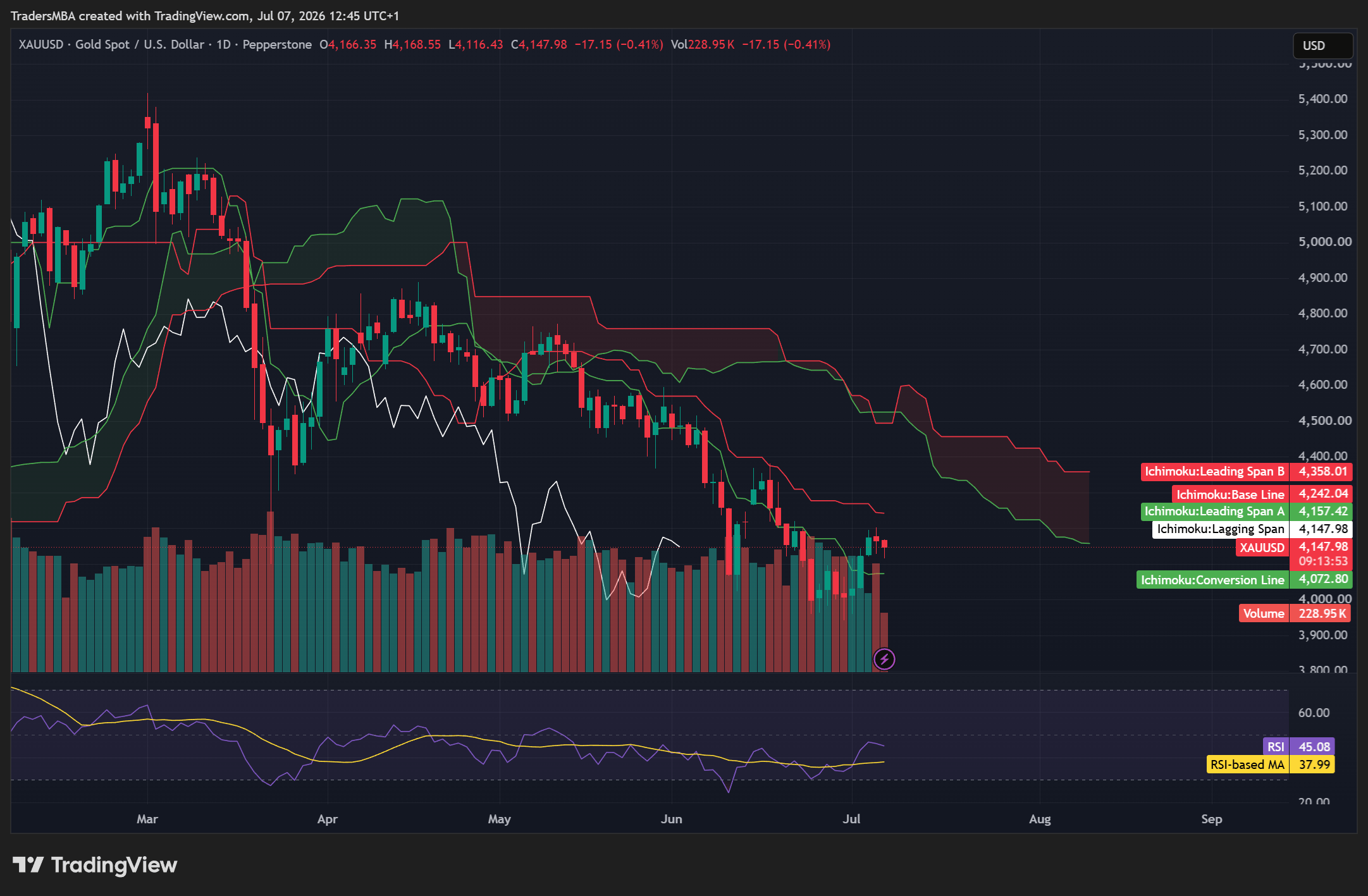
The daily chart shows a recovery attempt, but the market is still trading inside a broader corrective structure.
Gold is slightly above the daily Ichimoku Conversion Line near $4,072, which is a short-term positive. However, price is still below the more important resistance levels above.
The first key area is around $4,158–$4,160, where price is close to the daily cloud boundary. Above that, the daily Base Line sits around $4,242. Then comes the more important resistance zone near $4,350–$4,360, which also lines up with the weekly Conversion Line.
That makes $4,240–$4,360 the main decision zone.
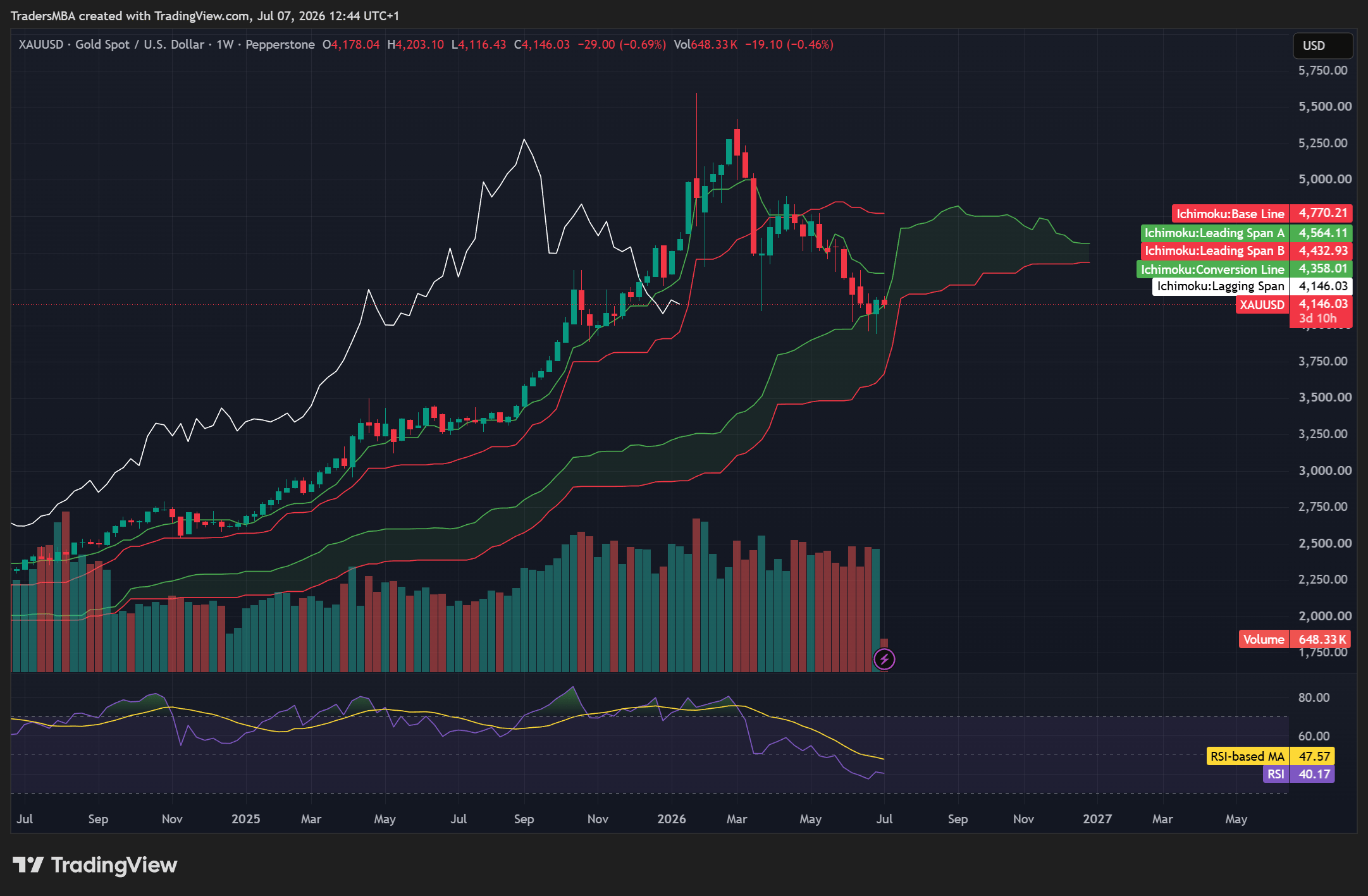
The weekly chart is still the concern. Gold has corrected sharply from the previous peak around $5,300–$5,500 and remains below the key weekly Ichimoku levels. Weekly resistance sits around $4,358, then $4,433, then $4,564, with the weekly Base Line much higher near $4,770.
This means gold has a lot of work to do before the medium-term structure turns bullish again.
The important levels are clear:
Support
- $4,070–$4,080
- $4,000
- $3,900–$3,950
- $3,750–$3,800
Resistance
- $4,158–$4,160
- $4,240–$4,250
- $4,350–$4,360
- $4,430–$4,565
- $4,770
- $5,000
Gold is currently between support and resistance. That is rarely the best place to force a trade.
The bullish case
The bullish case is simple: gold may have already formed a base around $3,900–$4,000, and the recent recovery could be the early stage of a broader rebound.
For that view to become more convincing, gold needs to reclaim $4,240 first, then hold above $4,350–$4,360. A daily close above that upper zone would show that buyers are starting to absorb resistance. A weekly close above it would be even more important.
The bullish case would be helped by a softer US dollar, falling real yields, weaker inflation data, dovish Fed communication, stronger ETF flows, or a rise in safe-haven demand.
If gold confirms the breakout, the next upside areas would be $4,430–$4,565, then $4,770. Beyond that, $5,000 becomes the obvious psychological level, but gold would need stronger momentum and better macro support to justify that move.
The issue is that the market has not done enough yet. Buying before confirmation means buying into resistance, not after resistance has been cleared.
The bearish case
The bearish case is also still valid.
Gold remains below major weekly resistance, weekly momentum is weak, and the recovery could still be nothing more than a relief rally inside a correction. If price fails around $4,240–$4,360, that would suggest sellers are still active at higher levels.
A break back below $4,070 would weaken the recovery. Below $4,000, pressure would likely build again. The bigger bearish confirmation would come below $3,900, because that would damage the recent base and open the door towards $3,750–$3,800.
The bearish case would be strengthened by a stronger US dollar, rising Treasury yields, higher real yields, hawkish Fed language, weaker investment flows, or fading geopolitical risk premium.
The problem with shorting gold here is that price has already bounced from support. There is no clean rejection yet. Selling into a recovering market without confirmation gives a weaker risk-reward profile.
Catalysts to watch
The next move in gold is likely to depend on a combination of macro data and technical confirmation.
The biggest catalyst is US inflation. Softer inflation would likely support gold by reducing pressure on yields and making it easier for markets to price future rate cuts. Hotter inflation would be more negative, especially if it pushes yields and the dollar higher.
Federal Reserve communication also matters. Any shift towards a softer policy tone would support gold. A more cautious or hawkish Fed would make it harder for gold to break resistance.
The US dollar remains critical. A weakening dollar would improve the bullish case. A stronger dollar would make the $4,240–$4,360 zone more difficult to clear.
Treasury yields and real yields are just as important. Gold needs yields to stay contained. If real yields push higher, the current recovery could stall quickly.
Geopolitical risk is the wildcard. Any escalation in global tensions could increase safe-haven demand, but the price still needs to confirm that demand on the chart.
ETF and institutional flows should also be watched. A stronger gold rally needs real participation, not just a short-term bounce.
The cleanest catalyst, though, is price itself. Gold needs to either break above $4,240–$4,360 or reject that zone and lose $4,070. Until one of those happens, the setup remains unfinished.
Trade idea assessment
Directional bias
Neutral for now, with a slight bearish-to-neutral medium-term bias while gold remains below $4,240–$4,360.
Best current classification
Watchlist idea, not a confirmed trade.
Long trigger
A daily close above $4,240, with stronger confirmation above $4,350–$4,360.
Long invalidation
Failure back below $4,070–$4,080, especially after a breakout attempt.
Long targets
$4,430–$4,565, then $4,770 if momentum improves.
Short trigger
Rejection from $4,240–$4,360, followed by a move below $4,070.
Short invalidation
A sustained break above $4,360.
Short targets
$4,000, then $3,900–$3,950. A break below $3,900 would expose $3,750–$3,800.
Risk-reward quality
Moderate at current price. Better after confirmation.
Trade quality score
58/100
The score is not low because gold has clear levels, a strong macro story, and an improving short-term structure. It is not higher because the market is still below major resistance and the weekly chart remains weak.
Final view
Gold is a good market to monitor, but not yet a high-quality trade at current levels.
The long-term case for gold still has support from macro uncertainty, safe-haven demand, inflation concerns, and central bank reserve diversification. The short-term chart has also improved after the rebound from $3,900–$4,000.
However, the technical picture is not clean enough to call this a confirmed long. Gold remains below major daily and weekly Ichimoku resistance, and the weekly momentum profile is still weak.
It is also not a clean short. The market has already bounced from support, daily momentum has improved, and selling without a rejection signal would be premature.
The best trade idea is conditional.
Gold becomes more attractive on the long side if it breaks and holds above $4,240–$4,360. Gold becomes more attractive on the short side if it rejects that same zone and breaks back below $4,070, with stronger confirmation below $3,900.
For now, the highest-quality decision is patience. Gold is setting up, but it has not triggered yet.
Author

Sachin Kotecha
International Trading Institute (ITI)
Sachin Kotecha is a multi-asset trader, Professor at the International Trading Institute, and creator of institutional trading frameworks, macroeconomic intelligence platforms, and professional trading education programmes.