|

Gold stumbles from recent highs

Executive summary

  • Trend bias: Gold (XAUUSD) appears to be in the beginning stages of wave ((c)) lower.
  • Key levels: Slight bounce to $5,258 possible, but bearish down to $4,402.
  • Bearish view while price holds below $5,410.

Gold has trended higher since finding a low on February 2. The conflict in the middle east hasn’t appeared to move gold higher. As we’ll see, the pattern has developed into a bearish structure.

Current Elliott Wave analysis
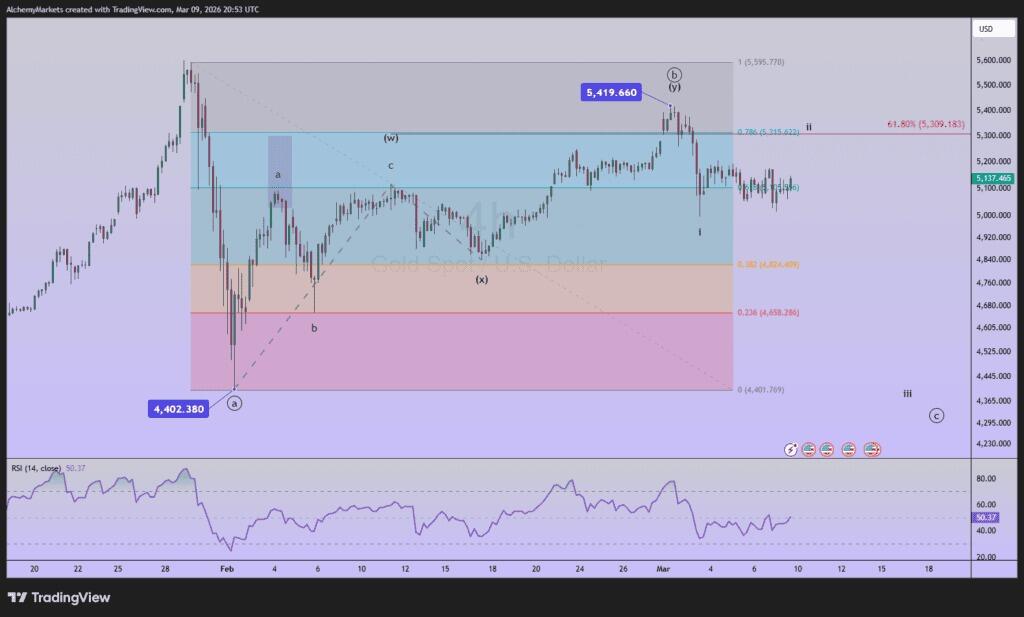
Gold has been in rally mode since finding a low on February 2. The rally has taken the structure of a corrective bounce in Elliott wave terms. This means the rally is likely to be retraced in the coming months.

The current Elliott wave count we are following is that wave ((b)) of a larger zigzag decline topped on March 2. Next, would be a decline in wave ((c)) of the zigzag.

We know from our Elliott wave studies that C-waves tend to be 5-wave motive structures, unless it is the C-wave of a triangle. We can’t say for sure if this is a triangle, so I’m leaning towards this structure as a larger bearish zigzag.

It appears wave (i) of ((c)) is complete and the sideways range since March 3 is wave (ii).

Gold prices may bump slightly higher to $5258, the 61.8% Fibonacci retracement of wave (i), but it doesn’t have to.

Once wave (ii) exhausts, the wave (iii) would push gold lower to retest $4,400 and possibly lower levels.

Our previous forecast on February 3 essentially worked out, though the rally was slightly higher than anticipated. The top end of our forecasted rally was $5,316 and gold prices reached $5,419.

The next decline for gold should be more aggressive as it would be a third wave or C-wave.

Bottom line

Gold appears to be declining in wave ((c)) of a larger bearish zigzag. Though a near-term bounce to $5258 cannot be ruled out, the larger trend appears to be pointed lower to retest supportat $4,402.

If gold prices rally above $5,419, then we’ll reconsider alternative wave counts.

Author

Zorrays Junaid

Zorrays Junaid

Alchemy Markets

Zorrays Junaid has extensive combined experience in the financial markets as a portfolio manager and trading coach. More recently, he is an Analyst with Alchemy Markets, and has contributed to DailyFX and Elliott Wave Forecast in the past.


More from Zorrays Junaid
Share:

Editor's Picks

AUD/USD stabilizes above two-week low/0.6950 as traders await US election results

AUD/USD edges higher in the Asian session on Wednesday, recovering slightly from a two-week low touched on a less hawkish RBA reaction the previous day. Hopes for Iran diplomacy undermine the safe-haven US Dollar and support the currency pair, though the upside remains capped as traders await US midterm election results.

USD/JPY retreats from three-week top, slips below 158.50 amid intervention risks and softer USD

USD/JPY slides below 158.50 in the Asian session on Wednesday, snapping a two-day winning streak to hit a near three-week high the previous day, as intervention risks support the Japanese Yen. Meanwhile, the US Dollar remains on the back foot amid hopes for Iran diplomacy, further weighing on the currency pair as traders brace for some volatility surrounding US midterm election results.


Gold consolidates below $3,950 as Fed hike bets counter softer USD ahead of US election results

Gold struggles to capitalize on the previous day's bounce from sub-$3,900 levels, oscillating in a range during the Asian session on Wednesday as traders brace for short-term market volatility surrounding US midterm election results. Meanwhile, hopes for Iran diplomacy weigh on the safe-haven US Dollar and support bullion, though upside remains capped amid Fed rate hike bets.

Ethereum: US-led selling keeps ETH below $2,309 realized price
Ethereum (ETH) faces pressure near $2,300 on Tuesday as it struggles to recover its realized price. The top altcoin fell below its realized price, or investors' average on-chain cost basis, at $2,309 following the $6.3 billion Binance hack last Thursday.
US Midterms: Can Wall Street rally despite AI debt and credit risks?
Political uncertainty may be coming to an end, but the real question for investors is whether the technology sector can sustain its enormous spending commitments. The US midterm elections are arriving at an interesting moment for financial markets.
The 2% inflation target came from a throwaway remark. It now moves trillions
The Federal Reserve's 2% inflation goal grew out of an off-the-cuff remark by a New Zealand politician in 1988. Bond investors still price long-term US debt as if 2% holds, so a change in how the Fed measures inflation would move markets.