Gold remains firm as PCE data and Fed signals set the next direction

Gold (XAU/USD) continues to hold near recent highs as price consolidates after its strong advance. Weakness in the US Dollar and reduced expectations for a Federal Reserve rate hike continue to support the precious metal. Lower Oil prices have eased inflation concerns, while US-Canada trade tensions have added to market uncertainty. Strong physical demand from India and the US Treasury’s expanded bond-buyback plan provide additional support. Markets will now focus on US inflation data and Federal Reserve signals for the next direction.
Gold remains firm as Dollar weakness and Fed expectations support demand
Gold is consolidating near recent highs after its strong advance. Weakness in the US Dollar continues to support the precious metal. Improving risk sentiment has lowered demand for the US Dollar as a safe-haven asset. Developments around the Strait of Hormuz have also pushed Oil prices lower. Lower energy prices have eased concerns about persistent inflation and reduced expectations for a Federal Reserve rate hike. These conditions could help gold maintain its strength near current levels.
Trade tensions between the United States and Canada have added another layer of uncertainty. Canada plans to impose new tariffs on a wide range of US products in response to American trade measures. Concerns about prolonged trade disputes could continue to weigh on confidence in the US currency. Gold also receives support from the US Treasury’s expanded bond-buyback plan. Strong physical demand from India provides another positive factor. World Gold Council data showed that Indian gold imports increased significantly in July after two weaker months.
Markets will now focus on the US core Personal Consumption Expenditures Price Index. The Federal Reserve closely watches this inflation measure when assessing monetary policy. Softer inflation could reduce expectations for higher interest rates and place additional pressure on Treasury yields and the US Dollar. This could provide further support for gold. Stronger inflation could produce the opposite reaction and increase expectations for tighter monetary policy. Attention will then shift toward Federal Reserve Chair Kevin Warsh’s speech at the Jackson hole symposium for further guidance on the interest-rate outlook.
Gold technical analysis: XAU/USD holds above key breakout levels
The gold chart below shows a major resistance trendline that limited price gains for several months. Gold remained below this trendline while forming several rounded bottoms near support. These formations helped establish a stronger base as price repeatedly held the lower area. Gold later gained strength and advanced toward the resistance trendline.
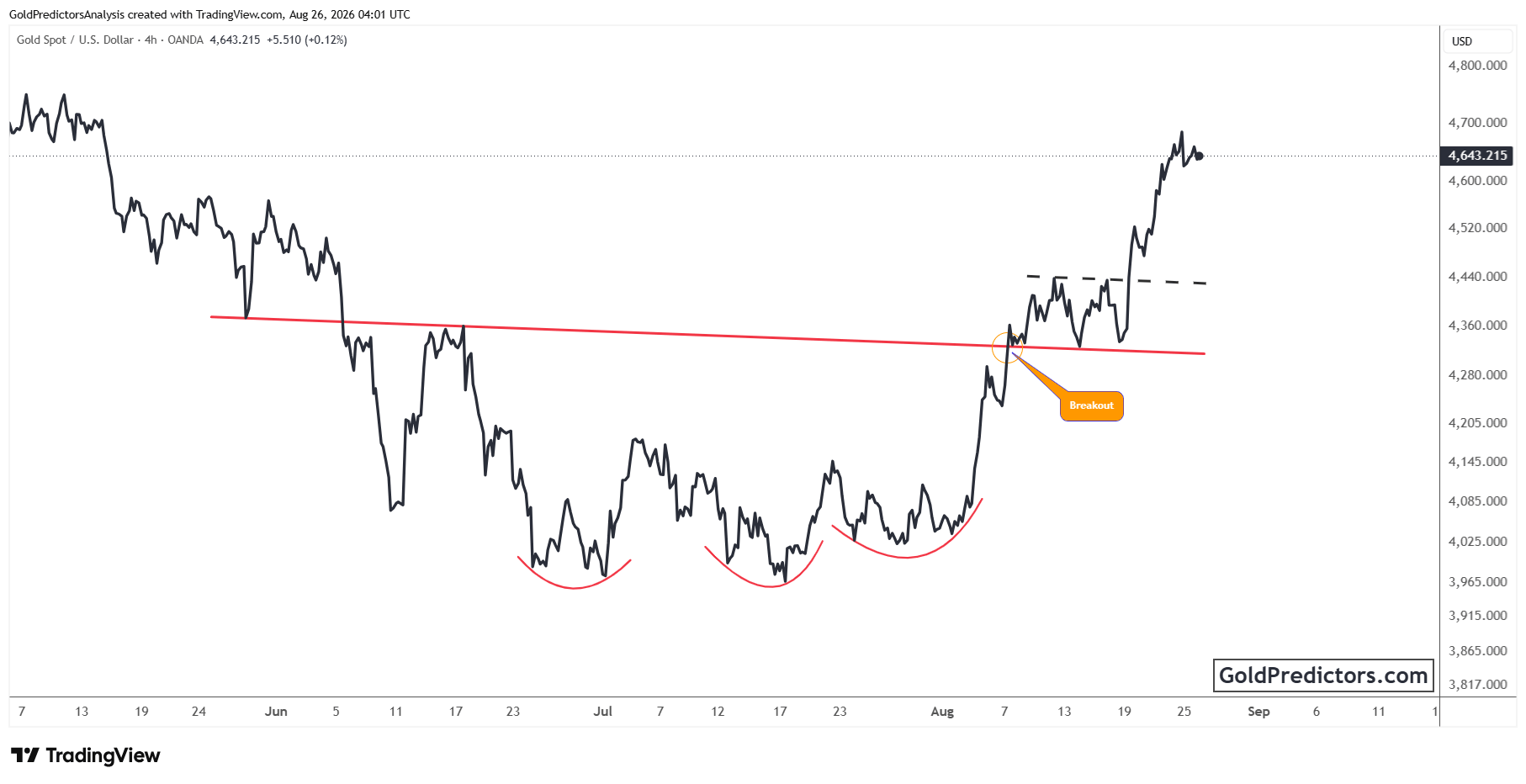
Gold eventually broke through this resistance near the $4,330 region. This breakout marked an important change in the technical structure. Price held above the broken resistance and continued to strengthen. Gold later moved through another resistance area near $4,440. The strong advance above both resistance levels confirmed growing momentum and opened the way for further gains.
The latest advance pushed gold toward the $4,690 region before price turned lower. Despite this decline, gold remains well above the former resistance trendline and keeps the breakout structure intact. The $4,440 area could provide initial support if weakness continues. A deeper decline could bring the broken resistance trendline back into focus. However, holding above these key support areas could help gold regain strength and challenge the recent high.
Gold outlook: US inflation data and Fed signals could set the next move
Gold continues to show strength as weakness in the US Dollar and lower rate hike expectations support prices. Lower Oil prices have eased inflation concerns, while trade tensions and strong physical demand provide further support. The technical structure remains firm as gold holds above its former resistance areas. The $4,440 region could provide initial support if weakness continues. Markets will now focus on US inflation data and Federal Reserve signals for the next direction.
Unlock exclusive gold and silver trading signals and updates that most investors don’t see. Join our free newsletter now!
Author

Muhammad Umair, PhD
Gold Predictors
Muhammad Umair is a financial markets analyst and investor who focuses on the forex and precious metals markets.
















