|

Gold regains traction after Tuesday's drop, larger bullish structure intact above $5,000

Gold price edged higher on Wednesday (up 1.6% in Asian / European trading) after falling over 4% on Tuesday.

Stronger US dollar on increased safe-haven demand and fading prospects of Fed rate cuts, pressured yellow metal, although Wednesday’s recovery, which retraced around 50% of the previous day’s drop, suggests that losses are likely to be short-lived.

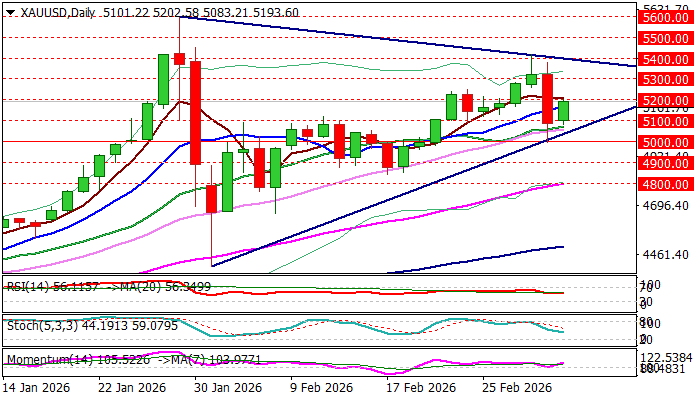
Psychological $5000 support (reinforced by daily Kijun-sen) contained Tuesday’s drop, pointing to a healthy correction of the upleg from $4402 (Feb 2 low) and keeping larger bulls in play.

Gold is expected to continue to shine as geopolitical situation (one of metal’s key drivers) remains very fragile with threats of further escalation.

In such scenario, global uncertainty is expected to deepen and further fuel safe-haven demand from the central banks, as well as individual and institutional investors.

Technical picture on daily chart has improved as MA’s returned to full bullish configuration, positive momentum strengthens and the price action remains underpinned by the daily cloud.

However, bulls need to clear significant barriers at $5200 zone (psychological / daily Tenkan-sen / 50% retracement of $5419/$4996 bear-leg), to confirm fresh bullish signal and shift near-term focus towards next targets at $5257 (Fibo 61.8%), $5300/19 (psychological / Fibo 76.4%) and $5400/19 (psychological / daily triangle upper boundary / Monday’s peak).

Broken ascending 10DMA offers immediate support at $5170, ahead of $5100 (session low / psychological), $5048 (trendline support), guarding $5000 breakpoint.

Res: 5207; 5257; 5319; 5400

Sup: 5170; 5100; 5048; 5000
Author

Slobodan Drvenica

Slobodan Drvenica

Windsor Brokers

Industry veteran with over 22 years’ experience, Slobodan Drvenica joined Windsor Brokers in 1995 when he was an active trader for more than 10 years, managing the trading desk and own account departments.


More from Slobodan Drvenica
Share:

Editor's Picks

AUD/USD stabilizes above two-week low/0.6950 as traders await US election results

AUD/USD edges higher in the Asian session on Wednesday, recovering slightly from a two-week low touched on a less hawkish RBA reaction the previous day. Hopes for Iran diplomacy undermine the safe-haven US Dollar and support the currency pair, though the upside remains capped as traders await US midterm election results.

USD/JPY retreats from three-week top, slips below 158.50 amid intervention risks and softer USD

USD/JPY slides below 158.50 in the Asian session on Wednesday, snapping a two-day winning streak to hit a near three-week high the previous day, as intervention risks support the Japanese Yen. Meanwhile, the US Dollar remains on the back foot amid hopes for Iran diplomacy, further weighing on the currency pair as traders brace for some volatility surrounding US midterm election results.


Gold consolidates below $3,950 as Fed hike bets counter softer USD ahead of US election results

Gold struggles to capitalize on the previous day's bounce from sub-$3,900 levels, oscillating in a range during the Asian session on Wednesday as traders brace for short-term market volatility surrounding US midterm election results. Meanwhile, hopes for Iran diplomacy weigh on the safe-haven US Dollar and support bullion, though upside remains capped amid Fed rate hike bets.

Ethereum: US-led selling keeps ETH below $2,309 realized price
Ethereum (ETH) faces pressure near $2,300 on Tuesday as it struggles to recover its realized price. The top altcoin fell below its realized price, or investors' average on-chain cost basis, at $2,309 following the $6.3 billion Binance hack last Thursday.
US Midterms: Can Wall Street rally despite AI debt and credit risks?
Political uncertainty may be coming to an end, but the real question for investors is whether the technology sector can sustain its enormous spending commitments. The US midterm elections are arriving at an interesting moment for financial markets.
The 2% inflation target came from a throwaway remark. It now moves trillions
The Federal Reserve's 2% inflation goal grew out of an off-the-cuff remark by a New Zealand politician in 1988. Bond investors still price long-term US debt as if 2% holds, so a change in how the Fed measures inflation would move markets.