Gold prices stabilize as US credit downgrade and trade tensions fuel market uncertainty

Gold prices are attempting a recovery following last week's losses. Traders are now focused on developments around the US economy, including statements from the Federal Reserve and fresh trade negotiations. Amid these uncertainties, Gold is caught between safe-haven demand and pressure from rising yields. This article explores the key fundamental and technical factors shaping gold's near-term direction.
US credit downgrade sparks safe-haven demand for Gold
Underlying fundamental forces are shaping Gold's cautious optimism. The recent downgrade of the US sovereign credit rating by Moody's has sent a strong signal to global markets. This downgrade, from "Aaa" to "Aa1," is rooted in America's massive $36 trillion debt burden and the rising cost of debt servicing. Uncertainty over President Donald Trump's trade strategies is further complicating the outlook.
The downgrade has weakened the US Dollar and Treasury bonds. This has revived some safe-haven demand for Gold, although that upside remains limited. Rising Treasury yields is fueled by economic concerns, which cap the metal's momentum above the $3,200 level.
Treasury Secretary Scott Bessent escalated trade tensions on Sunday with a tariff warning. He signaled that tariffs could return to earlier levels if trade partners don't negotiate seriously. This threat adds to Gold's support as markets remain uncertain.
Meanwhile, economic data from last week painted a mixed picture. The Producer Price Index (PPI) declined unexpectedly. Retail sales slowed. The Consumer Price Index (CPI) rose less than expected. All these indicators suggest economic weakness, adding to the fiscal concerns.
Any positive updates on upcoming trade deals could hurt gold in the short term. Similarly, hawkish comments from central bank officials could slow gold's recovery. In short, the yellow metal remains exposed to two-way risks.
Technical outlook: Can the ascending trend line sustain the bullish case?
The gold chart below shows a clear ascending trend line that has been respected multiple times since early 2025. Each time the price tested this support line, it bounced back strongly. These contact points suggest the trend line acts as a reliable support level.
Recently, Gold dipped near this line again but managed to recover. The price rebounded just above the $3,100 area, confirming the line's continued relevance. The chart highlights five key touchpoints along this trend, marked with orange circles. This confirms a pattern of higher lows—an essential feature of an uptrend.
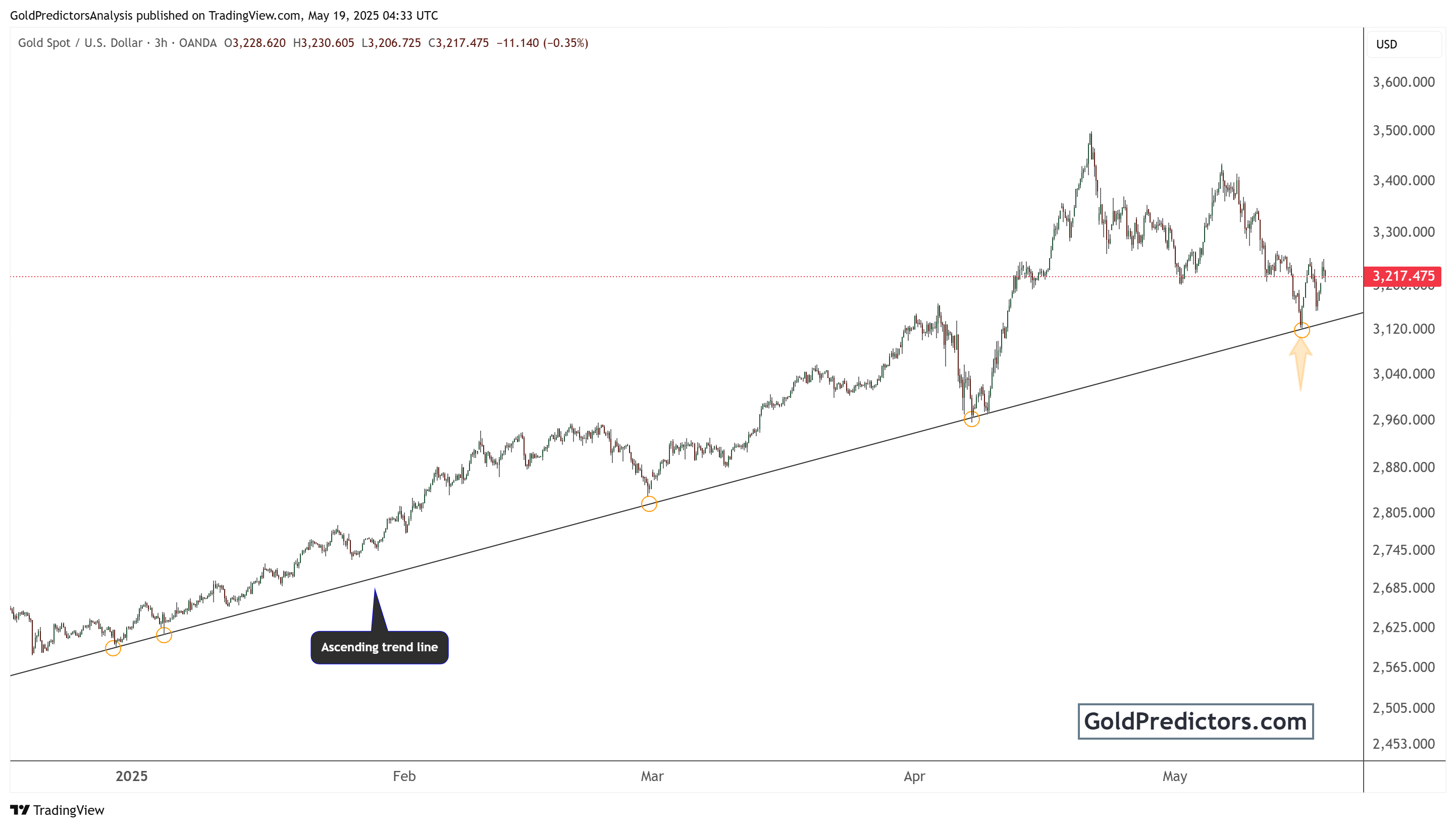
Despite a recent pullback from highs above $3,500, the broader trend remains intact. Price action above $3,200 suggests that bulls are not out of the game yet. However, a sustained move below the trend line could trigger a more significant sell-off.
For now, the price action is consolidating, hinting at indecision. Traders are watching whether gold can hold above this trend line for a fresh upward move. If it fails, it may enter a corrective phase. Until then, the technical outlook favors a bullish bias, as long as the ascending support holds.
Conclusion: Gold faces stability as traders watch key support
In conclusion, gold's near-term direction remains uncertain, influenced by fundamental and technical factors. Fiscal concerns, such as the US credit downgrade and rising Treasury yields, continue to support gold as a safe haven. However, trade developments and hawkish central bank comments could cap its upside. Technically, the price is testing a key support trend line, and as long as it holds, there is potential for a continued upward move. However, failure to sustain this level could lead to a larger correction. The balance of risks suggests a cautious, watchful approach for traders in the coming weeks.
Unlock exclusive gold and silver trading signals and updates that most investors don’t see. Join our free newsletter now!
Unlock exclusive gold and silver trading signals and updates that most investors don’t see. Join our free newsletter now!
Author

Muhammad Umair, PhD
Gold Predictors
Muhammad Umair is a financial markets analyst and investor who focuses on the forex and precious metals markets.

















