Gold Price Forecast: XAUUSD appears a ‘sell the bounce trade', with US NFP ahead
- Gold price remains vulnerable as the daily Relative Strength Index still stays below 50.00.
- The US Dollar retreats from weekly highs as risk tone improves.
- US Treasury yields remain underpinned by the hawkish Fed stance.
- XAUUSD’s road to recovery could be capped by the 21-Daily Moving Average of $1,652.

Gold price is looking to recover further ground from two-month lows of $1,617 but remains on track to record the second straight weekly decline. The US Dollar (USD) has retreated from nine-day highs of 113.15 against its major rivals, as investors resort to profit-taking on their USD longs ahead of the critical Nonfarm Payrolls data from the United States (US). The improving risk tone on the Asian indices, amid a rebound in the Chinese stocks, is adding to the weight on the safe-haven US Dollar. However, investors remain wary, with global central banks going in for super-sized rate hikes to contain inflation, which triggers a widespread recession.
The US Federal Reserve (Fed) said on Wednesday, they see interest rates increasing until inflation is brought down, with the peak rate seen as higher than previously estimated. On Thursday, the Bank of England (BOE) hiked the policy rate by 75 bps but projected that Britain will sink into a deeper recession while adding that rates are likely to rise less than the market’s expectations. All in all, the policy announcements suggest that higher borrowing costs are likely to stay for longer, which could keep any upside attempts in the non-interest-bearing Gold price short-lived.
All eyes on United States Nonfarm Payrolls data
The focus now shifts towards the all-important United States (US) Nonfarm Payrolls data, with the headline figure likely to drop to 200K in October vs. 263K previous. A bigger-than-expected decline in the payrolls is likely to hint at potential smaller rate increases by the Fed in the coming months, as the weak print would revive economic slowdown fears. In such a case, Gold price could extend its rebound. But the upside may likely remain limited, as investors would look out for next Thursday’s US Consumer Price Index (CPI) release for insights on the Fed’s next rate hike move.
Meanwhile, “SPDR Gold TrustGLD, the world's largest gold-backed exchange-traded fund, said its holdings fell 0.82 percent to 911.59 tonnes on Thursday from 919.12 tonnes on Wednesday,” per Reuters. This implies that investors’ sentiment around the XAUUSD price continues to remain bearish.
Gold price technical outlook: Daily chart
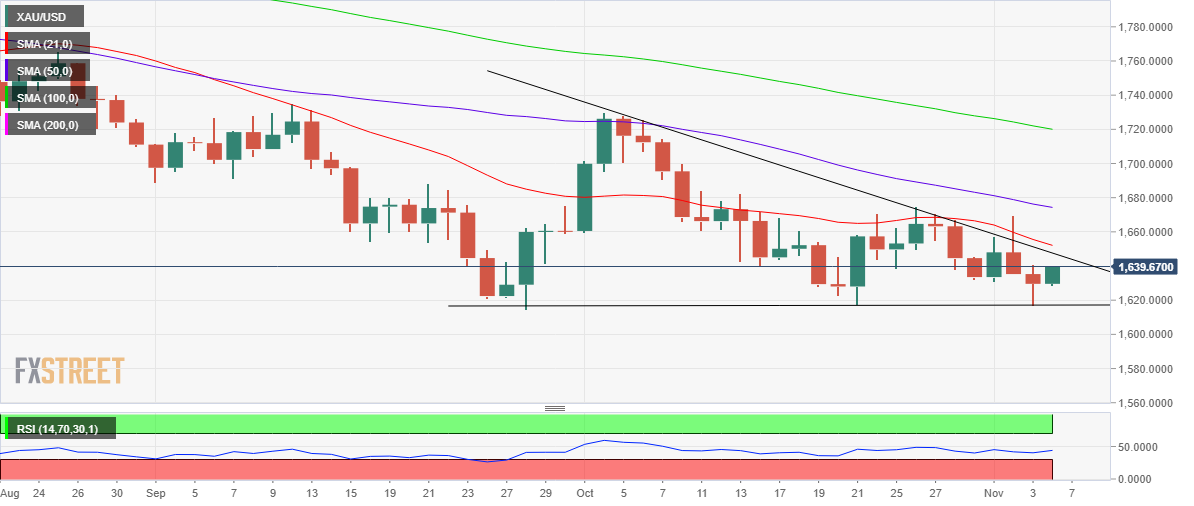
As observed on the daily timeframe, Gold price has charted out a descending triangle formation after peaking out near $1,730 in early October.
XAU bulls have continued to find support around the $1,616 area, making it a tough nut to crack for bears.
With the 14-day Relative Strength Index (RSI), however, lurking below the 50.00 level, risks to the downside remain intact unless the bright metal seeks a daily close above the critical resistance zone around $1,650.
That area is the confluence of the bearish 21-Daily Moving Average (DMA) and the falling trendline (triangle) resistance. Acceptance above the latter will validate a triangle breakout, initiating a fresh uptrend towards the $1,700 mark. Bulls still need to battle the descending 50DMA at $1,674 and the October 13 high of $1,683 on the renewed upside.
Failure to recapture the abovementioned critical resistance around $1,650 would revive the downtrend, with a retest of the two-month lows inevitable. The next significant downside target will align at the $1,600 threshold.
Author

Dhwani Mehta
FXStreet
Residing in Mumbai (India), Dhwani is a Senior Analyst and Manager of the Asian session at FXStreet. She has over 10 years of experience in analyzing and covering the global financial markets, with specialization in Forex and commodities markets.

















