|

Gold Price Forecast: XAU/USD’s technical set up favors bears, a test of $1800 inevitable

  • Gold turns south despite the US dollar’s weakness.
  • Vaccine optimism counters stimulus hopes.
  • Hourly technical set up points to more losses.

Gold (XAU/USD) extends Friday’s bearish momentum into a fresh week this Monday, as the sellers remain in control amid the overall market optimism, thanks to the encouraging covid vaccine rollout news worldwide. Meanwhile, no fresh updates on the likely US $1.9 trillion fiscal stimulus and broad-based US dollar weakness fail to offer any support to the gold bulls. The greenback remains on the back foot amid renewed doubts about the pace of the US economic recovery while investors await fresh cues ahead of the Retail Sales data and the FOMC minutes due later this week.

Amid holiday-thinned light trading, gold traders will also closely follow the performance of the platinum group metals (PGMs). Also, geopolitical tensions in the Middle East could be in focus, as the Saudi-led coalition fighting in Yemen intensifies.

Gold Price Chart - Technical outlook

Gold: Hourly chart
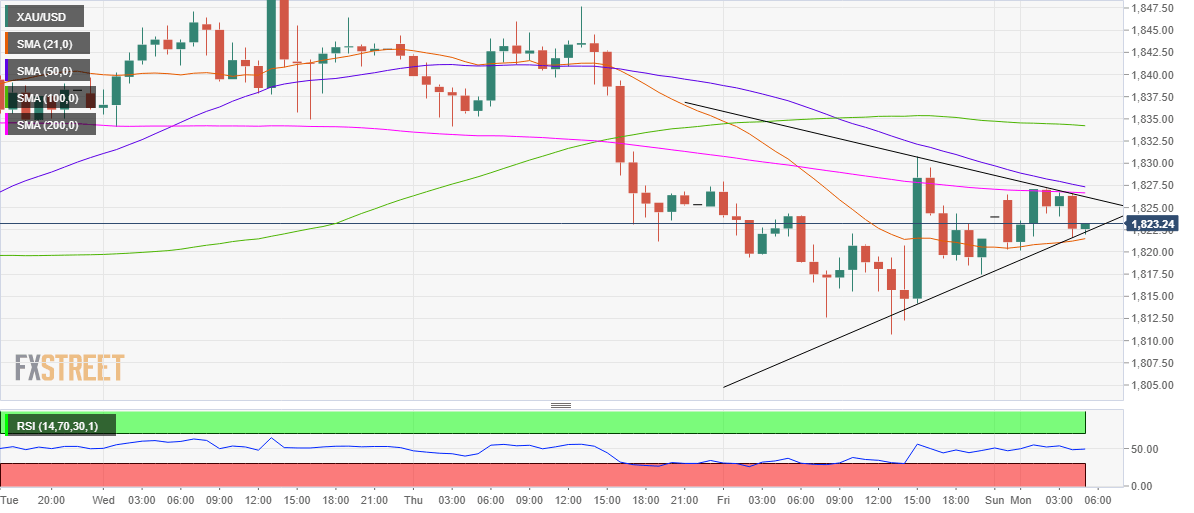
Gold’s hourly chart shows the price is on the verge of a symmetrical triangle breakdown.

An hourly closing below the rising trendline support at $1822 would confirm the downside break. At the level, the horizontal 21-hourly moving average (HMA) coincides.

Therefore, a test of the Feb 8 low of $1808 remains inevitable, below which the January 18 low of $1803 could be challenged.

The relative strength index (RSI) at 48.57 also points to more downside in the offing.

On the flip side, recapturing the powerful barrier at $1827 is critical to reviving the recovery momentum. That level is the confluence of the falling trendline resistance, 200 and 50-HMAs.

The horizontal 100-HMA at $1834 is the next relevant upside target for the XAU bulls.

Author

Dhwani Mehta

Dhwani Mehta

FXStreet

Residing in Mumbai (India), Dhwani is a Senior Analyst and Manager of the Asian session at FXStreet. She has over 10 years of experience in analyzing and covering the global financial markets, with specialization in Forex and commodities markets.


More from Dhwani Mehta
Share:

Editor's Picks

AUD/USD turns south toward 0.6900 as USD firms up

AUD/USD sees fresh selling and drops toward 0.6900 in late Asian trading on Monday, as renewed US Dollar strength weighs on the pair amid lingering Middle East and Russia-Ukraine geopolitical tensions. Focus remains on Oil prices, Treasury bond yields, and RBA expectations for fresh trading impetus in the major.

USD/JPY retakes 158.00 amid hawkish BoJ bets, firmer USD

USD/JPY erases losses and retakes 158.00 in the Asian session on Monday, trading within a one-week-old range. Geopolitical uncertainty continues to underpin the US Dollar, despite fading Fed rate hike hopes, supporting the pair's rebound. However, further upside could be capped by hawkish BoJ expectations and looming intervention risks that could support the Japanese Yen.

Gold trades flat as stronger US Dollar offsets easing Fed rate-hike bets

Gold trades little changed on Monday after giving back most of its early gains. The metal remains caught between easing Fed interest-rate hike bets and a stronger US Dollar (USD), while US Treasury yields also remain elevated near multi-year highs.

Crypto Today: Bitcoin rally slows while Ethereum and XRP extend recovery amid slowing ETF inflows

Bitcoin is narrowly consolidating while trading above $86,000 at the time of writing on Monday. Altcoins, on the other hand, show a positive outlook, with Ethereum edging higher above $2,700 while Ripple steadies above $1.52.

Eurozone inflation just hit 3.8%, its highest in three years. This chart shows why the ECB can’t simply hike its way out

The ECB would normally have a relatively straightforward answer to inflation running almost twice its target: raise interest rates. But these are not normal circumstances. This time, the bond market is already doing part of the tightening for it, leaving the ECB facing an increasingly difficult dilemma.

Eurozone inflation just hit 3.8%, its highest in three years. This chart shows why the ECB can’t simply hike its way out

The ECB would normally have a relatively straightforward answer to inflation running almost twice its target: raise interest rates. But these are not normal circumstances. This time, the bond market is already doing part of the tightening for it, leaving the ECB facing an increasingly difficult dilemma.














