Gold Price Forecast: XAU/USD’s sustained reccovery hinges on weak US ADP jobs data
- Gold price rebounds from three-week lows near $1,940 on Wednesday.
- Fitch lowers US credit rating, downs the US Dollar alongside the US Treasury bond yields.
- Gold price needs weak US ADP employment data to see a bullish reversal above $1,954.

Gold price is attempting a minor recovery near $1,950, having slumped $20 to hit three-week lows on Tuesday. The United States Dollar (USD) is seeing a pullback from multi-week highs against its major peers, as US Treasury yields also retreat after Fitch lowered the US credit rating.
Weak US ADP Employment Change data to support Gold price rebound
Late Tuesday, ratings agency, Fitch, downgraded the US government's top credit rating to AA+ from AAA, in the face of a potential fiscal deterioration over the next three years. The US Dollar reversed a part of earlier gains and tracked the renewed weakness in the US Treasury bond yields, lending some support to the Gold price early Wednesday.
The Greenback fails to capitalize on the extension of risk-off trades and US Treasury Secretary Janet Yellen’s disagreement with Fitch's downgrade, as bets ramp up for a US Federal Reserve (Fed) rate hike pause later this year amid signs that the US labor market is cooling.
The same was confirmed by Tuesday’s US JOLTS Job Openings data, which fell 34,000 to 9.582 million in June, its lowest level in more than two years. This gauge is closely followed by the Fed, as it is a barometer of the country’s labor market demand.
Further, the US ISM Manufacturing PMI improved below expectations in July, arriving at 46.4 vs. 46.8 expected. The continued contraction in the US manufacturing sector rekindled recession fears and limited the US Dollar decline led by the JOLTS report. Gold price, therefore, remained deep in the red, as the Greenback managed to hold higher ground on Tuesday.
Gold price was also undermined by the World Gold Council’s (WGC) bearish report on Gold trends. The agency said the reduction in central banks’ Gold purchases has fuelled a 2% YoY decline in global gold demand excluding over-the-counter (OTC) in the second quarter of 2023. India's gold demand in 2023 could fall 10% YoY to its lowest in three years, the WGC report said.
Looking ahead, all eyes remain on the United States ADP employment change data, which is likely to show that the US private sector may have added 189K jobs in July, down from a whopping 497k job gains seen in June. Weaker-than-expected US ADP data is likely to add credence to the dovish Fed outlook, lifting Gold price further at the expense of the US Dollar.
The sentiment on Wall Street will also play a pivotal role in the US Dollar valuations, as investors adjust their positions ahead of Thursday’s earnings from Amazon and Apple Inc, as well as heading into Friday’s critical US Nonfarm Payrolls release.
Gold price technical analysis: Daily chart
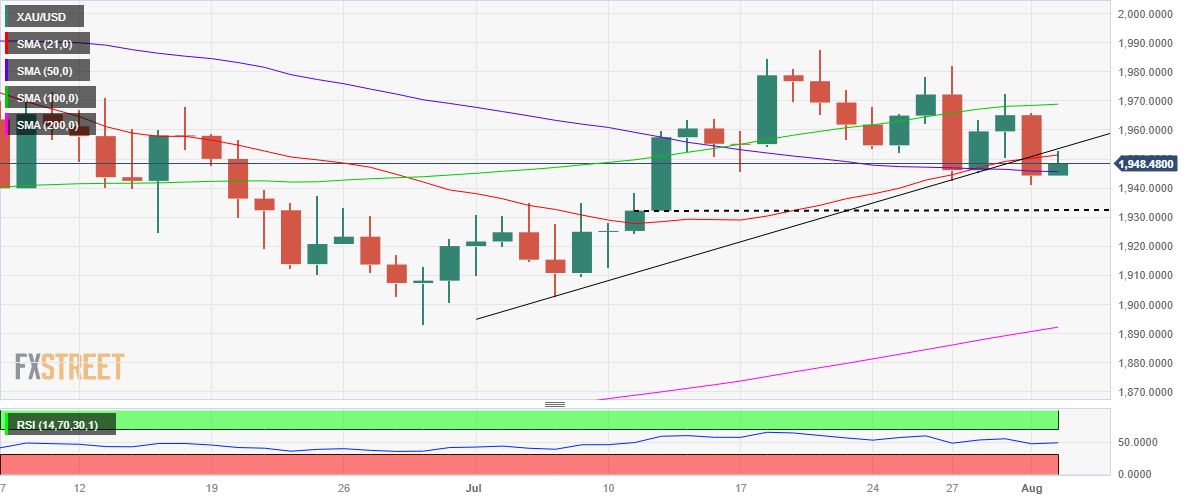
Gold price yielded a daily closing below the critical daily support line, then at $1,951, on Tuesday.
Meanwhile, the 14-day Relative Strength Index (RSI) also flipped bearish, piercing through the midline for the downside.
Therefore, risks appear skewed to the downside for Gold price unless the Gold price recovery finds acceptance above the aforesaid ascending trendline support-turned-resistance, now at $1,954. The bullish 21-Daily Moving Average (DMA) also hangs around at that level, making it a powerful upside hurdle.
Further up, the 100 DMA barrier at $1,969 will offer stiff resistance on the road to recovery. Ahead of that, the $1,960 round figure will challenge bearish commitments.
On the downside, a sustained break below the horizontal 50 DMA support at $1,945 will fuel a fresh sell-off toward the July 12 low of $1,932. The next cushion for Gold price is seen at around the $1,925 static support.
Author

Dhwani Mehta
FXStreet
Residing in Mumbai (India), Dhwani is a Senior Analyst and Manager of the Asian session at FXStreet. She has over 10 years of experience in analyzing and covering the global financial markets, with specialization in Forex and commodities markets.