Gold Price Forecast: XAU/USD trades with caution as Fed’s policy takes centre stage
- Gold price trades cautiously around $4,000 as Fed’s monetary policy looms.
- The Fed is expected to hold interest rates steady on Wednesday.
- A sharp recovery in the US Dollar and Middle East woes continue to keep the Gold price under pressure.

Gold reflects a subdued performance at around $4,000 in the opening session on Tuesday, as financial markets shifty their focus to the Federal Reserve’s (Fed) monetary policy announcement on Wednesday.
Fed seen on hold as RBC flags gradual tightening into 2027
Analysts at Royal Bank of Canada expect the Fed to keep policy steady at this week’s meeting, with the “Federal Reserve … expected to hold the fed funds target range unchanged on Wednesday after hiking for the first time since 2023 in September.”
While the September move marked a resumption of tightening, RBC notes that “FOMC members continue to signal that more hikes will follow, but comments after the last decision suggest a gradual approach.” In terms of the projected path, the bank reiterates that “we expect two 25-basis-point rate hikes ahead before the end of Q1 2027.”
Meanwhile, several factors including Gulf tensions, and a sharp recovery in the US Dollar are keeping the yellow metal under pressure.
According to TD Securities, the recent “combination of waning risk appetite amid a tech selloff, slumping spot gold, and geopolitically-driven petroleum complex price spikes” has prompted money managers to “aggressively cut their exposure in the yellow metal.” The firm adds that “concerns that kinetic military activity in the Persian Gulf region may escalate in the not-too-distant future should continue to keep gold and silver under selling pressure,” reinforcing a cautious near-term backdrop for precious metals positioning.
As of writing, the US Dollar Index (DXY), which gauges the Greenback’s value against six major currencies, holds onto two-day gains marginally above 102.00. Technically, a higher US Dollar makes the Gold price an unfavorable risk-reward bet for investors.
This week, investors will also pay close attention to the preliminary Q3 Gross Domestic Product (GDP) and Personal Consumption Expenditure (PCE) Price Index for September, which are scheduled for Thursday.
US growth seen resilient as Q3 GDP and inflation data loom
According to TD Securities, upcoming US activity data are expected to underscore that the economy “will likely show a resilient economy that can handle more restriction.” The bank anticipates that “Q3 GDP [will] show robust underlying growth, PCE prices [will] reflect elevated inflation, and ECI [will] report manageable wage growth,” pointing to a still-firm macro backdrop despite tighter financial conditions. In terms of the headline growth figures, TD Securities notes that “GDP growth picked up in Q3 to 2.5% from 2.2% previously with underlying activity remaining robust,” broadly in line with other projections that emphasize solid consumption and investment even as some components, such as net exports and inventories, act as modest drags.
Gold Technical Analysis
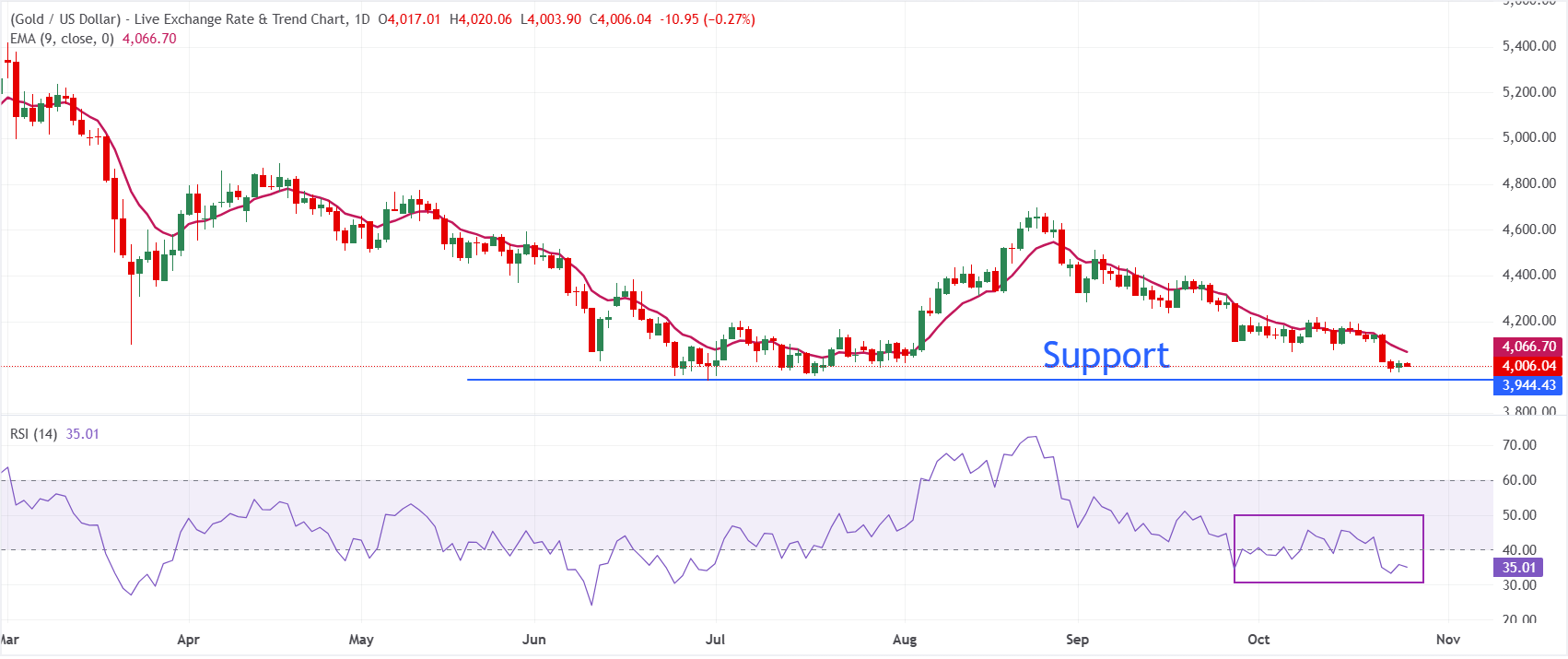
In the daily chart, XAU/USD trades at $4,006.06, keeping a bearish near-term tone as spot remains below the 9-day exponential moving average (EMA) at $4,066.71. Price action continues to retreat from recent highs, and the Relative Strength Index (14) at 35.01 hovers just above oversold territory, suggesting persistent downside pressure rather than an immediate recovery impulse.
On the topside, initial resistance is defined by the 9-day EMA at $4,066.71, which caps any rebound attempts and acts as the first hurdle for a more meaningful corrective bounce. Looking down, the June 30 low at $3,941.76 is the key support level. A decisive break below $3,941.76 could lead to a fresh downside leg.
(The technical analysis of this story was written with the help of an AI tool. Know more.)
Gold FAQs
Gold has played a key role in human’s history as it has been widely used as a store of value and medium of exchange. Currently, apart from its shine and usage for jewelry, the precious metal is widely seen as a safe-haven asset, meaning that it is considered a good investment during turbulent times. Gold is also widely seen as a hedge against inflation and against depreciating currencies as it doesn’t rely on any specific issuer or government.
Central banks are the biggest Gold holders. In their aim to support their currencies in turbulent times, central banks tend to diversify their reserves and buy Gold to improve the perceived strength of the economy and the currency. High Gold reserves can be a source of trust for a country’s solvency. Central banks added 1,136 tonnes of Gold worth around $70 billion to their reserves in 2022, according to data from the World Gold Council. This is the highest yearly purchase since records began. Central banks from emerging economies such as China, India and Turkey are quickly increasing their Gold reserves.
Gold has an inverse correlation with the US Dollar and US Treasuries, which are both major reserve and safe-haven assets. When the Dollar depreciates, Gold tends to rise, enabling investors and central banks to diversify their assets in turbulent times. Gold is also inversely correlated with risk assets. A rally in the stock market tends to weaken Gold price, while sell-offs in riskier markets tend to favor the precious metal.
The price can move due to a wide range of factors. Geopolitical instability or fears of a deep recession can quickly make Gold price escalate due to its safe-haven status. As a yield-less asset, Gold tends to rise with lower interest rates, while higher cost of money usually weighs down on the yellow metal. Still, most moves depend on how the US Dollar (USD) behaves as the asset is priced in dollars (XAU/USD). A strong Dollar tends to keep the price of Gold controlled, whereas a weaker Dollar is likely to push Gold prices up.
Author

Sagar Dua
FXStreet
Sagar Dua is associated with the financial markets from his college days. Along with pursuing post-graduation in Commerce in 2014, he started his markets training with chart analysis.