Gold Price Forecast: XAU/USD tests bearish commitments near $3,350 amid geopolitics, Fed concerns
- Gold rebounds toward $3,350 after hitting 11-day lows despite an improved risk sentiment.
- US Dollar hangs near two-week troughs as focus shifts to US-Ukraine meeting and Fed events.
- Gold buyers face bearish pressures yet again; the $3,350 area appears a tough nut to crack.

Gold is making another run to find acceptance above the key $3,350 supply zone early Monday, after having hit a fresh 11-day low near $3,325 amid looming geopolitical risks.
Gold looks to US-Ukraine talks amid better mood
Geopolitical uncertainty continues to play a pivotal role in driving the haven demand for the traditional store of value, Gold, at the start of a busy week on Monday.
The much-awaited weekend meeting between US President Donald Trump and Russian President Vladimir Putin in Alaska concluded without securing a Ukraine peace deal.
Therefore, all eyes are now turning to a meeting between Trump and his Ukrainian counterpart Volodymyr Zelenskiy on Monday, with a rapid peace deal in sight.
“Zelenskiy is travelling to Washington on Monday for talks that leaders of nations including Germany, the UK and France will now join,” per Reuters.
Despite the looming meeting, markets appear to be in an upbeat mood, capping the further upside in the safe-haven Gold.
Hopes that Trump may lift sanctions on Russia and invest instead, alongside dovish US Federal Reserve (Fed) expectations, keep the broader market sentiment buoyed.
However, risk sentiment could sour if the US-Ukraine talks go south as in the past, likely further boosting Gold’s safe-haven appeal.
Meanwhile, Gold could also face fresh downside risks if the US Dollar (USD) sees a short-covering rally as traders might resort to profit-taking and repositioning ahead of the Minutes of the July Fed meeting and the annual Kansas City Fed’s Jackson Hole Economic Policy Symposium, which will take place Aug. 21-23.
Fed Chairman Jerome Powell is due to speak on Friday at the event, and his speech will be closely scrutinized for clarity on the scope and timing of interest rate cuts beyond the September policy meeting.
Gold price technical analysis: Daily chart
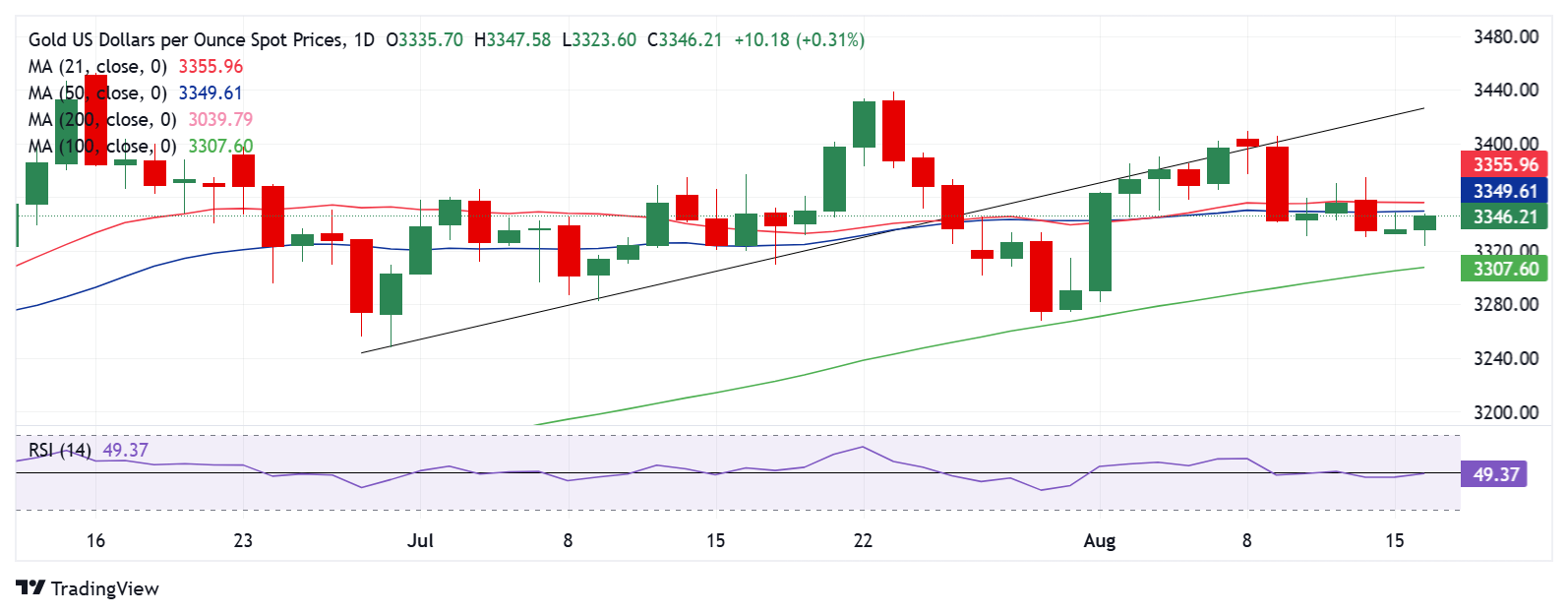
At the time of writing. the daily chart shows a lack of clear direction for Gold, with a mild bias leaning toward sellers as the 14-day Relative Strength Index (RSI) flirts with the 49 level.
Acceptance above the $3,350 confluence zone of the 21-day Simple Moving Average (SMA) and 50-day SMA is critical to resuming the early August recovery.
The next bullish targets are seen at the previous week’s high of $3,375 and the $3,400 round level.
On the flip side, the 100-day Simple Moving Average (SMA) at $3,307 could offer immediate support if the intraday low of $3,324 gives way.
Deeper declines will challenge the July 31 low of $3,274.
Fed FAQs
Monetary policy in the US is shaped by the Federal Reserve (Fed). The Fed has two mandates: to achieve price stability and foster full employment. Its primary tool to achieve these goals is by adjusting interest rates. When prices are rising too quickly and inflation is above the Fed’s 2% target, it raises interest rates, increasing borrowing costs throughout the economy. This results in a stronger US Dollar (USD) as it makes the US a more attractive place for international investors to park their money. When inflation falls below 2% or the Unemployment Rate is too high, the Fed may lower interest rates to encourage borrowing, which weighs on the Greenback.
The Federal Reserve (Fed) holds eight policy meetings a year, where the Federal Open Market Committee (FOMC) assesses economic conditions and makes monetary policy decisions. The FOMC is attended by twelve Fed officials – the seven members of the Board of Governors, the president of the Federal Reserve Bank of New York, and four of the remaining eleven regional Reserve Bank presidents, who serve one-year terms on a rotating basis.
In extreme situations, the Federal Reserve may resort to a policy named Quantitative Easing (QE). QE is the process by which the Fed substantially increases the flow of credit in a stuck financial system. It is a non-standard policy measure used during crises or when inflation is extremely low. It was the Fed’s weapon of choice during the Great Financial Crisis in 2008. It involves the Fed printing more Dollars and using them to buy high grade bonds from financial institutions. QE usually weakens the US Dollar.
Quantitative tightening (QT) is the reverse process of QE, whereby the Federal Reserve stops buying bonds from financial institutions and does not reinvest the principal from the bonds it holds maturing, to purchase new bonds. It is usually positive for the value of the US Dollar.
Author

Dhwani Mehta
FXStreet
Residing in Mumbai (India), Dhwani is a Senior Analyst and Manager of the Asian session at FXStreet. She has over 10 years of experience in analyzing and covering the global financial markets, with specialization in Forex and commodities markets.