Gold Price Forecast: XAU/USD sellers eye $2,300 yet again as new week kicks in
- Gold price licks its wounds early Monday in the aftermath of Friday’s sell-off.
- The US Dollar holds gains amid risk-aversion and subdued US Treasury bond yields.
- Gold price closes the week below 50-day SMA even after the symmetrical triangle breakout.
- The daily RSI drops back below 50 while Bear Cross remains in play. Fedspeak awaited.

Gold price is nursing losses early Monday, having witnessed a more than 1% sell-off on Friday. Gold traders now look forward to a slew of speeches from US Federal Reserve (Fed) policymakers due later on Monday for fresh policy cues and its impact on the US Dollar (USD).
Gold price stays vulnerable ahead of Fedspeak
Persistent US Dollar strength and a sharp upsurge in Palladium price weighed heavily on Gold price last Friday. The Greenback extended its recovery momentum alongside the US Treasury bond yields after the S&P Global preliminary US business activity jumped to a 26-month high. The Composite PMI Output Index that tracks the manufacturing and services sectors rose to the highest level since April 2022 at 54.6 this month. The final reading in May was at 54.5.
Markets’ pricing of a 25 basis points (bps) Fed rate cut in September remained at about 60% after the data release, little changed from late Thursday and at the time of writing, according to CME FedWatch Tool. Renewed signs of US economic resilience gave a boost to the US Dollar at the expense of the Gold price.
Additionally, significant exchange-traded funds (ETF) flows into Palladium drove the white metal sharply higher and reduced the appeal of Gold price as an alternate investment in the precious metals group.
Early Monday, a sense of caution prevails as the US PCE inflation week kicks in and investors still scouting for hints on the Fed’s next interest move while bracing for the outcome of the French elections on Sunday. Also, traders stay unnerved heading into the half-yearly close.
Against this backdrop, investors scurry toward the safe-haven US Dollar, keeping it afloat against its major six currency rivals and the Gold price. It remains to be seen if Gold price extends the downside in the upcoming sessions should the Fed speak send a hawkish message, pushing back against expectations of a September Fed rate cut.
Also, the persisting risk trend and the end-of-the-month flows will play a pivotal role in the Gold price action in the lead-up to Friday’s key US inflation data release.
Gold price technical analysis: Daily chart
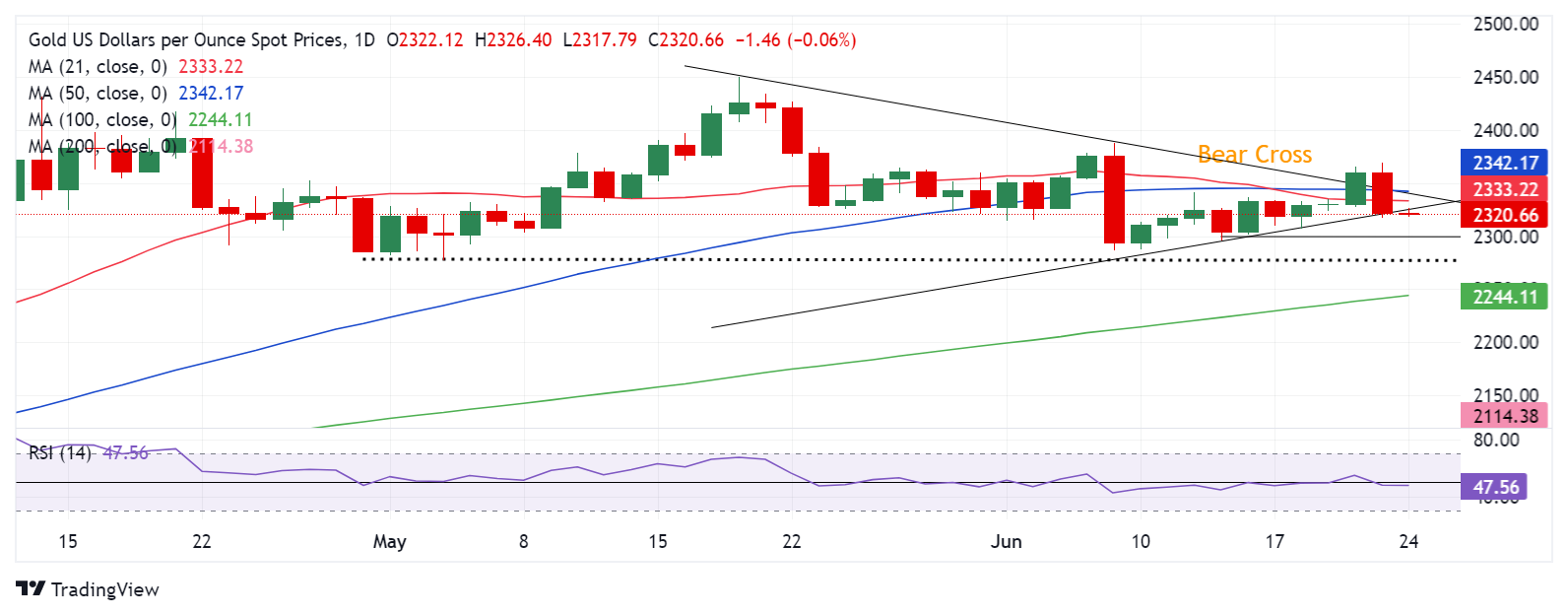
Despite a triangle breakout confirmed last Thursday, Gold price failed to extend the upside break and turned south, yielding a weekly closing below the key 50-day Simple Moving Average (SMA), now at $2,342.
Such a move has revived sellers, now aiming for Gold price to close Monday below the triangle support line at $2,325. Daily closing below that level will lead to the triangle pattern failure.
The 14-day Relative Strength Index (RSI) moved back below the 50 level, currently near 47.50, suggesting that the downside appears more compelling for Gold price.
Further, a Bear Cross validated last week, after the 21-day SMA crossed the 50-day SMA from above on a daily closing basis, remains a cause for concern for buyers.
Gold price needs to reclaim the 50-day SMA at $2,342 to revive the previous week’s recovery momentum.
Further up, the two-week high of $2,366 will be challenged. A sustained move above that level will expose the June 7 high of $2,388.
If sellers flex their muscles then the initial demand area is seen at the $2,310 round level. The next relevant support is seen at the $2,300 threshold.
Acceptance below the latter will put the May 3 low at $2,277 back in the spotlight.
Gold FAQs
Gold has played a key role in human’s history as it has been widely used as a store of value and medium of exchange. Currently, apart from its shine and usage for jewelry, the precious metal is widely seen as a safe-haven asset, meaning that it is considered a good investment during turbulent times. Gold is also widely seen as a hedge against inflation and against depreciating currencies as it doesn’t rely on any specific issuer or government.
Central banks are the biggest Gold holders. In their aim to support their currencies in turbulent times, central banks tend to diversify their reserves and buy Gold to improve the perceived strength of the economy and the currency. High Gold reserves can be a source of trust for a country’s solvency. Central banks added 1,136 tonnes of Gold worth around $70 billion to their reserves in 2022, according to data from the World Gold Council. This is the highest yearly purchase since records began. Central banks from emerging economies such as China, India and Turkey are quickly increasing their Gold reserves.
Gold has an inverse correlation with the US Dollar and US Treasuries, which are both major reserve and safe-haven assets. When the Dollar depreciates, Gold tends to rise, enabling investors and central banks to diversify their assets in turbulent times. Gold is also inversely correlated with risk assets. A rally in the stock market tends to weaken Gold price, while sell-offs in riskier markets tend to favor the precious metal.
The price can move due to a wide range of factors. Geopolitical instability or fears of a deep recession can quickly make Gold price escalate due to its safe-haven status. As a yield-less asset, Gold tends to rise with lower interest rates, while higher cost of money usually weighs down on the yellow metal. Still, most moves depend on how the US Dollar (USD) behaves as the asset is priced in dollars (XAU/USD). A strong Dollar tends to keep the price of Gold controlled, whereas a weaker Dollar is likely to push Gold prices up.
Author

Dhwani Mehta
FXStreet
Residing in Mumbai (India), Dhwani is a Senior Analyst and Manager of the Asian session at FXStreet. She has over 10 years of experience in analyzing and covering the global financial markets, with specialization in Forex and commodities markets.