Gold Price Forecast: XAU/USD seems vulnerable; breakdown below 200-SMA on H4 in play
- Gold price regains some positive traction following the previous day’s slump to a two-week low.
- Strong US PPI-inspired USD recovery falters amid Fed rate cut bets and supports the commodity.
- The upbeat market mood could cap the safe-haven XAU/USD pair ahead of the US macro data.

Gold attracts some dip-buying during the Asian session on Friday and stalls the previous day's retracement slide from the $3,375 region. The US Dollar (USD) struggles to capitalize on Thursday's strong US Producer Price Index (PPI)-inspired recovery move from the vicinity of its lowest level since July 28, and turns out to be a key factor acting as a tailwind for the precious metal.
The US Bureau of Labor Statistics reported that the headline PPI accelerated from the 2.4% YoY rate to 3.3% in July, surpassing expectations of a 2.5% by a wide margin. This overshadows the relatively cooler July Consumer Price Index (CPI) report released on Tuesday and suggests that a broad pickup in inflation was imminent. Traders were quick to react and trimmed their bets for a more aggressive policy easing by the Federal Reserve (Fed), which, in turn, triggered an intraday USD short-covering and weighed on the non-yielding Gold.
The USD recovery momentum, however, runs out of steam as traders are still pricing in a greater chance that the Fed will lower borrowing costs at its upcoming monetary policy meeting in September. Furthermore, the CME Group's FedWatch Tool indicates the possibility of two 25-basis-point (bps) Fed rate cuts by the end of this year. This keeps the USD bulls on the defensive and turns out to be a key factor that helps revive demand for Gold. However, the prevalent risk-on environment could act as a headwind for the safe-haven commodity.
An extension of the US-China tariff truce for another three months eased concerns about a full-blown trade war between the world's two largest economies. Moreover, investors remain hopeful that the US-Russian summit this Friday will increase the chances of ending the prolonged war in Ukraine. This remains supportive of the bullish sentiment across the global financial markets. This, in turn, makes it prudent to wait for strong follow-through buying before traders start positioning for any further appreciating move for the Gold price.
Friday's US economic docket – featuring the release of Monthly Retail Sales, the Empire State Manufacturing Index, followed by the University of Michigan Consumer Sentiment and Inflation Expectations Index. This, along with speeches by influential FOMC members, could offer fresh cues about the Fed's rate-cut path, which, in turn, should provide some impetus to the Gold price later during the North American session. Nevertheless, the XAU/USD pair remains on track to register heavy losses for the first time in the previous three weeks.
Gold 4-hour chart
Technical Outlook
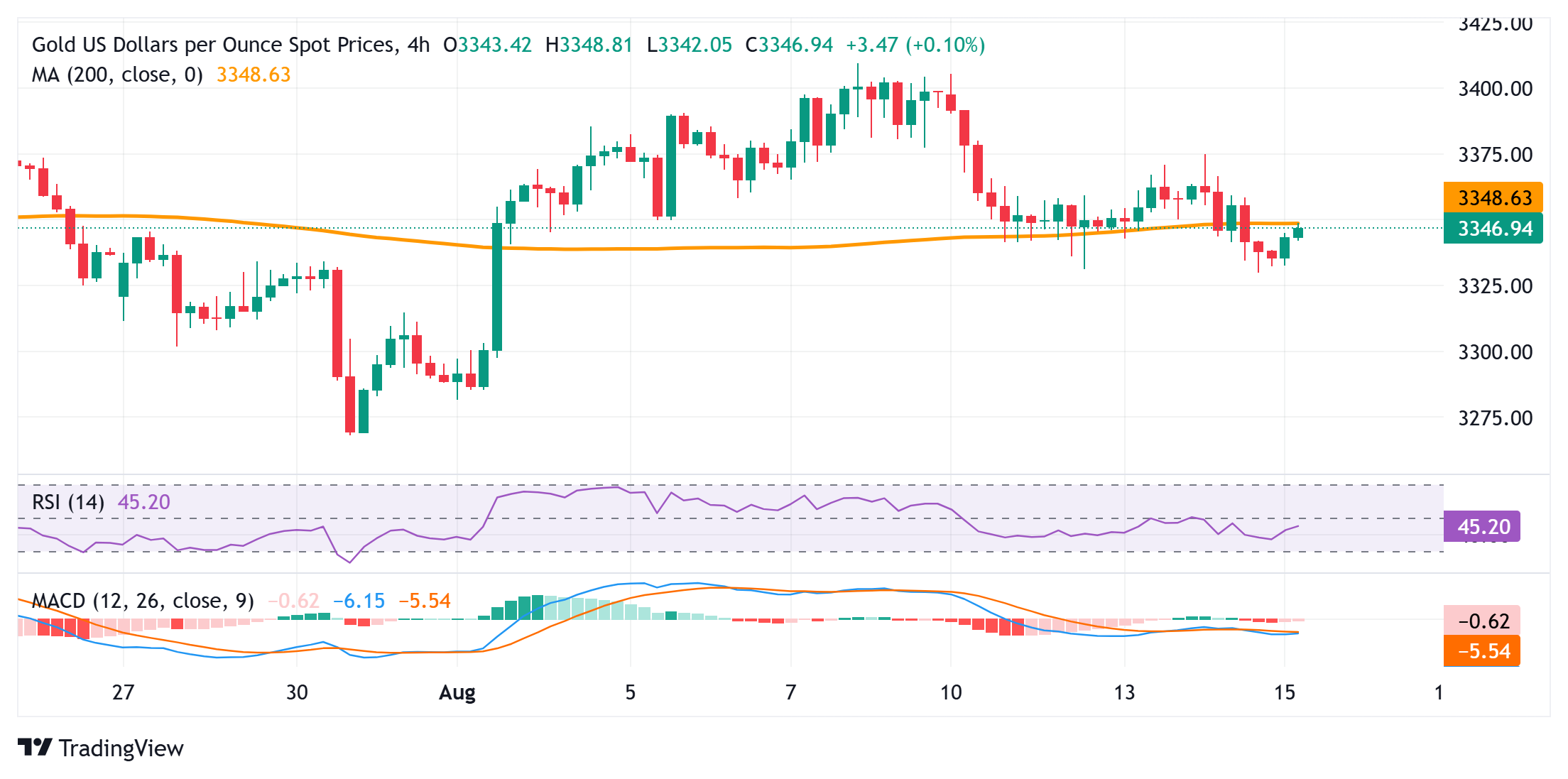
The overnight sustained break and acceptance below the 200-period Simple Moving Average (SMA) on the 4-hour charts was seen as a key trigger for the XAU/USD bears. Moreover, slightly negative oscillators on hourly/daily charts suggest that any further move up is more likely to attract fresh sellers and remain capped near the 100-hour SMA, currently pegged near the $3,355 region. A sustained strength beyond the latter, however, could trigger a short-covering move and lift the Gold beyond the overnight swing high, around the $3,375 zone, towards reclaiming the $3,400 mark.
On the flip side, the two-week low, near the $3,330 area, now seems to have emerged as a strong support and should protect the immediate downside. Some follow-through selling could make the Gold vulnerable to accelerate the fall further towards the $3,3,00 round figure. The latter should act as a key pivotal point, which, if broken decisively, could negate any near-term positive bias and shift the bias in favor of the XAU/USD bears. This should pave the way for a fall towards the $3,272-$3,270 horizontal support, representing the lower boundary of a nearly three-month-old trading range.
Author

Haresh Menghani
FXStreet
Haresh Menghani is a detail-oriented professional with 10+ years of extensive experience in analysing the global financial markets.