Gold Price Forecast: XAU/USD remains stuck in a familiar range as US GDP, Fed loom
- Gold price keeps the weekly range between $3,350-$3,300 ahead of key US data, Fed policy announcements.
- The US Dollar falls on profit-taking after this week’s EU-US deal backed upsurge.
- Technically, the path of least resistance for Gold price remains to the downside.
Gold price is treading water while below the critical resistance of $3,345 early Wednesday as traders opt to remain on the sidelines ahead of the all-important US Federal Reserve (Fed) monetary policy announcements.
Gold price downside appears more compelling ahead of Fed
Despite the previous rebound from three-week lows of $3,302, Gold price is struggling as traders remain reluctant and refrain from creating fresh positions, anticipating the US second-quarter (Q1) Gross Domestic Product (GDP) before the Fed verdict.
These US event risks are expected to have a significant impact on the markets’ pricing of the scope and timing of the next Fed interest rate cuts, eventually impacting the US Dollar (USD) and the non-yielding Gold price.
The US economy is seen rebounding 2.4% in Q2 on an annualized basis, following a 0.5% contraction reported in the first quarter. Meanwhile, the quarterly core Personal Consumption Expenditures (PCE) is expected to arrive at 2.4% in Q2 after the previous quarter’s 3.5% reading.
Disappointing US economic data could refuel expectations of two Fed rate cuts this year, starting in September, doubling down on the latest leg lower in the USD while lifting Gold price.
In contrast, stronger-than-expected US data could push back against these expectations, boosting the Greenback at the expense of the bright metal.
However, any reaction to the US macro data will likely be limited ahead of the critical Fed verdict.
The Fed is widely expected to hold fed funds rate between 4.25%-4.5% in July as US President Donald Trump struck trade deals with most of its major trading partners, prompting policymakers to opt for a cautious stance assessing the tariff impact on inflation and growth outlook.
Markets will closely scrutinize the Monetary Policy Statement and Fed Chair Jerome Powell’s words for fresh hints on the timing of the next rate reduction.
Markets are currently pricing in a 64% chance that the Fed will lower rates by 25 basis points (bps) in September, according to the CME Group’s FedWatch Tool.
Industry experts and analysts are expecting multiple Fed Governors, including Christopher Waller. to dissent as Chair Jerome Powell and most Fed officials are likely to stick to their wait-and-see stance, per the Wall Street Journal (WSJ).
The split could be possible as some governors potentially lean in favor Trump’s calls for lower interest rates in an effort to keeping their long-shot candidacy viable as the next Fed Chair.
More than two dissenting Fed Governors could reinforce dovish expectations, supporting the non-interesting bearing Gold price. Meanwhile, such a split could raise doubts on the Fed’s independence, weighing negatively on the US Dollar.
Gold price technical analysis: Daily chart
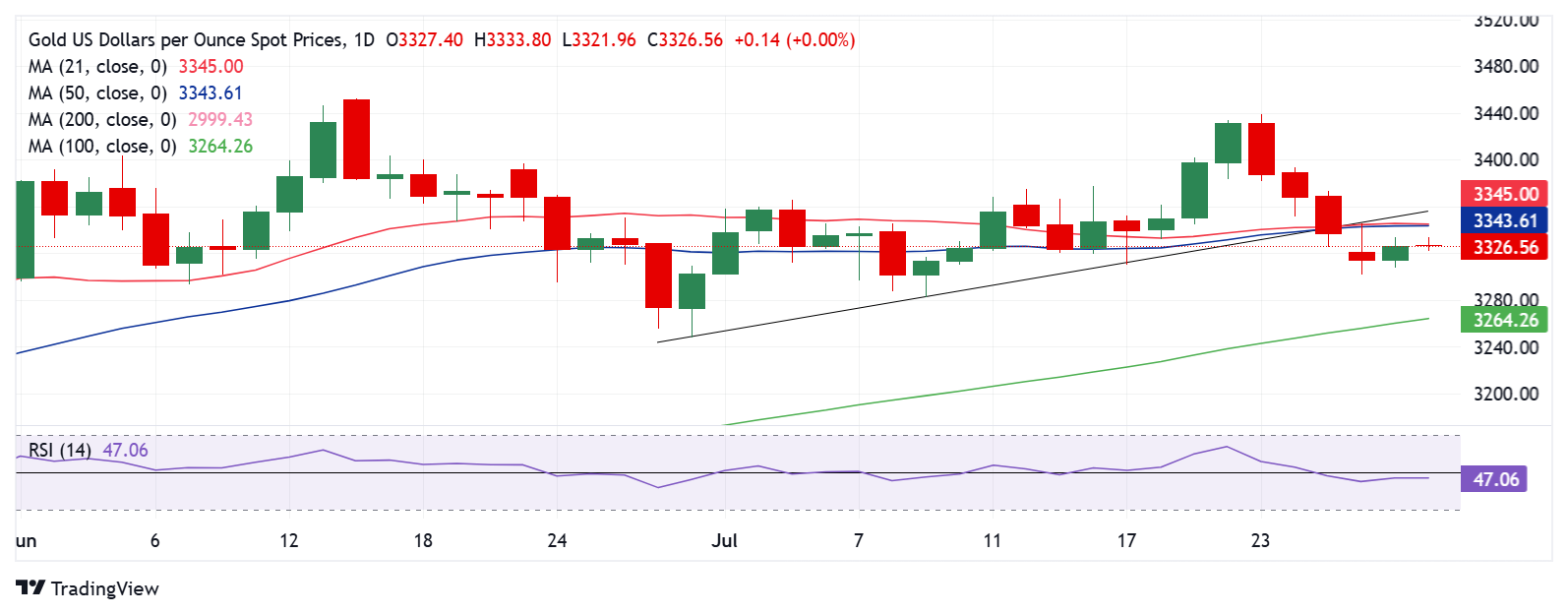
The near-term technical outlook for Gold price remains more or less the same heading into the Fed showdown.
The daily chart shows that Gold price looks vulnerable while it remains below the key resistance at $3,345. That level is the confluence of the rising trendline resistance, 21-day Simple Moving Average (SMA) and the 50-day SMA.
The 14-day Relative Strength Index (RSI) stays below the midline, currently near 47, keeping the bearish potential in place.
If selling pressure resurfaces, Gold price could retest the three-week lows of $3,302, below which the July 9 low of $3,283 will be tested.
The last line of defense for Gold buyers is placed at the June 30 low of $3,248.
On the flip side, recapturing the strong support-turned-resistance at $3,345 on a daily closing basis is critical for initiating a meaningful recovery.
The next topside hurdle is seen at the $3,380 static resistance en route to the $3,400 mark.
Fed FAQs
Monetary policy in the US is shaped by the Federal Reserve (Fed). The Fed has two mandates: to achieve price stability and foster full employment. Its primary tool to achieve these goals is by adjusting interest rates. When prices are rising too quickly and inflation is above the Fed’s 2% target, it raises interest rates, increasing borrowing costs throughout the economy. This results in a stronger US Dollar (USD) as it makes the US a more attractive place for international investors to park their money. When inflation falls below 2% or the Unemployment Rate is too high, the Fed may lower interest rates to encourage borrowing, which weighs on the Greenback.
The Federal Reserve (Fed) holds eight policy meetings a year, where the Federal Open Market Committee (FOMC) assesses economic conditions and makes monetary policy decisions. The FOMC is attended by twelve Fed officials – the seven members of the Board of Governors, the president of the Federal Reserve Bank of New York, and four of the remaining eleven regional Reserve Bank presidents, who serve one-year terms on a rotating basis.
In extreme situations, the Federal Reserve may resort to a policy named Quantitative Easing (QE). QE is the process by which the Fed substantially increases the flow of credit in a stuck financial system. It is a non-standard policy measure used during crises or when inflation is extremely low. It was the Fed’s weapon of choice during the Great Financial Crisis in 2008. It involves the Fed printing more Dollars and using them to buy high grade bonds from financial institutions. QE usually weakens the US Dollar.
Quantitative tightening (QT) is the reverse process of QE, whereby the Federal Reserve stops buying bonds from financial institutions and does not reinvest the principal from the bonds it holds maturing, to purchase new bonds. It is usually positive for the value of the US Dollar.
Author

Dhwani Mehta
FXStreet
Residing in Mumbai (India), Dhwani is a Senior Analyst and Manager of the Asian session at FXStreet. She has over 10 years of experience in analyzing and covering the global financial markets, with specialization in Forex and commodities markets.


![How Wall Street rigs the game [Video]](https://editorial.fxsstatic.com/images/i/market-chaos-01.jpg)