Gold Price Forecast: XAU/USD remains confined within the monthly trading range
- Gold price drifts lower amid the emergence of fresh USD buying on Thursday.
- Diminishing odds for an immediate Fed rate cut continue to underpin the USD.
- Trade-related uncertainty could limit losses for the safe-haven precious metal.

Gold price (XAU/USD) initially shot to a three-and-a-half week high, around the $3,377 area amid nervousness over reports that US President Donald Trump was seeking to remove Federal Reserve (Fed) Chair Jerome Powell. The market volatility, however, subsided after Trump told reporters that he was unlikely to fire the central bank chief. This helped ease concerns about the Fed’s independence, prompting some intraday USD recovery and capping the upside for the XAU/USD pair.
On the economic data front, the US Producer Price Index (PPI) fell short of market expectations and remained flat in June. This marked a notable deceleration in the price of goods sold by manufacturers. However, comments from FOMC members suggest that the Fed would wait at least until September before resuming its rate-cutting cycle. This assists the USD to attract some follow-through buying and continues to weigh on the Gold price through the early European session on Thursday.
Nevertheless, traders are still pricing in the possibility of 50 basis points worth of policy easing by the Fed this year. Adding to this, worries about the potential economic fallout from Trump's erratic trade policies could underpin the safe-haven Gold price and limit losses. Trump recently announced a 50% tariff on US copper imports and notified leaders of 25 countries about new tariff rates from August 1, while threatening that 200% levies on pharmaceutical imports will come by the month-end.
The aforementioned mixed fundamental backdrop warrants some caution for the XAU/USD bears and makes it prudent to wait for strong follow-through selling before positioning for any further depreciating move. Traders now look forward to the US economic docket – featuring the release of monthly Retail Sales, the usual Weekly Initial Jobless Claims data, and the Philly Fed Manufacturing Index. Furthermore, speeches from influential FOMC members would be scrutinized for cues about the Fed's rate-cut path, which, in turn, will drive the USD demand and provide some meaningful impetus to the Gold price.
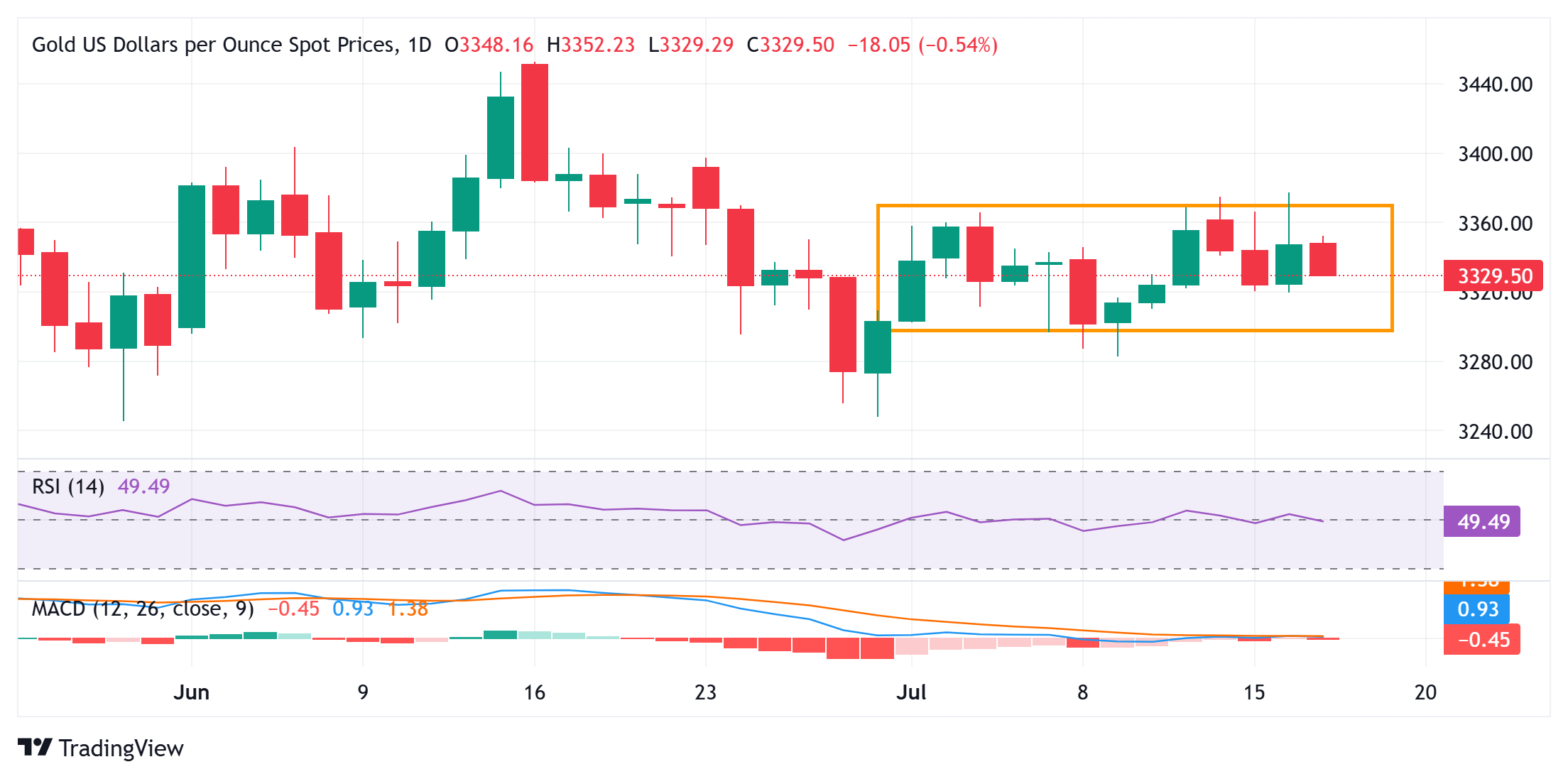
XAU/USD daily chart
Technical Outlook
From a technical perspective, the XAU/USD pair remains confined in a familiar range held since the start of this month. This constitutes the formation of a rectangle chart pattern and points to indecision among traders. Moreover, neutral oscillators on the daily chart warrant some caution before positioning for the next leg of a directional move. Hence, any further slide is more likely to find some support near the $3,322-$3,320 horizontal zone ahead of the $3,300 round figure. Some follow-through selling below the $3,283-3,282 region, or over a one-week low touched last Tuesday, could drag the Gold price to the July swing low, around the $3,248-3,247 zone.
On the flip side, the XAU/USD bulls need to wait for sustained strength and acceptance above the $3,365-3,366 region, or the top boundary of the short-term trading range, before placing fresh bets. A subsequent move beyond the overnight swing high, around the $3,377 area, should allow the Gold price to reclaim the $3,400 round figure. The upward trajectory could extend further towards testing the next relevant hurdle near the $3,434-3,435 area.
Premium
You have reached your limit of 3 free articles for this month.
Start your subscription and get access to all our original articles.
Author

Haresh Menghani
FXStreet
Haresh Menghani is a detail-oriented professional with 10+ years of extensive experience in analysing the global financial markets.