Gold Price Forecast: XAU/USD remains confined in monthly range amid mixed cues
- Gold price struggles to capitalize on the previous day’s late rebound from a one-week trough.
- Reduced Fed rate cut bets underpin the USD and cap the commodity amid a positive risk tone.
- Persistent trade-related uncertainties might continue to offer support to the precious metal.

Gold price (XAU/USD) bounced off a one-week low, around the $3,309 region touched on Thursday, after Federal Reserve (Fed) Governor Christopher Waller backed the case for a rate cut in July. In fact, Waller said that he continues to believe the US central bank should cut interest rates at the end of this month amid mounting risks to the economy. Waller further emphasized that tariffs will not lead to a sustained increase in inflation and only cause a “temporary surge” in prices.
Traders, however, seem convinced that the Fed will wait at least until the September policy meeting before pulling the trigger and are pricing in the possibility of a 50 basis points rate cut by the end of this year. The expectations were further reaffirmed by Thursday's upbeat US macro data and a slew of influential FOMC members. This keeps the US Dollar (USD) close to its highest level since June 23 and keeps the XAU/USD bulls on the defensive through the Asian session on Friday.
The US Commerce Department reported that Retail Sales rose 0.6% in June, defying market expectations. This marks a significant improvement after a 0.9% fall in May, providing a glimmer of optimism for an economy that has been struggling. Moreover, US Initial Jobless Claims dropped for the fifth straight week, to 221K during the week ending July 12, or the lowest level in three months, suggesting a still resilient US labor market and validating reduced Fed rate cut bets.
Meanwhile, Fed governor Adriana Kugler said that the still-restrictive policy stance is important to keep longer-run inflation expectations anchored, and it will be appropriate to hold the policy rate at the current level for some time. Separately, Atlanta Fed President Raphael Bostic noted that the economic outlook remains highly uncertain and rate cuts might be difficult in the short run. This, along with the upbeat market mood, continues to undermine demand for the safe-haven Gold price.
Traders now look forward to the US economic docket – featuring housing market data, followed by the Preliminary Michigan US Consumer Sentiment and Inflation Expectations. The data might influence the USD, which, along with the risk sentiment, should provide some impetus to the Gold price. Nevertheless, the XAU/USD pair remains on track to register modest losses for the first time in three weeks, though the downside seems limited amid persistent trade uncertainties.
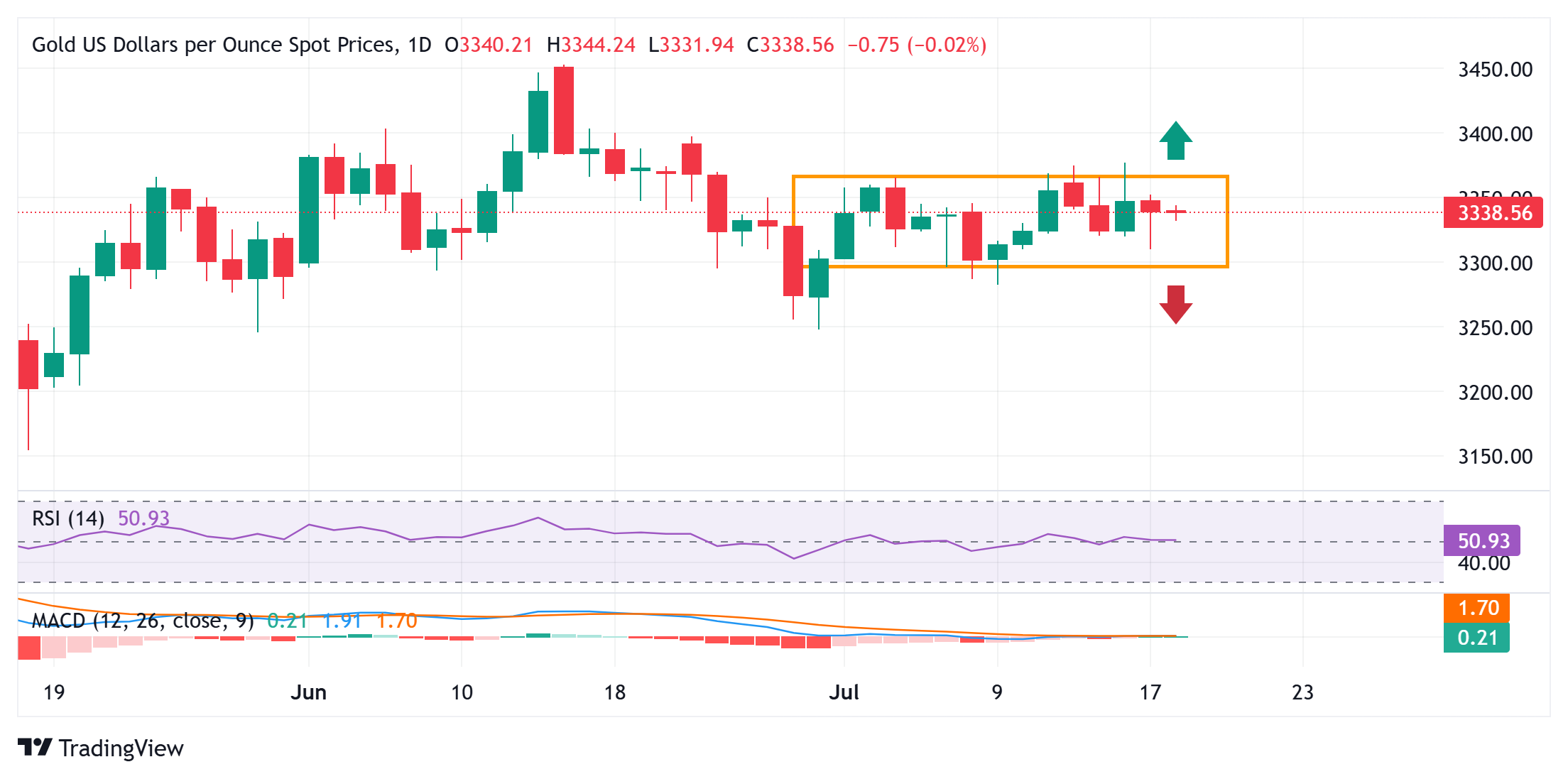
XAU/USD daily chart
Technical Outlook
From a technical perspective, nothing seems to have changed much for the commodity, and the recent range-bound price action witnessed since the beginning of this month warrants caution before placing aggressive directional bets. Hence, any further slide might continue to attract dip-buyers ahead of the $3,300 round figure. A convincing break below the said handle, however, could make the Gold price vulnerable to accelerate the fall towards the July swing low, around the $3,248-3,247 zone.
On the flip side, the $3,352 area could act as an immediate hurdle ahead of the $3,365-3,366 region, or the top boundary of the short-term trading range. A sustained strength beyond would be seen as a key trigger for bullish traders and trigger a short-covering rally. The subsequent move up should allow the Gold price to reclaim the $3,400 mark and extend the momentum towards the next relevant hurdle near the $3,434-3,435 area.
Author

Haresh Menghani
FXStreet
Haresh Menghani is a detail-oriented professional with 10+ years of extensive experience in analysing the global financial markets.