Gold Price Forecast: XAU/USD recaptures $2,350 on Middle East escalation, more upside likely?
- Gold price jumps on a flight to safety after Iran attacked Israel late Saturday.
- US Dollar fails to benefit from geopolitical turmoil and higher US Treasury bond yields.
- Gold price looks north alongside 4H RSI ahead of US Retail Sales data.

Gold price (XAU/USD) consolidates its rebound above $2,350 early Monday, reversing half the corrective decline from record highs of $$2,432 seen on Friday.
Gold price gains on flight to safety
Despite a recovery in Asian markets, led by the rally in Chinese stocks, investors remain in a wait-and-see mode before placing fresh bets on risky assets following late Saturday’s escalation in the Middle East geopolitical tensions.
Iran’s retaliatory drone attacks on Israel on Saturday spooked markets and rekindled the safety appeal of Gold, as investors stay fearful of whether Iran’s unprecedented strike on Israel could fuel a wider regional conflict.
Gold price is also benefiting from a broadly weaker US Dollar (USD), as the Greenback pays little heed to the cautious market environment. Market participants likely believe that the recent upsurge in the US Dollar is excessive, and hence, they avoid opening fresh positions in the US currency even though US Treasury bond yields look to extend Friday’s positive momentum.
US Treasury bond yields keep up recent gains due to the pushback in expectations of the US Federal Reserve’s (Fed) interest rate cut from June to September, courtesy of elevated inflation level and a resilient US economy. Therefore, a further upside in the Gold price appears elusive on firmer US Treasury bond yields.
However, if risk sentiment sees a dramatic positive shift, it could trigger a fresh selling wave in Gold price. Traders are taking account of the UK, France and Egypt condemning Iran's action while Saudi Arabia has called for restraint, calming markets somewhat so far this Monday. The S&P 500 futures are up 0.25% on the day, reflecting the renewed market optimism.
All eyes now remain on geopolitical developments in the Middle East for fresh trading impetus in Gold price. If the Middle East turmoil worsens, Gold price could see an extension of the rebound toward $2,400. However, a resurgent demand for the US Dollar on increased safe-haven flows and hawkish US Federal Reserve (Fed) expectations could act as a headwind to the Gold price upswing.
The top-tier US Retail Sales data due later on Monday could also have a significant impact on the value of the US Dollar and, in turn, on the USD-denominated Gold price.
The monthly headline US Retail Sales are expected to increase by 0.3% in March, slower than February’s 0.6% rise.
Gold price technical analysis: Four-hour chart
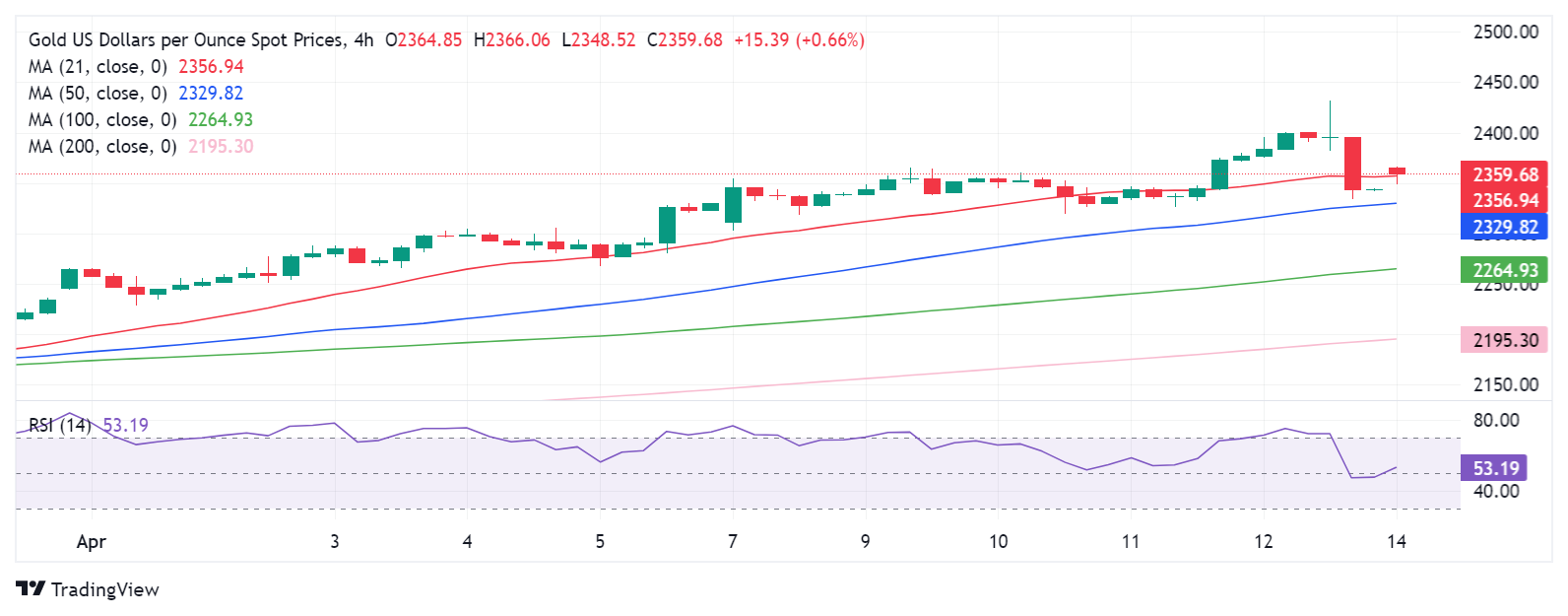
As observed on the 4-hour chart, Gold price is defending the 21-Simple Moving Average (SMA) at $2,356, at the moment.
The Relative Strength Index (RSI) has recaptured the 50 level, now holding near 53.0, suggesting that the upside bias appears intact.
Initial topside target is seen at the intraday highs of $2,373, above which the $2,400 round figure will be tested again.
Acceptance above the latter will expose the record high of $2,432.
If the Gold price fails to hold above the 21-SMA at $2,356 on a 4-hour candlestick closing basis, the correction could resume toward the previous day’s low of $2,334. The 50-SMA aligns near that level.
Further down, the previous week’s low of $2,319 will come into play.
Gold FAQs
Gold has played a key role in human’s history as it has been widely used as a store of value and medium of exchange. Currently, apart from its shine and usage for jewelry, the precious metal is widely seen as a safe-haven asset, meaning that it is considered a good investment during turbulent times. Gold is also widely seen as a hedge against inflation and against depreciating currencies as it doesn’t rely on any specific issuer or government.
Central banks are the biggest Gold holders. In their aim to support their currencies in turbulent times, central banks tend to diversify their reserves and buy Gold to improve the perceived strength of the economy and the currency. High Gold reserves can be a source of trust for a country’s solvency. Central banks added 1,136 tonnes of Gold worth around $70 billion to their reserves in 2022, according to data from the World Gold Council. This is the highest yearly purchase since records began. Central banks from emerging economies such as China, India and Turkey are quickly increasing their Gold reserves.
Gold has an inverse correlation with the US Dollar and US Treasuries, which are both major reserve and safe-haven assets. When the Dollar depreciates, Gold tends to rise, enabling investors and central banks to diversify their assets in turbulent times. Gold is also inversely correlated with risk assets. A rally in the stock market tends to weaken Gold price, while sell-offs in riskier markets tend to favor the precious metal.
The price can move due to a wide range of factors. Geopolitical instability or fears of a deep recession can quickly make Gold price escalate due to its safe-haven status. As a yield-less asset, Gold tends to rise with lower interest rates, while higher cost of money usually weighs down on the yellow metal. Still, most moves depend on how the US Dollar (USD) behaves as the asset is priced in dollars (XAU/USD). A strong Dollar tends to keep the price of Gold controlled, whereas a weaker Dollar is likely to push Gold prices up.
Author

Dhwani Mehta
FXStreet
Residing in Mumbai (India), Dhwani is a Senior Analyst and Manager of the Asian session at FXStreet. She has over 10 years of experience in analyzing and covering the global financial markets, with specialization in Forex and commodities markets.