Gold Price Forecast: XAU/USD rebounds, but not out of the woods yet
- Gold attempts a tepid bounce to near $3,950 early Wednesday.
- US Dollar enters bullish consolidation after the global risk sell-off-led upsurge.
- Technically, Gold’s path of least resistance appears to the downside.

Gold is licking its wounds near $3,950 in Asian trades on Wednesday, following a 1.80% decline seen on Tuesday. Traders look forward to the US ADP employment data and the US ISM Services PMI report for fresh trading impetus.
Gold: Downside risks remain intact ahead of US data
Gold buyers are coming up for some air early Wednesday, as the US Dollar (USD) pauses its intense buying momentum witnessed in the US last session.
The extension of the Wall Street tech sell-off into Asian markets keeps investors on edge, allowing Gold to attempt a tepid recovery.
However, the monthly US ADP jobs report and the US ISM Services PMI will determine the next big wave in Gold, as the data will help shape the market expectations of future interest rate cuts by the US Federal Reserve (Fed), impacting non-yielding assets such as Gold.
Last week, the Fed’s cautious rate cut prompted traders to scale back their bets on a December rate reduction, with markets continuing to price in a less than 70% chance of such a move, according to the CME Group’s FedWatch Tool.
On Tuesday, the USD received a double booster shot and stretched its recent rally due to reduced dovish Fed expectations and broad risk aversion that revived the safe-haven demand for the Greenback.
Traders witnessed a wave of exhaustion following the Artificial Intelligence (AI) driven record rally in global stocks. US tech stocks tumbled, drowning the major indices, with investors selling Gold to cover their losses in equity markets.
Gold resumed its corrective downside, surrendering critical support levels to challenge levels below the $3,950 mark.
Gold price technical analysis: Daily chart
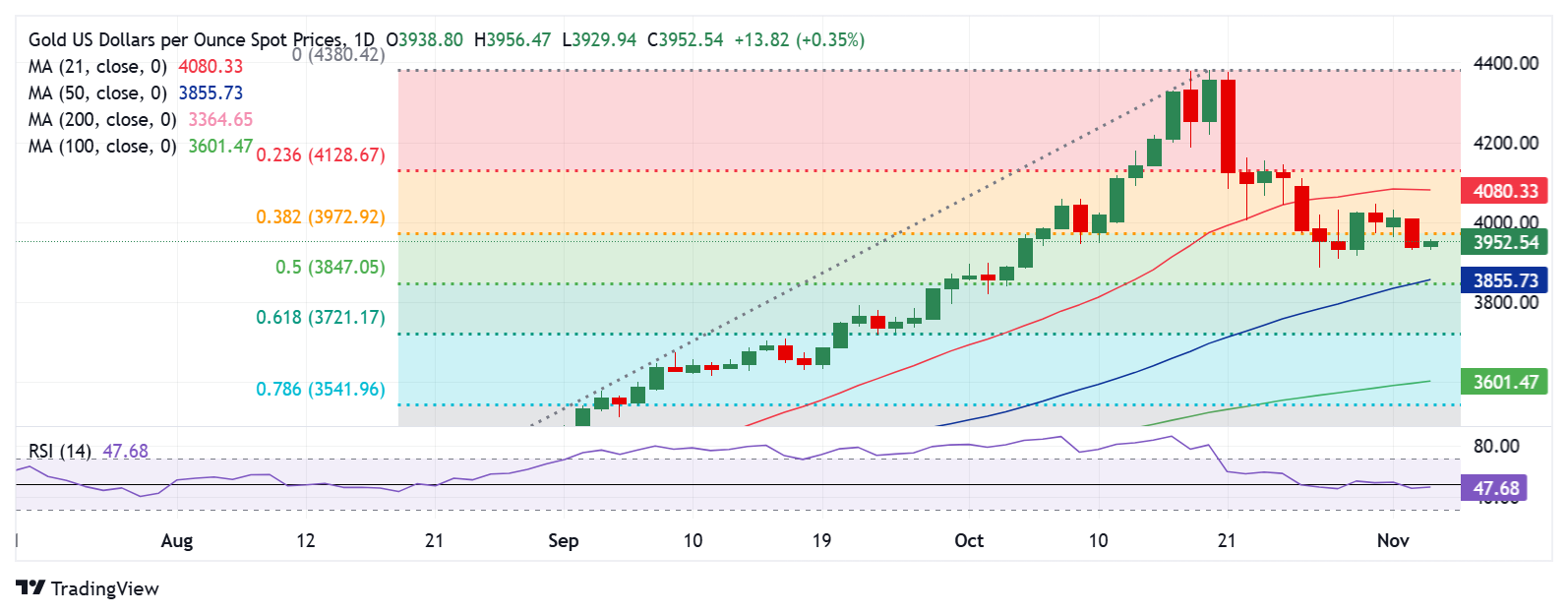
The daily chart suggests that the bearish potential remains intact for Gold as the 14-day Relative Strength Index (RSI) holds below the midline.
Additionally, Gold closed Tuesday below the critical support at $3,972, the 38.2% Fibonacci Retracement level of the parabolic rise to the record high that began on August 19.
If buyers manage to reclaim the latter on a sustained basis on the renewed upside, the door will open up toward the $4,000 threshold.
The $4,050 psychological level will offer stiff resistance further north.
Conversely, the immediate support is seen at the October 28 low of $3,887, below which the $3,850 demand area will come into play.
That zone is the confluence of the 50-day Simple Moving Average (SMA) and the 50% Fibo level of the same advance.
Gold FAQs
Gold has played a key role in human’s history as it has been widely used as a store of value and medium of exchange. Currently, apart from its shine and usage for jewelry, the precious metal is widely seen as a safe-haven asset, meaning that it is considered a good investment during turbulent times. Gold is also widely seen as a hedge against inflation and against depreciating currencies as it doesn’t rely on any specific issuer or government.
Central banks are the biggest Gold holders. In their aim to support their currencies in turbulent times, central banks tend to diversify their reserves and buy Gold to improve the perceived strength of the economy and the currency. High Gold reserves can be a source of trust for a country’s solvency. Central banks added 1,136 tonnes of Gold worth around $70 billion to their reserves in 2022, according to data from the World Gold Council. This is the highest yearly purchase since records began. Central banks from emerging economies such as China, India and Turkey are quickly increasing their Gold reserves.
Gold has an inverse correlation with the US Dollar and US Treasuries, which are both major reserve and safe-haven assets. When the Dollar depreciates, Gold tends to rise, enabling investors and central banks to diversify their assets in turbulent times. Gold is also inversely correlated with risk assets. A rally in the stock market tends to weaken Gold price, while sell-offs in riskier markets tend to favor the precious metal.
The price can move due to a wide range of factors. Geopolitical instability or fears of a deep recession can quickly make Gold price escalate due to its safe-haven status. As a yield-less asset, Gold tends to rise with lower interest rates, while higher cost of money usually weighs down on the yellow metal. Still, most moves depend on how the US Dollar (USD) behaves as the asset is priced in dollars (XAU/USD). A strong Dollar tends to keep the price of Gold controlled, whereas a weaker Dollar is likely to push Gold prices up.
Author

Dhwani Mehta
FXStreet
Residing in Mumbai (India), Dhwani is a Senior Analyst and Manager of the Asian session at FXStreet. She has over 10 years of experience in analyzing and covering the global financial markets, with specialization in Forex and commodities markets.