Gold Price Forecast: XAU/USD range play intact, with eyes on trade talks, Fedspeak
- Gold price remains stuck in a familiar band early Monday as the new week kicks off.
- The US Dollar sold into US fiscal concerns and trade uncertainty ahead of Fedspeak.
- The daily RSI stays bearish but Gold buyers refuse to give up while the 50-day SMA holds.

Gold price is showing some fresh signs of life early Monday, following a weekly decline. The further upside in Gold price depends on the upcoming Fedspeak and talks over potential US trade deals amid rising concerns over US fiscal debt.
Gold price remains exposed to two-way risks
Markets have resorted to selling US assets as they respond to the credit blow, marking the start of a new week. Moody's downgraded the US sovereign credit rating on Friday by one notch from its pristine "Aaa" rating to “Aa1”.
The rating downgrade is based on concerns about the nation's growing $36 trillion debt pile and higher interest payments amid US President Donald Trump’s erratic economic and trade policies.
The US Dollar (USD) wilted alongside the Treasury bonds and US equity futures, reviving the safe-haven appeal of Gold price. However, rising US Treasury bond yields on economic concerns limit the upside attempts in the yellow metal, leaving the bullion confined in a range above $3,200.
Further, US Treasury Secretary Scott Bessent’s tariff threat on Sunday also keeps markets on the edge, allowing Gold price some sigh of relief. Bessent said, “Trump has put them (trading partners) on notice that if you do not negotiate in good faith, you will ratchet back up to your April 2 level.”
These factors have unnerved markets, and hence, they pay little heed to the news that the House panel approved President Trump’s tax cut bill early Monday, paving the way for possible passage in the House of Representatives later this week.
In the day ahead, Gold price could likely remain supported as the USD could face headwinds from growing economic and fiscal concerns. Data released last week showed that the US Producer Price Index (PPI) in April fell unexpectedly, while Retail Sales growth slowed, and Consumer Price Index (CPI) rose less than expected.
However, any optimistic headlines on the expected US trade agreements with South Korea, India and Japan could refuel the Gold price downside. Cautious remarks from Federal Reserve (Fed) policymakers will likely hinder the rebound in the bright metal.
Gold price technical analysis: Daily chart
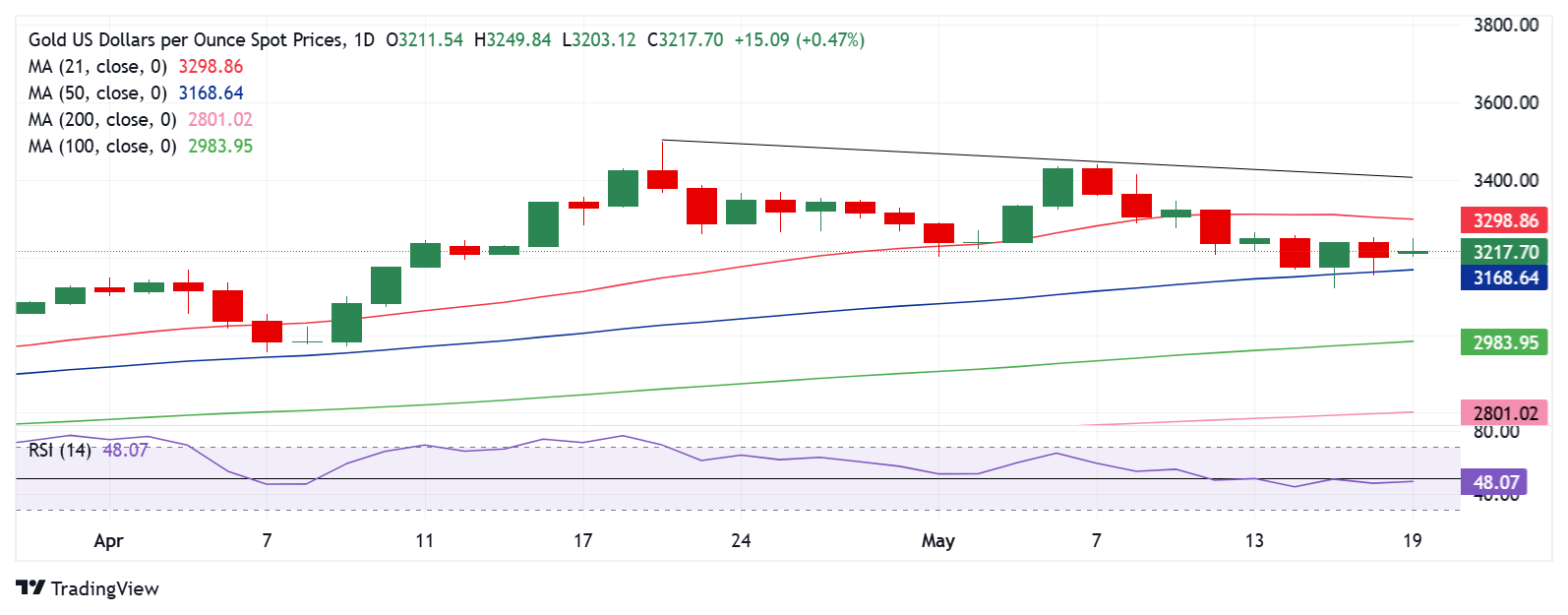
Technically, Gold price remains exposed to further downside risks as the 14-day Relative Strength Index (RSI) sits beneath the midline, near 48.50.
The bright metal remains capped between the 21-day Simple Moving Average (SMA) at $3,299 and the 50-day SMA at $3,169.
So long as the price stays above the throwback support of the 50-day SMA, a brief recovery toward the 21-day SMA remains in the offing.
Acceptance above that level will add legs to the upswing, exposing the falling trendline resistance at $3,407.
On the downside, if sellers manage to crack the 50-day SMA on a sustained basis, a fresh sell-off could be fuelled toward the $3,100 mark.
The April 10 low of $3,072 would then come to the rescue of buyers.
Tariffs FAQs
Tariffs are customs duties levied on certain merchandise imports or a category of products. Tariffs are designed to help local producers and manufacturers be more competitive in the market by providing a price advantage over similar goods that can be imported. Tariffs are widely used as tools of protectionism, along with trade barriers and import quotas.
Although tariffs and taxes both generate government revenue to fund public goods and services, they have several distinctions. Tariffs are prepaid at the port of entry, while taxes are paid at the time of purchase. Taxes are imposed on individual taxpayers and businesses, while tariffs are paid by importers.
There are two schools of thought among economists regarding the usage of tariffs. While some argue that tariffs are necessary to protect domestic industries and address trade imbalances, others see them as a harmful tool that could potentially drive prices higher over the long term and lead to a damaging trade war by encouraging tit-for-tat tariffs.
During the run-up to the presidential election in November 2024, Donald Trump made it clear that he intends to use tariffs to support the US economy and American producers. In 2024, Mexico, China and Canada accounted for 42% of total US imports. In this period, Mexico stood out as the top exporter with $466.6 billion, according to the US Census Bureau. Hence, Trump wants to focus on these three nations when imposing tariffs. He also plans to use the revenue generated through tariffs to lower personal income taxes.
Author

Dhwani Mehta
FXStreet
Residing in Mumbai (India), Dhwani is a Senior Analyst and Manager of the Asian session at FXStreet. She has over 10 years of experience in analyzing and covering the global financial markets, with specialization in Forex and commodities markets.

















