Gold Price Forecast: XAU/USD prods overbought zone, shy of $2,600 as Fed meeting looms
- Gold price pauses a three-day uptrend, sits at record highs just below $2,600 early Tuesday.
- The US Dollar licks wounds with Treasury bond yields heading into the two-day Fed gathering.
- Gold price could correct before a fresh uptrend kicks in. The daily RSI prods the overbought territory.
Gold price is just a hairline short of the new record high of $2,590 reached Monday, as buyers take a pause heading into the highly anticipated two-day US Federal Reserve (Fed) monetary policy meeting, starting on Tuesday.
Gold price stays supported by large Fed rate cut bets
With growing bets of a 50 basis points (bps) interest rate cut by the Fed this week due to increased concerns over the US economic outlook and loosening labor market conditions, the US Dollar (USD) licks its wounds alongside the US Treasury bond yields.
The Greenback mires in weekly lows against its major rivals, keeping Gold price afloat just shy of the $2,600 threshold. Markets are currently pricing in a 67% probability of an outsized rate cut in September, the CME Group’s FedWatch Tool showed.
Gold price also finds support from the ongoing inflows into the Gold exchange-traded funds (ETF) and increased over-the-counter physical demand, as global central banks enter an era of lower interest rates. Non-interest-bearing Gold price tend to benefit from a lower interest-rate environment.
Additionally, investors continue to flock to safety in the traditional safe-haven Gold price, still digesting news from Sunday, which reported of a potential second assassination attempt on Republican presidential candidate Donald Trump, also as traders remain worried about China’s economic concerns.
Furthermore, “investment banks and analysts have turned increasingly bullish on gold, with Wall Street bank Goldman Sachs showing the highest confidence in near-term upside in gold, which remains its preferred hedge against geopolitical and financial risks,” Reuters reports.
"While we see some tactical downside to gold prices under our economists' base case of a 25bp Fed cut on Wednesday, we reiterate our long gold trading recommendation and our price target of $2,700/oz by early 2025," the investment bank said in a note published on Monday.
Looking ahead, Gold price see a minor pullback before the next leg higher, as traders stay cautious ahead of the Fed policy announcements on Wednesday. The US Retail Sales report, however, could offer some fresh trading incentives to the bright metal traders, with markets glued to the increasing odds of a big Fed rate cut in the offing.
Gold price technical analysis: Daily chart
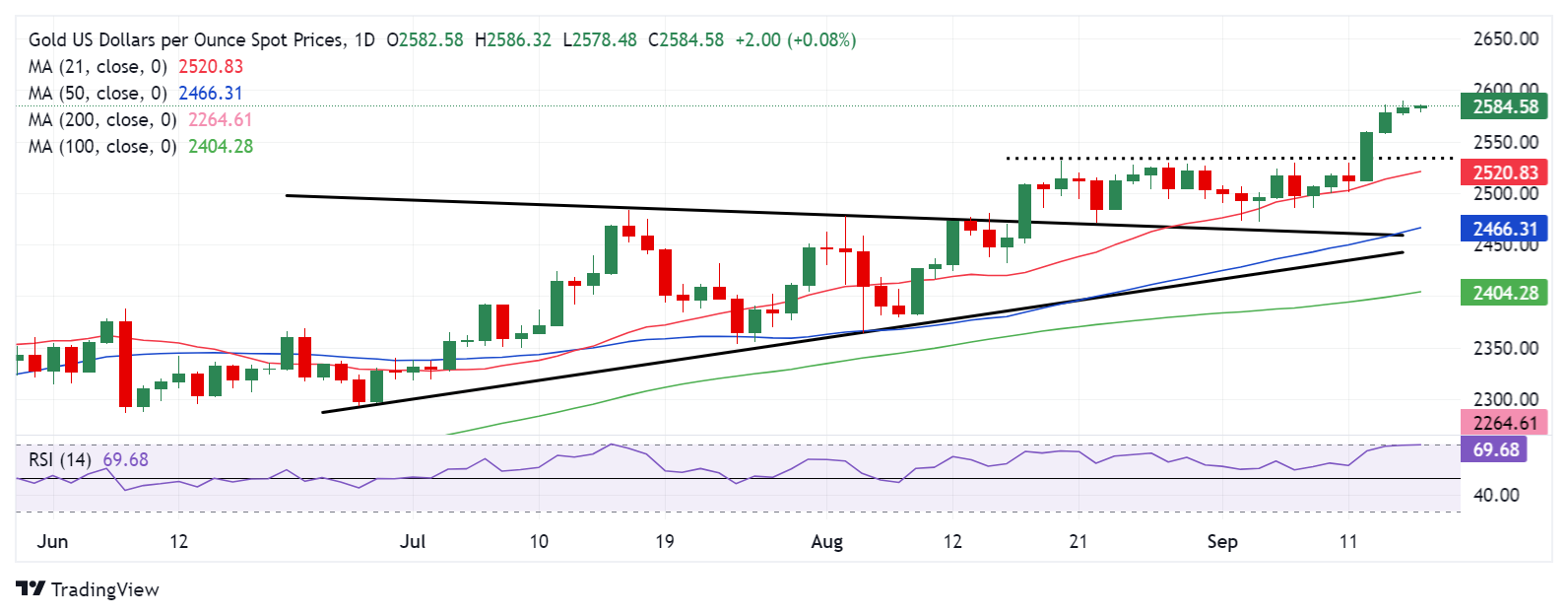
Having achieved the one-and-a-half-month-old symmetrical triangle target, measured at $2,560, Gold price continued its upward trajectory, as bulls refused to give up.
However, the 14-day Relative Strength Index (RSI) is prodding the overbought territory, as of writing, warranting caution for buyers.
A rejection at the $2,600 level could trigger a temporary correction toward Friday’s low of $2,557, below which the August 20 high of $2,532 will be tested.
Deeper declines will challenge the 21-day Simple Moving Average (SMA) at $2,521.
If Gold price sees resurgent demand, the next upside hurdle is seen at the $2,600 level once the record high of $2,590 is taken out convincingly.
Further up, the $2,650 psychological level will come into play.
Gold FAQs
Gold has played a key role in human’s history as it has been widely used as a store of value and medium of exchange. Currently, apart from its shine and usage for jewelry, the precious metal is widely seen as a safe-haven asset, meaning that it is considered a good investment during turbulent times. Gold is also widely seen as a hedge against inflation and against depreciating currencies as it doesn’t rely on any specific issuer or government.
Central banks are the biggest Gold holders. In their aim to support their currencies in turbulent times, central banks tend to diversify their reserves and buy Gold to improve the perceived strength of the economy and the currency. High Gold reserves can be a source of trust for a country’s solvency. Central banks added 1,136 tonnes of Gold worth around $70 billion to their reserves in 2022, according to data from the World Gold Council. This is the highest yearly purchase since records began. Central banks from emerging economies such as China, India and Turkey are quickly increasing their Gold reserves.
Gold has an inverse correlation with the US Dollar and US Treasuries, which are both major reserve and safe-haven assets. When the Dollar depreciates, Gold tends to rise, enabling investors and central banks to diversify their assets in turbulent times. Gold is also inversely correlated with risk assets. A rally in the stock market tends to weaken Gold price, while sell-offs in riskier markets tend to favor the precious metal.
The price can move due to a wide range of factors. Geopolitical instability or fears of a deep recession can quickly make Gold price escalate due to its safe-haven status. As a yield-less asset, Gold tends to rise with lower interest rates, while higher cost of money usually weighs down on the yellow metal. Still, most moves depend on how the US Dollar (USD) behaves as the asset is priced in dollars (XAU/USD). A strong Dollar tends to keep the price of Gold controlled, whereas a weaker Dollar is likely to push Gold prices up.
Author

Dhwani Mehta
FXStreet
Residing in Mumbai (India), Dhwani is a Senior Analyst and Manager of the Asian session at FXStreet. She has over 10 years of experience in analyzing and covering the global financial markets, with specialization in Forex and commodities markets.