Gold Price Forecast: XAU/USD on its way to record highs at $3,500 amid thin markets
- Gold rises for a fifth consecutive day early Monday, at fresh five-month highs.
- The US Dollar turns south again despite risk aversion as trade uncertainty and dovish Fed bets weigh.
- Technically, Gold has more room to the upside as the daily RSI holds just beneath the overbought region.

Gold has regained traction early Monday, sitting at the highest levels in five months near $3,480. The US and Canadian markets are closed on Monday due to Labor Day, leaving Gold at the mercy of thin trading conditions.
Gold: Light trading could exaggerate moves
Gold is seeing a positive start to September, extending its uptrend into a fifth consecutive day, while approaching the record highs of $3,500.
The latest leg north in Gold could be attributed to the revival of safe-haven demand amid the declines across the Asian markets, especially with the Japanese Nikkei 225 index hit hard in the aftermath of Friday’s tech sell-off on Wall Street.
Renewed uncertainty on the trade front adds to the risk-averse market profile. On Friday, a US court ruled that President Donald Trump’s global tariffs, unilaterally imposed, as largely illegal.
However, US Trade Representative Jamieson Greer said in a Fox News interview on Sunday that the Trump administration will likely continue negotiations with its trade partners despite Friday’s US court ruling.
Moreover, a surprise jump in the Chinese Caixin Manufacturing PMI for August adds to the renewed Gold price upside.
The RatingDog China general Manufacturing Purchasing Managers Index rose to 50.5 last month from 49.5 in July, according to data released Monday by S&P Global, beating the estimated 49.5 readout.
Furthermore, expectations of aggressive US Federal Reserve (Fed) easing in the coming months also power the non-yielding Gold. Markets are pricing in a roughly 90% chance of the Fed lowering interest rates this month, according to the CME Group’s FedWatch Tool.
In line with estimates US Core Personal Consumption Expenditures (PCE) Price Index - the Fed’s preferred inflation gauge, released on Friday, strengthened the dovish sentiment around the Fed expectations.
Meanwhile, attention turns to a slew of critical US employment data due later this week for fresh signs on the health of the country’s labor market, which is key to determining the scope and the timing of the next Fed rate cuts.
Additionally, speeches by Fed policymakers and trade headlines will also keep Gold traders entertained.
Gold price technical analysis: Daily chart
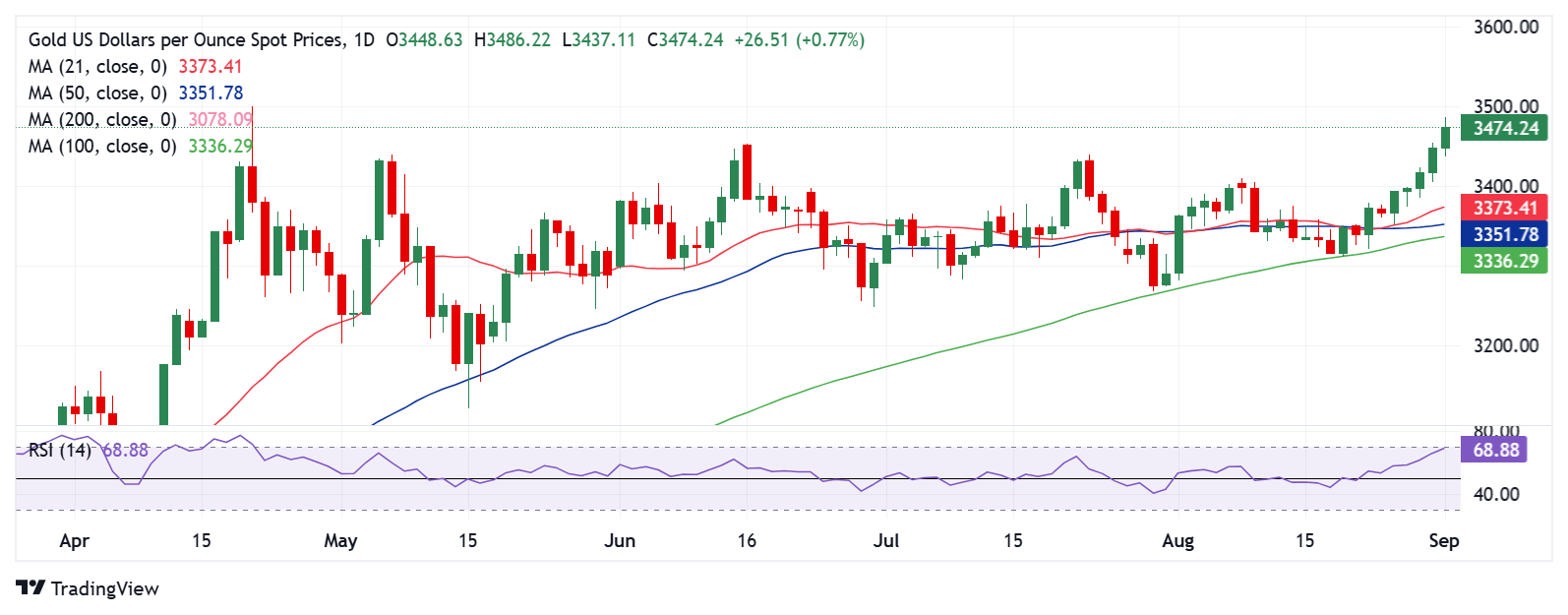
The daily chart shows that Gold has more room to the upside as the 14-day Relative Strength Index (RSI) is still beneath the overbought region while comfortably in the bullish zone.
Meanwhile, the 21-day Simple Moving Average (SMA) and the 50-day SMA bullish crossover remains in play.
The immediate topside hurdle is seen at the record high of $,3500, above which the $3,550 psychological level will be tested.
On the flip side, any pullback will challenge the intraday of $3,437 initially, below which sellers will attack the $3,400 level.
A sustained break below the latter will expose the 21-day SMA at $3,373.
Nonfarm Payrolls FAQs
Nonfarm Payrolls (NFP) are part of the US Bureau of Labor Statistics monthly jobs report. The Nonfarm Payrolls component specifically measures the change in the number of people employed in the US during the previous month, excluding the farming industry.
The Nonfarm Payrolls figure can influence the decisions of the Federal Reserve by providing a measure of how successfully the Fed is meeting its mandate of fostering full employment and 2% inflation. A relatively high NFP figure means more people are in employment, earning more money and therefore probably spending more. A relatively low Nonfarm Payrolls’ result, on the either hand, could mean people are struggling to find work. The Fed will typically raise interest rates to combat high inflation triggered by low unemployment, and lower them to stimulate a stagnant labor market.
Nonfarm Payrolls generally have a positive correlation with the US Dollar. This means when payrolls’ figures come out higher-than-expected the USD tends to rally and vice versa when they are lower. NFPs influence the US Dollar by virtue of their impact on inflation, monetary policy expectations and interest rates. A higher NFP usually means the Federal Reserve will be more tight in its monetary policy, supporting the USD.
Nonfarm Payrolls are generally negatively-correlated with the price of Gold. This means a higher-than-expected payrolls’ figure will have a depressing effect on the Gold price and vice versa. Higher NFP generally has a positive effect on the value of the USD, and like most major commodities Gold is priced in US Dollars. If the USD gains in value, therefore, it requires less Dollars to buy an ounce of Gold. Also, higher interest rates (typically helped higher NFPs) also lessen the attractiveness of Gold as an investment compared to staying in cash, where the money will at least earn interest.
Nonfarm Payrolls is only one component within a bigger jobs report and it can be overshadowed by the other components. At times, when NFP come out higher-than-forecast, but the Average Weekly Earnings is lower than expected, the market has ignored the potentially inflationary effect of the headline result and interpreted the fall in earnings as deflationary. The Participation Rate and the Average Weekly Hours components can also influence the market reaction, but only in seldom events like the “Great Resignation” or the Global Financial Crisis.
Author

Dhwani Mehta
FXStreet
Residing in Mumbai (India), Dhwani is a Senior Analyst and Manager of the Asian session at FXStreet. She has over 10 years of experience in analyzing and covering the global financial markets, with specialization in Forex and commodities markets.