Gold Price Forecast: XAU/USD looks to record highs on fresh Trump’s tariff threats
- Gold price holds the previous rebound above $3,000 ahead of mid-tier US data, Fedspeak.
- The US Dollar loses recovery momentum as Trump’s tariff threats return, supporting Gold price.
- Gold buyers are likely to extend control toward $3,050 and beyond amid bullish technicals.

Gold price is consolidating the previous rebound above $3,000 early Wednesday, gathering pace before the next push higher. The focus is back on US tariffs and their impact on the global economies, enhancing the safe-haven appeal of Gold price.
Gold price eyes tariff updates, record highs
US President Donald Trump is reportedly set to impose three escalating levels of tariffs, with Canada likely to be on the lower end of the April 2 tariffs, per the Toronto Star. Trump later clarified that “all we're going to do is reciprocal,” adding that “not many exceptions on April 2 tariffs.”
At the same time, Bloomberg News reported that the US President “plans to implement copper import tariffs within weeks.”
These renewed tariff threats rekindled US economic concerns, keeping the US Dollar (USD) upside in check as investors sought refuge in the traditional safe-haven of Gold price.
Earlier this week, fears over a US economic slowdown were doused after the release of a stronger-than-expected S&P Global flash US Composite PMI Output Index. The gauge which tracks the manufacturing and services sectors, jumped to 53.5 this month from 51.6 in February.
That said, the further upside in Gold price appears intact as markets reposition, bracing for the April 2 reciprocal tariffs. However, if the US Durable Goods Orders data exceeds estimates by a wide margin, it could reinforce expectations for one interest rate cut by the US Federal Reserve (Fed) this year, fuelled by the upbeat PMI data on Monday.
The less dovish Fed narrative could cap the Gold price rebound while taking cues on policy from several Fed officials, who are due to speak later on Wednesday.
Also of note remains the geopolitical developments surrounding the Ukraine peace deal. The US on Tuesday reached deals with Ukraine and Russia to pause their attacks at sea and against energy targets, with Washington agreeing to push to lift some sanctions against Moscow. However, Ukrainian President Volodymyr Zelensky stated that he would seek US President Trump’s support in providing weapons and imposing sanctions on Russia if Moscow violated the agreements.
Gold price technical analysis: Daily chart
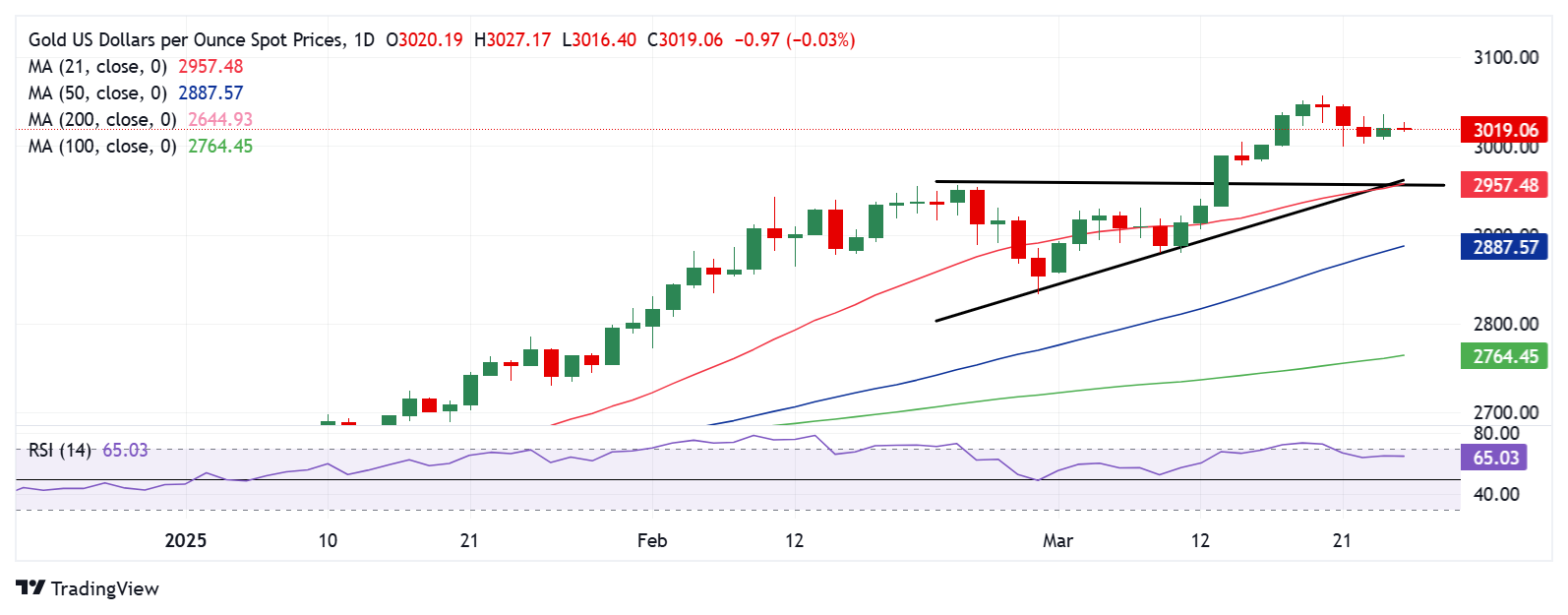
The technical setup on the daily chart favors buyers, with their sights set on the ascending triangle target, measured at $3,080.
The 14-day Relative Strength Index (RSI) is trending higher, currently at 66, which justifies the bullish momentum.
Gold price remains poised to take out the record high of $3,058 on the way to achieving the triangle target of $3,080.
Alternatively, the $3,000 round level will emerge as a powerful support. The next downside cap is aligned at the previous week’s low of $2,982.
Further south, the 21-day Simple Moving Average (SMA) and the triangle support confluence at $2,958 will be a tough nut to crack for sellers.
Tariffs FAQs
Tariffs are customs duties levied on certain merchandise imports or a category of products. Tariffs are designed to help local producers and manufacturers be more competitive in the market by providing a price advantage over similar goods that can be imported. Tariffs are widely used as tools of protectionism, along with trade barriers and import quotas.
Although tariffs and taxes both generate government revenue to fund public goods and services, they have several distinctions. Tariffs are prepaid at the port of entry, while taxes are paid at the time of purchase. Taxes are imposed on individual taxpayers and businesses, while tariffs are paid by importers.
There are two schools of thought among economists regarding the usage of tariffs. While some argue that tariffs are necessary to protect domestic industries and address trade imbalances, others see them as a harmful tool that could potentially drive prices higher over the long term and lead to a damaging trade war by encouraging tit-for-tat tariffs.
During the run-up to the presidential election in November 2024, Donald Trump made it clear that he intends to use tariffs to support the US economy and American producers. In 2024, Mexico, China and Canada accounted for 42% of total US imports. In this period, Mexico stood out as the top exporter with $466.6 billion, according to the US Census Bureau. Hence, Trump wants to focus on these three nations when imposing tariffs. He also plans to use the revenue generated through tariffs to lower personal income taxes.
Author

Dhwani Mehta
FXStreet
Residing in Mumbai (India), Dhwani is a Senior Analyst and Manager of the Asian session at FXStreet. She has over 10 years of experience in analyzing and covering the global financial markets, with specialization in Forex and commodities markets.