Gold Price Forecast: XAU/USD looks to mid-tier US data, Fedspeak for fresh impetus
- Gold price consolidates recent gains above $2,850 early Thursday, awaits US data, Fedspeak.
- Ebbing trade war fears, USD/JPY sell-off weigh on the US Dollar amid mixed US ISM and ADP data.
- Gold price remains overbought on the daily time frame, risking a pullback in the near term.

Gold price extends its winning streak into a sixth straight day on Thursday, consolidating near record highs of $2,882 set on Wednesday.
Gold price sticks to record rally, with eyes on US jobs data
Sustained US Dollar (USD) weakness alongside the extended correction in the US Treasury bond yields continue to bode well for the non-yielding Gold price. The Greenback bears the brunt of receding fears of a potential global trade war after US President Donald Trump’s pushback on Canada and Mexico for a month while markets look past the US-Sino tariff war, expecting no further escalation.
Additionally, Trump’s plans to end the Israel-Hamas geopolitical conflict also provided a ray of hope to markets, diminishing the USD’s safe-haven appeal. Israeli Prime Minister Benjamin Netanyahu and Trump met on Tuesday at the White House and discussed the elimination of Hamas, Iran strategy and renewed Israel-Saudi normalization.
Furthermore, expectations of policy divergence between the US Federal Reserve (Fed) and the Bank of Japan (BoJ) drive the Japanese Yen to near two-month highs against the US Dollar, dragging USD/JPY sharply lower. The USD/JPY weakness remains a drag on the Greenback, allowing Gold price to maintain its buoyant tone.
According to the LSEG data, a quarter-point Fed cut is fully priced for July, with markets expecting 46.3 percentage points of cuts by the December meeting. Meanwhile, markets have priced in around 94.8% odds for a quarter-point hike by September.
With trade tensions in the back seat for now, attention turns to Friday’s critical US Nonfarm Payrolls (NFP) data, which could offer cues on the Fed’s next policy move. The NFP data could emerge as the main market driver for Gold price heading into next week’s US Consumer Price Index (CPI) release.
In the meantime, the US weekly Jobless Claims and Preliminary Unit Labor Cost will be eyed alongside the Fedspeak for some trading incentives in Gold price. Any fresh developments surrounding Trump’s tariff plans will likely temper the Gold price rally, reviving the haven demand for the USD.
Gold price technical analysis: Daily chart
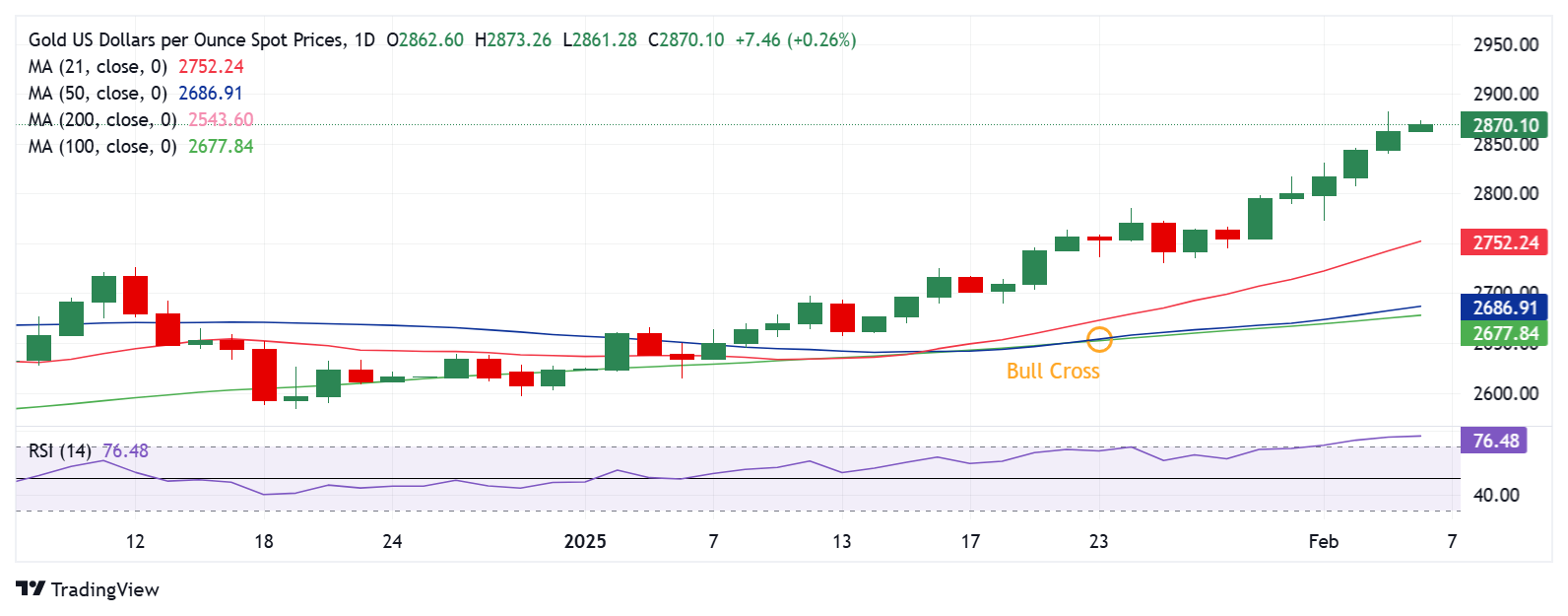
The daily chart continues to caution Gold buyers as the 14-day Relative Strength Index (RSI) remains in an extremely overbought zone, currently near 76.50.
That said, Gold price risks a pullback on a sustained move below the $2.850 level.
If the selling pressure intensifies, Gold price could challenge the $2,800 round level, below which the February 3 low of $2,772 will be tested.
However, the 50-day Simple Moving Average (SMA) and 100-day SMA Bull Cross keep hopes alive for buyers, while Gold price also managed to close Wednesday above the $2,850 psychological barrier.
Gold buyers must take out the record highs of $2,882 for further upside. The next relevant target is aligned at the $3,000 round level.
Gold FAQs
Gold has played a key role in human’s history as it has been widely used as a store of value and medium of exchange. Currently, apart from its shine and usage for jewelry, the precious metal is widely seen as a safe-haven asset, meaning that it is considered a good investment during turbulent times. Gold is also widely seen as a hedge against inflation and against depreciating currencies as it doesn’t rely on any specific issuer or government.
Central banks are the biggest Gold holders. In their aim to support their currencies in turbulent times, central banks tend to diversify their reserves and buy Gold to improve the perceived strength of the economy and the currency. High Gold reserves can be a source of trust for a country’s solvency. Central banks added 1,136 tonnes of Gold worth around $70 billion to their reserves in 2022, according to data from the World Gold Council. This is the highest yearly purchase since records began. Central banks from emerging economies such as China, India and Turkey are quickly increasing their Gold reserves.
Gold has an inverse correlation with the US Dollar and US Treasuries, which are both major reserve and safe-haven assets. When the Dollar depreciates, Gold tends to rise, enabling investors and central banks to diversify their assets in turbulent times. Gold is also inversely correlated with risk assets. A rally in the stock market tends to weaken Gold price, while sell-offs in riskier markets tend to favor the precious metal.
The price can move due to a wide range of factors. Geopolitical instability or fears of a deep recession can quickly make Gold price escalate due to its safe-haven status. As a yield-less asset, Gold tends to rise with lower interest rates, while higher cost of money usually weighs down on the yellow metal. Still, most moves depend on how the US Dollar (USD) behaves as the asset is priced in dollars (XAU/USD). A strong Dollar tends to keep the price of Gold controlled, whereas a weaker Dollar is likely to push Gold prices up.
Author

Dhwani Mehta
FXStreet
Residing in Mumbai (India), Dhwani is a Senior Analyst and Manager of the Asian session at FXStreet. She has over 10 years of experience in analyzing and covering the global financial markets, with specialization in Forex and commodities markets.

















