Gold Price Forecast: XAU/USD looks to Fed event risks for fresh directional impetus
- Gold trades listlessly near $3,330 early Tuesday amid geopolitical optimism and dovish Fed bets.
- US Dollar consolidates recovery gains as repositioning kicks in ahead of Fed events.
- Gold’s rejection at $3,350 flips the daily technical setup to bearish.

Gold is treading water early Tuesday, although in a familiar range near $3,330 as traders remain wary of placing fresh positional bets ahead of the US Federal Reserve (Fed) Minutes and the Jackson Hole Economic Symposium scheduled later this week.
Gold remains confined in a range, with downside bias
Markets appear cautiously optimistic as the highly anticipated meeting between US President Donald Trump and his Ukrainian counterpart Volodymyr Zelenskiy concluded late Monday with a promise to end hostilities between Russia and Ukraine, paving the way for a potential trilateral meeting in the coming months.
Zelenskiy said security guarantees for his nation will likely be worked out within 10 days after talks with Trump and European leaders.
North Atlantic Treaty Organization (NATO) Secretary General Mark Rutte said in Fox News interview on Monday that “Trump's meeting with Zelenskiy and other European and NATO partners was very successful,” per Reuters.
This optimism curbs the haven demand for Gold, capping its upside, while the downside remains cushioned due to heightened expectations that the Fed will lower interest rates twice this year, starting from September. Gold tends to benefit in a low-interest-rate regime.
Further, Gold also draws some support from the news that the S&P Global Ratings agency affirmed the US 'AA+/A-1+' sovereign ratings while maintaining a ‘Stable’ outlook on steady, albeit high, deficits.
Attention is now turning to the annual Kansas City Fed’s Jackson Hole Economic Policy Symposium, which will take place August 21-23.
Fed Chair Jerome Powell is due to speak on Friday on the economic outlook and the central bank's policy framework at the event.
His words will be closely scrutinized for confirmation whether the Fed will stick to its recent dovish tilt, in the face of emerging risks to the economy and the labor market.
Ahead of that, the Minutes of the July Fed meeting will also help provide markets some sense of the US central bank’s path forward on rates.
In the meantime, the geopolitical developments on the Ukraine peace deal, the US Dollar (USD) performance and the repositioning trades will have a significant influence on the Gold action.
The USD staged a decent comeback from two-week lows against its major currency rivals on Monday as position readjustments offset the risk-on market profile.
Gold price technical analysis: Daily chart
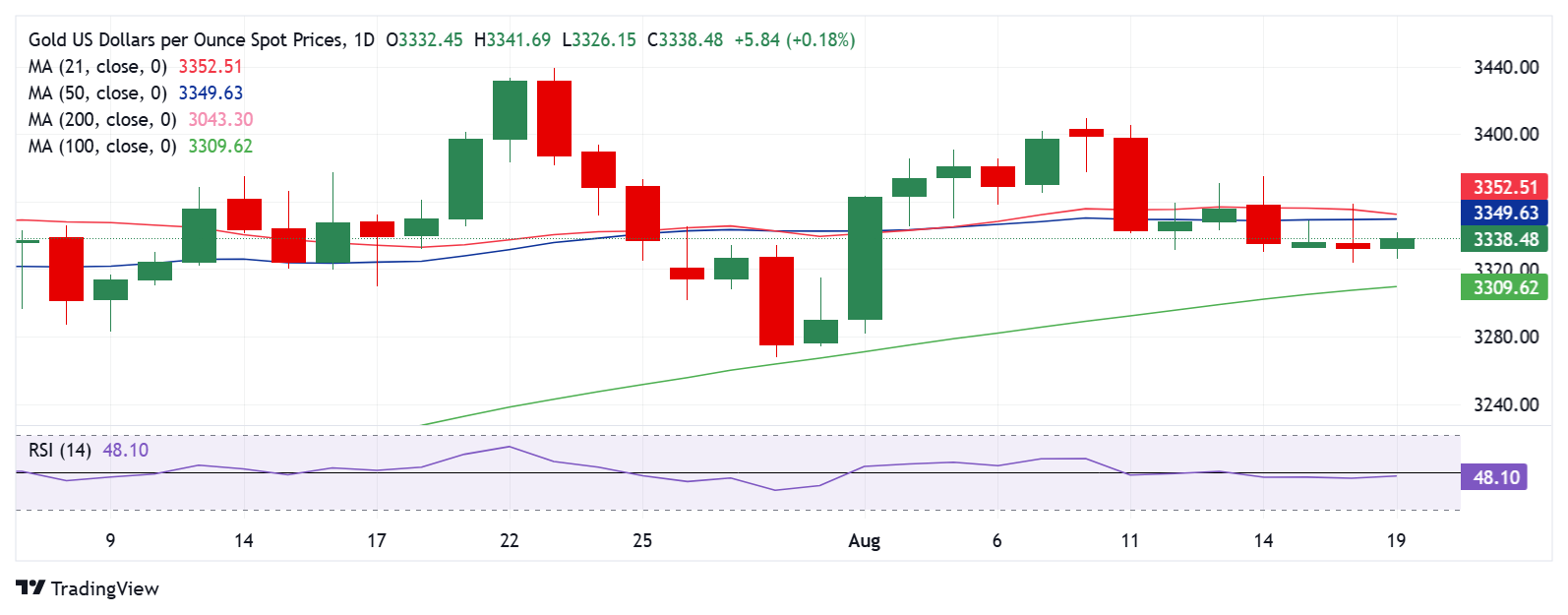
The daily chart shows that a Bear Cross is in the making as the 21-day Simple Moving Average (SMA) is closing in on the 50-day SMA from above.
Meanwhile, the 14-day Relative Strength Index (RSI) hovers below the midline, currently near 48, pointing to downside risks.
Sellers remain hopeful so long as Gold remains below the $3,352 confluence zone, where the 21-day SMA and the 50-day SMA coincide.
The next bullish targets are seen at the previous week’s high of $3,375 and the $3,400 round level.
On the flip side, the 100-day Simple Moving Average (SMA) at $3,310 could offer immediate support if the intraday low of $3,326 gives way.
Deeper declines will challenge the July 31 low of $3,274.
Gold FAQs
Gold has played a key role in human’s history as it has been widely used as a store of value and medium of exchange. Currently, apart from its shine and usage for jewelry, the precious metal is widely seen as a safe-haven asset, meaning that it is considered a good investment during turbulent times. Gold is also widely seen as a hedge against inflation and against depreciating currencies as it doesn’t rely on any specific issuer or government.
Central banks are the biggest Gold holders. In their aim to support their currencies in turbulent times, central banks tend to diversify their reserves and buy Gold to improve the perceived strength of the economy and the currency. High Gold reserves can be a source of trust for a country’s solvency. Central banks added 1,136 tonnes of Gold worth around $70 billion to their reserves in 2022, according to data from the World Gold Council. This is the highest yearly purchase since records began. Central banks from emerging economies such as China, India and Turkey are quickly increasing their Gold reserves.
Gold has an inverse correlation with the US Dollar and US Treasuries, which are both major reserve and safe-haven assets. When the Dollar depreciates, Gold tends to rise, enabling investors and central banks to diversify their assets in turbulent times. Gold is also inversely correlated with risk assets. A rally in the stock market tends to weaken Gold price, while sell-offs in riskier markets tend to favor the precious metal.
The price can move due to a wide range of factors. Geopolitical instability or fears of a deep recession can quickly make Gold price escalate due to its safe-haven status. As a yield-less asset, Gold tends to rise with lower interest rates, while higher cost of money usually weighs down on the yellow metal. Still, most moves depend on how the US Dollar (USD) behaves as the asset is priced in dollars (XAU/USD). A strong Dollar tends to keep the price of Gold controlled, whereas a weaker Dollar is likely to push Gold prices up.
Author

Dhwani Mehta
FXStreet
Residing in Mumbai (India), Dhwani is a Senior Analyst and Manager of the Asian session at FXStreet. She has over 10 years of experience in analyzing and covering the global financial markets, with specialization in Forex and commodities markets.