Gold Price Forecast: XAU/USD looks to $4,000 as the record rally resumes
- Gold sees another record run early Monday, breaking through the $3,900 barrier first time.
- Concerns over the fallout of the extended US shutdown outweigh the USD/JPY rally-led US Dollar uptick.
- Gold’s four-hour chart continues to paint a bullish picture in the near term.
Gold has extended the previous advance, rallying as much as 1% so far this Monday to clinch a new all-time high near $3,925.
Gold remains on the hunt for $4,000
Gold buyers appear unstoppable at the start of a fresh week, early Monday, despite the renewed US Dollar (USD) upswing and a risk-on rally on global stocks.
Gold is finding demand due to increased safe-haven flows, mainly driven by the murky United States (US) economic outlook in the face of the extended government shutdown, which has entered a seventh day.
There are no public signs that the Republican and Democratic lawmakers are making any efforts to end the impasse on reopening the federal government.
This deadlock has raised worries over layoffs amid already weakening US labor market conditions.
Asked on Sunday night when federal workers would be fired as he has threatened to do, US President Donald Trump said that “it's taking place right now and it's all because of the Democrats.”
“The Democrats are causing the loss of a lot of jobs,” Trump added.
Delayed US economic reports also add to the uncertainty over the US Federal Reserve’s (Fed) outlook on interest rates beyond the October 28-29 meeting.
Markets have fully priced in a 25 basis points (bps) rate cut later this month, with chances of a December rate reduction standing at about 94%, according to the CME Group’s FedWatch Tool.
The Fed’s dovish narrative combined with the US political and fiscal concerns outweighs the risk-on mood and the USD/JPY rally-driven USD rebound, powering the Gold price upside.
The Japanese Yen (JPY) sinks against the USD after “Sanae Takaichi won the Japanese ruling Liberal Democratic Party (LDP) leadership election at the weekend, setting the country on course for more expansionary fiscal policy and complicating the task facing the Bank of Japan (BoJ),” per Reuters.
Looking ahead, any fresh updates on the US shutdown talks could have a significant impact on the Greenback and Gold.
Meanwhile, any private data from the US will be closely eyed alongside speeches from Fed officials for fresh insights on the US economy and the Fed’s path forward on interest rates.
Gold price technical analysis: Four-hourly chart
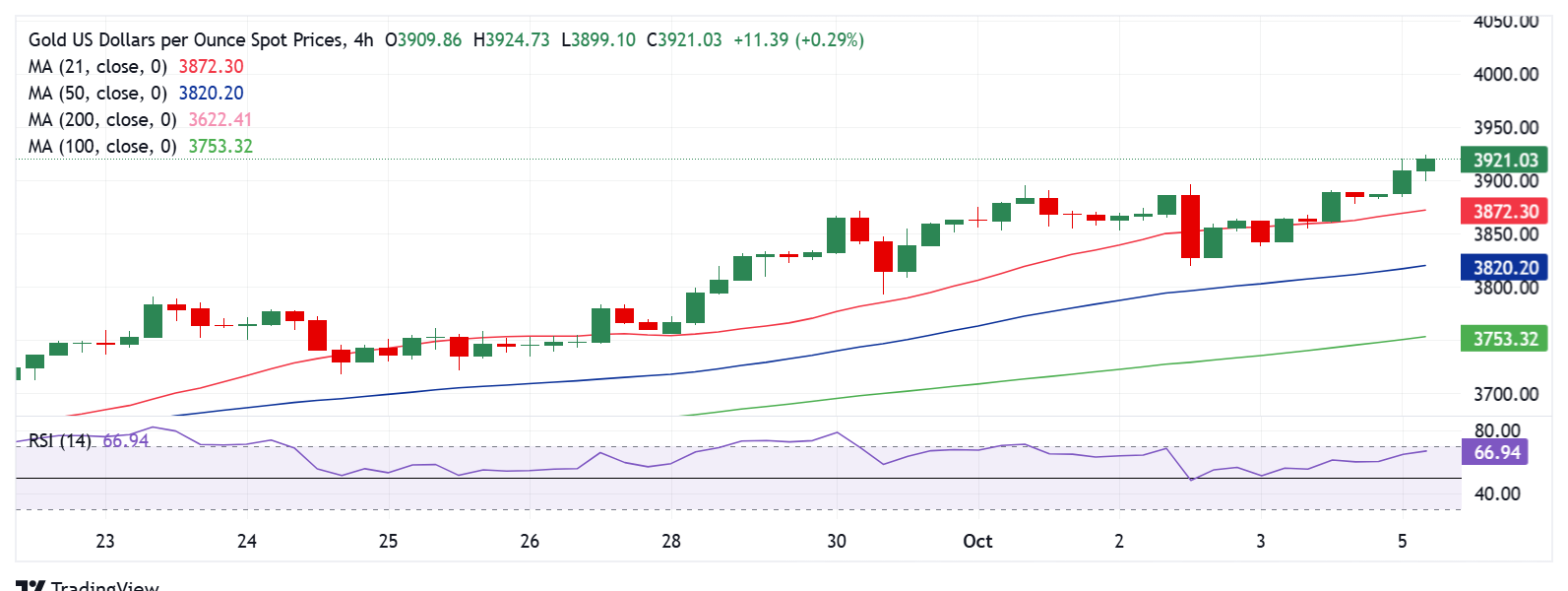
As observed on the four-hour chart, the 14-day Relative Strength Index (RSI) is approaching the overbought region, currently near 67, suggesting that there is more room to the upside in the upcoming sessions.
Buyers now target the $3,950 psychological barrier on the way to the $4,000 mark.
Alternatively, if buyers take a breather and a pullback sets in, Gold could test the initial support at $3,872, the 21-Simple Moving Average (SMA), below which a drop toward the 50-SMA at $3,820 will be inevitable.
A deeper correction could target the 100-SMA at $3,753.
Gold FAQs
Gold has played a key role in human’s history as it has been widely used as a store of value and medium of exchange. Currently, apart from its shine and usage for jewelry, the precious metal is widely seen as a safe-haven asset, meaning that it is considered a good investment during turbulent times. Gold is also widely seen as a hedge against inflation and against depreciating currencies as it doesn’t rely on any specific issuer or government.
Central banks are the biggest Gold holders. In their aim to support their currencies in turbulent times, central banks tend to diversify their reserves and buy Gold to improve the perceived strength of the economy and the currency. High Gold reserves can be a source of trust for a country’s solvency. Central banks added 1,136 tonnes of Gold worth around $70 billion to their reserves in 2022, according to data from the World Gold Council. This is the highest yearly purchase since records began. Central banks from emerging economies such as China, India and Turkey are quickly increasing their Gold reserves.
Gold has an inverse correlation with the US Dollar and US Treasuries, which are both major reserve and safe-haven assets. When the Dollar depreciates, Gold tends to rise, enabling investors and central banks to diversify their assets in turbulent times. Gold is also inversely correlated with risk assets. A rally in the stock market tends to weaken Gold price, while sell-offs in riskier markets tend to favor the precious metal.
The price can move due to a wide range of factors. Geopolitical instability or fears of a deep recession can quickly make Gold price escalate due to its safe-haven status. As a yield-less asset, Gold tends to rise with lower interest rates, while higher cost of money usually weighs down on the yellow metal. Still, most moves depend on how the US Dollar (USD) behaves as the asset is priced in dollars (XAU/USD). A strong Dollar tends to keep the price of Gold controlled, whereas a weaker Dollar is likely to push Gold prices up.
Author

Dhwani Mehta
FXStreet
Residing in Mumbai (India), Dhwani is a Senior Analyst and Manager of the Asian session at FXStreet. She has over 10 years of experience in analyzing and covering the global financial markets, with specialization in Forex and commodities markets.