Gold Price Forecast: XAU/USD looks to $2,600, as more gains remain in the offing
- Gold price extends Thursday’s bullish breakout ahead of US sentiment data on Friday.
- The US Dollar keeps the red with Treasury bond yields on renewed bets of outsized Fed rate cut bets.
- Gold price achieves a symmetrical triangle target at $2,560, with more upside likely as the RSI stays bullish.

Gold price is sitting at the highest level on record near $2,570, with buyers contemplating the next move amid sustained weakness in the US Dollar (USD) and the US Treasury bond yields. Traders now look forward to the US Michigan preliminary Consumer Sentiment data for fresh directives.
Gold price capitalizes on increased bets jumbo Fed rate cut
Gold price extended the early bounce on Thursday, as the tide turned in favor of buyers following the release of the US Producers Price Index (PPI) and Jobless Claims data, which reinforced bets of an outsized interest rate cut by the US Federal Reserve (Fed) interest rate cut next week.
The PPI increased 0.2% MoM in August, the US Bureau of Labor Statistics (BLS) said Thursday, beating the expected 0.1% increase. Excluding food and energy, PPI rose 0.3%, slightly hotter than the 0.2% consensus estimate. Annually, headline PPI rose 1.7%. Excluding food, energy and trade, the annual rate was 3.3%.
Meanwhile, the Initial Jobless Claims came in at 230,000 for the week ended Sept. 7, up 2,000 from the previous period while aligning with the forecast. Dismal US data combined with the Wall Street Journal (WSJ) article on the Fed's rate cut dilemma brought back bets for a jumbo cut at the September meeting.
The US Dollar snapped its recovery mode and fell steeply on dovish Fed expectations, tracking the sell-off in the US Treasury bond yields.
The USD also bore the brunt of the resurgent demand for the Euro after the European Central Bank (ECB) on Thursday cut rates but President Christine Lagarde poured cold water on the expectations for another cut next month. The Hawkish cut by the ECB sent EUR/USD higher at the expense of the Greenback.
These factors added to the Gold price rebound, driving the bright metal to a fresh lifetime high of $2,560 on Thursday.
In Friday’s trading so far, Gold price witnessed a fresh leg higher and renewed record highs at $2,568, as Asian traders hit their desks and reacted to the overnight optimism surrounding the renewed dovish bets surrounding the Fed announcements next week.
However, buyers are catching their breath at the moment, as they turn slightly cautious heading into the weekend. Markets could resort to repositioning ahead of next week’s Fed policy meeting, fuelling a corrective decline in Gold price. Also, the end-of-the-week flows could play a pivotal role in the Gold price action alongside the release of the US Consumer Sentiment and Inflation Expectations data.
Gold price technical analysis: Daily chart
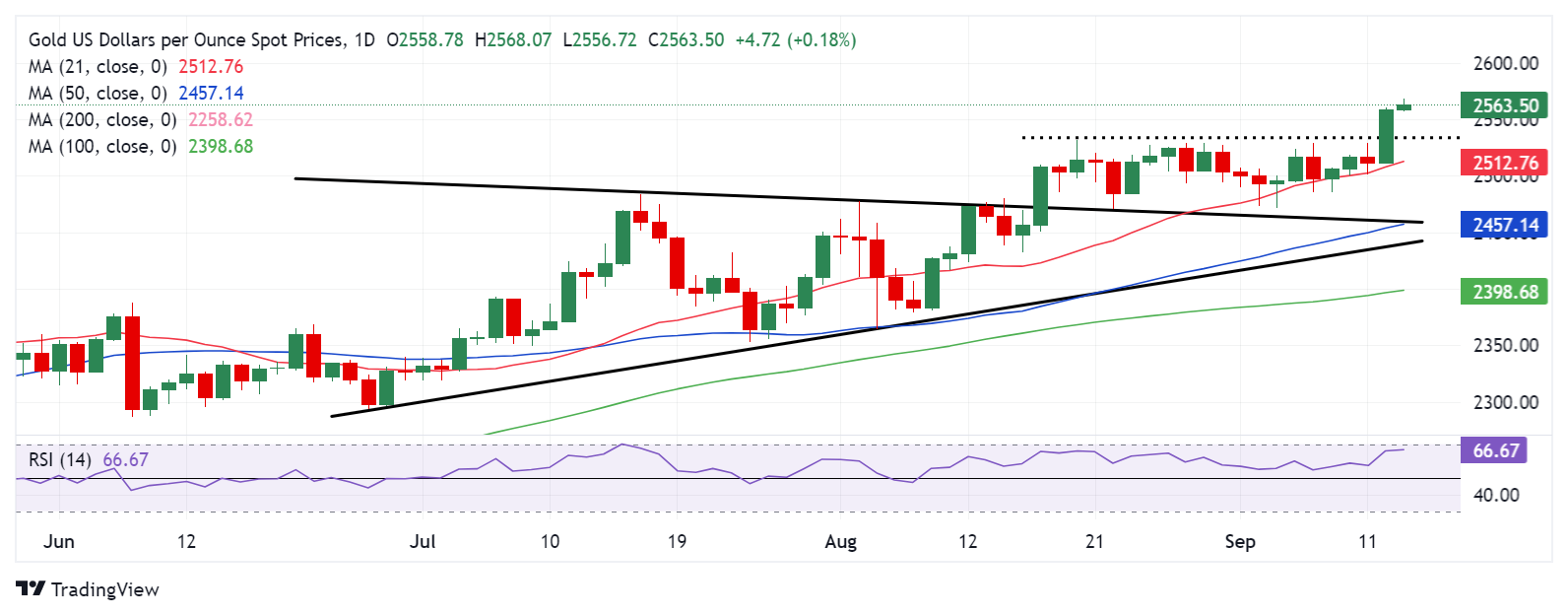
As observed on the daily chart, Gold price finally yielded a breakout after closing Thursday above the upper boundary of the three-week-old trading range, pegged at the previous record high of $2,532.
Meanwhile, the 21-day Simple Moving Average (SMA), now at $2,513, continued to offer strong support to Gold buyers.
With the range breakout in play, Gold price finally achieved the one-and-a-half-month-old symmetrical triangle target, measured at $2,560.
Despite the relentless rise, the 14-day Relative Strength Index (RSI) still holds in the bullish territory, with room for more upside until it prods the overbought boundary. The RSI indicator currently trades near 66.50.
If Gold price extends its bullish momentum, the next upside hurdle is seen at the $2,600 level, above which the $2,650 psychological level will be tested.
Should a correction ensue, the initial support is seen at the previous record high of $2,532, below which the 21-day SMA at $2,513 will be put to the test.
A sustained break below the latter is needed to challenge the key $2,500 threshold.
Gold FAQs
Gold has played a key role in human’s history as it has been widely used as a store of value and medium of exchange. Currently, apart from its shine and usage for jewelry, the precious metal is widely seen as a safe-haven asset, meaning that it is considered a good investment during turbulent times. Gold is also widely seen as a hedge against inflation and against depreciating currencies as it doesn’t rely on any specific issuer or government.
Central banks are the biggest Gold holders. In their aim to support their currencies in turbulent times, central banks tend to diversify their reserves and buy Gold to improve the perceived strength of the economy and the currency. High Gold reserves can be a source of trust for a country’s solvency. Central banks added 1,136 tonnes of Gold worth around $70 billion to their reserves in 2022, according to data from the World Gold Council. This is the highest yearly purchase since records began. Central banks from emerging economies such as China, India and Turkey are quickly increasing their Gold reserves.
Gold has an inverse correlation with the US Dollar and US Treasuries, which are both major reserve and safe-haven assets. When the Dollar depreciates, Gold tends to rise, enabling investors and central banks to diversify their assets in turbulent times. Gold is also inversely correlated with risk assets. A rally in the stock market tends to weaken Gold price, while sell-offs in riskier markets tend to favor the precious metal.
The price can move due to a wide range of factors. Geopolitical instability or fears of a deep recession can quickly make Gold price escalate due to its safe-haven status. As a yield-less asset, Gold tends to rise with lower interest rates, while higher cost of money usually weighs down on the yellow metal. Still, most moves depend on how the US Dollar (USD) behaves as the asset is priced in dollars (XAU/USD). A strong Dollar tends to keep the price of Gold controlled, whereas a weaker Dollar is likely to push Gold prices up.
Author

Dhwani Mehta
FXStreet
Residing in Mumbai (India), Dhwani is a Senior Analyst and Manager of the Asian session at FXStreet. She has over 10 years of experience in analyzing and covering the global financial markets, with specialization in Forex and commodities markets.