Gold Price Forecast: XAU/USD looks north towards 1,790, focus on BOE, yields
- Gold price keeps the green after a volatile ride on Wednesday.
- US dollar eases with Treasury yields amid a broad market optimism.
- XAU/USD eyes $1,790 and BOE but the main driver remains the yields.

Gold price is looking to build onto Wednesday’s rebound, as bulls continue to keep their eyes on the critical $1,790 resistance amid a renewed downtick in the US dollar and the Treasury yields. Risk flows extend into Thursday’s trading so far, as investors cheer strong US corporate guidance and easing US-China tensions over Taiwan. US House Speaker Nancy Pelosi departed Taiwan on Wednesday, which has helped calm market nerves, although investors view her visit as a bigger geopolitical game. Meanwhile, fresh covid lockdowns in China and further Fed tightening expectations continue to stoke recession fears, boding well for the traditional safe-haven gold. The risks of an economic downturn are being signaled by the US bond markets, as the yields remain vulnerable despite the rebound seen earlier this week.
The focus now shifts towards the US employment data, as the weekly Jobless Claims are due on the cards on Thursday. The Initial Jobless Claims continue to hold near eight-month highs and markets predict that a sustained rise in the numbers could alarm recession bells for the world’s largest economy. Friday’s US Nonfarm Payrolls hold the key, with a rise of 250K expected in July. Ahead of the US jobs data, the Bank of England (BOE) is set to announce a 50 bps rate hike this ‘Super Thursday’, although the hints on the bank’s future tightening path and voting pattern will have a significant impact on the pound and risk sentiment, eventually influencing the non-interest bearing yellow metal.
Also read: BOE Rate Decision Preview: Bailey to follow Powell’s footsteps with a dovish hike
XAU/USD witnessed good two-way businesses a day before, closely following the moves in the greenback. Despite the hawkish Fed commentary, the dollar closed in the red, as strong US earnings and ISM Services PMI lifted the overall market mood. More Fed policymakers voiced their view that more tightening is needed to rein in inflation. San Francisco Fed President Mary Daly, however, favored a 50 bps hike at the September meeting. Meanwhile, the US ISM Services Prices Paid component came in at 72.3, lower than the previous but still at a reasonably high level. Money markets now price in a 42% chance of a 75 bps Sept Fed rate hike, according to the CME FedWatch Tool.
Gold price technical outlook: Daily chart
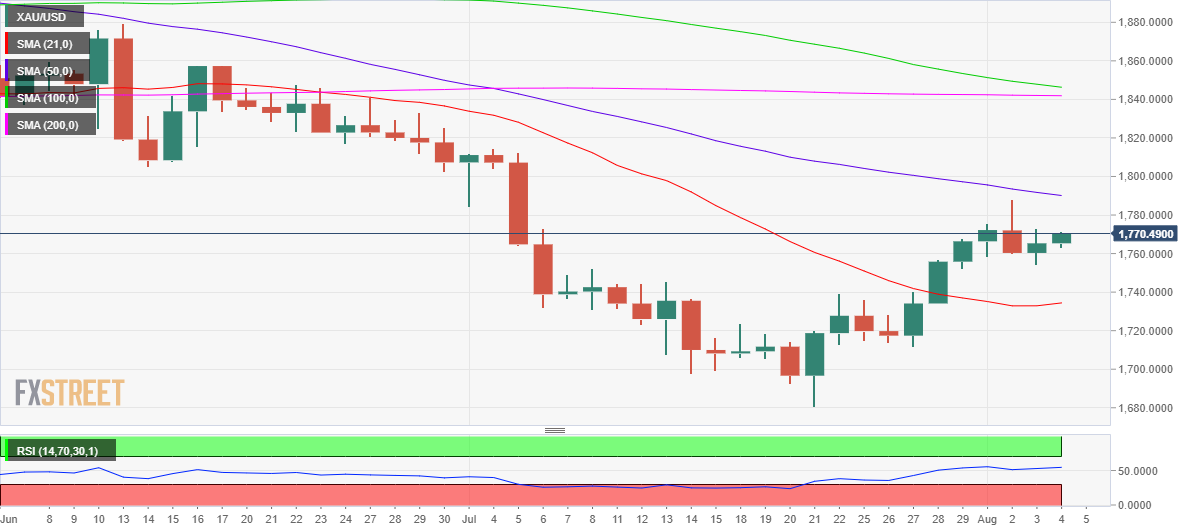
Nothing seems to have changed technically for Gold price, as it continues to yearn for a sustained move above the downward-sloping 50-Daily Moving Average (DMA), now at $1,790.
Ahead of that barrier, bulls need to recapture the July 6 high of $1,773. If the upside momentum gains traction above the 50 DMA, then a test of the $1,800 mark will be inevitable.
The 14-day Relative Strength Index (RSI) remains firmer above the midline, keeping buyers hopeful.
On the flip side, the immediate support is seen at $1,760 the figure, below which the previous day’s low of $1,754 could be challenged again.
The $1,750 psychological and the mildly bullish 21 DMA at $1,734 will be the next stop for bears should a fresh downswing kick in.
Author

Dhwani Mehta
FXStreet
Residing in Mumbai (India), Dhwani is a Senior Analyst and Manager of the Asian session at FXStreet. She has over 10 years of experience in analyzing and covering the global financial markets, with specialization in Forex and commodities markets.