Gold Price Forecast: XAU/USD keeps falling on relentless US Dollar recovery
- Gold price extends losses to hit weekly lows below $3,250 early Thursday.
- The US Dollar recovers further on the US court’s tariff ruling, cautious Fed Minutes and upbeat mood.
- Gold buyers appear to give up as the RSI breaches the midline, critical support near $3,295 cracked.

Gold price is extending its four-day bearish streak early Thursday, flirting with the lowest level in a week near $3,250.
Gold price gives into the US Dollar resurgence
The buying interest around the US Dollar (USD) remains unabated so far this week, with the latest leg up powered by the cautious Minutes of the US Federal Reserve’s (Fed) May policy meeting and a US federal court’s ruling that blocked President Donald Trump’s "Liberation Day" tariffs.
The court deemed such tariffs illegal, citing that Trump didn't have the authority to impose across-the-board duties on imports from nations that sell more to the United States (US) than they buy, per Reuters.
Meanwhile, the Fed Minutes read, “participants agreed that uncertainty about the economic outlook had increased further, making it appropriate to take a cautious approach until the net economic effects of the array of changes to government policies become clearer.”
Furthermore, the upbeat market mood on the back of encouraging earnings report from the American artificial intelligence (AI) pioneer Nvidia, showing a strong revenue forecast.
The earnings showed a $44.06bn of revenue for last quarter, beating industry estimates of $43.2bn, earnings per share also beat estimates at $0.96, vs. $0.93.
The market optimism helped the US Dollar bolster its recovery, offsetting any impact of the ongoing US-China trade tension.
According to the latest report, by the New York Times (NYT) the Trump administration is moving to restrict the sale of critical US technologies, including those related to jet engines, semiconductors, and certain chemicals, to China.
Attention now turns to the mid-tier US economic data releases and speeches from a slew of Fed policymakers for some respite to Gold buyers.
A bout of profit-taking in the Greenback could be on the cards ahead of Friday’s US core Personal Consumption Expenditure (PCE) Price Index, the Fed’s preferred inflation measure.
The data could pour cold water on the Fed’s recent hawkish stance and likely trigger a fresh pullback in the USD, allowing Gold price to stage a comeback.
In the meantime, US weekly Jobless Claims and the revision to Gross Domestic Product (GDP) data could provide some trading incentives to the USD and Gold traders.
Trade headlines and geopolitical updates will also continue to play a critical role in the Gold price performance.
Gold price technical analysis: Daily chart
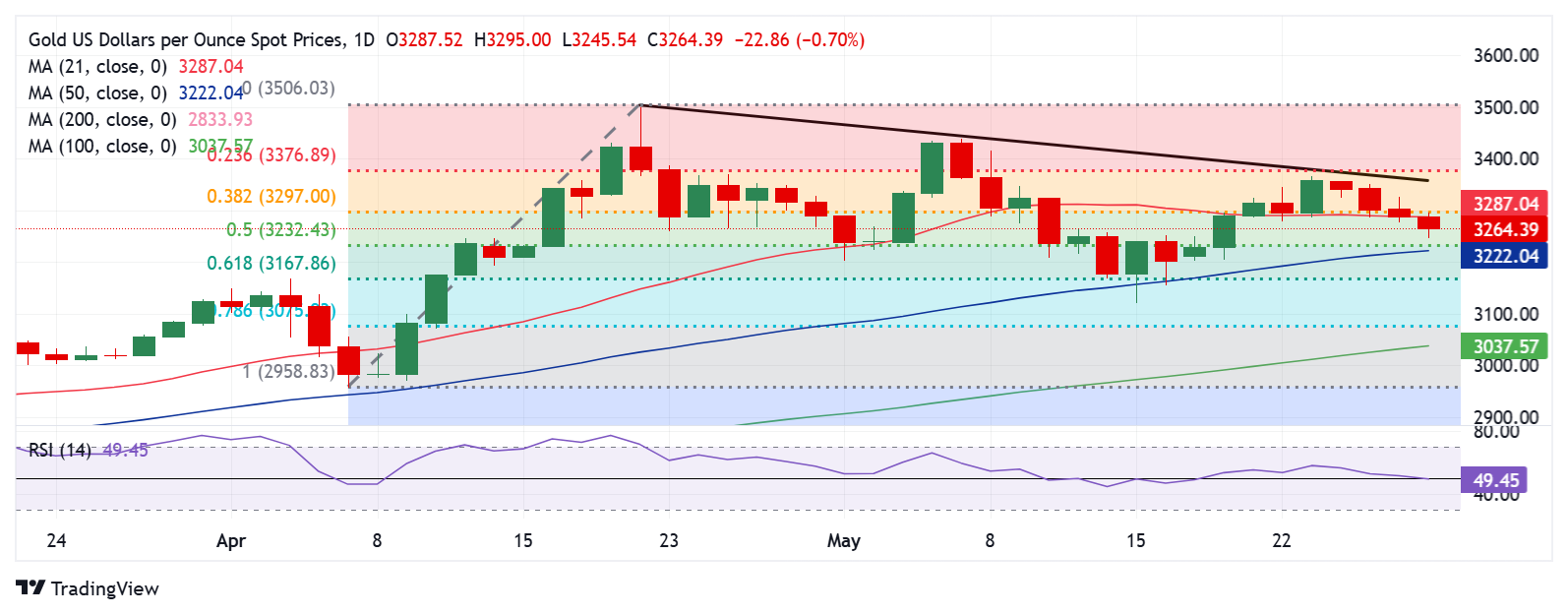
The tide seems to have turned in favor of sellers in the near term as the 14-day Relative Strength Index (RSI) tests waters below the midline, currently near 49.50.
Also, Gold buyers failed to defend a powerful demand area near $3,295, which was the confluence of the 21-day Simple Moving Average (SMA) and the 38.2% Fibo of the April record rally..The next test for them is the 50% Fibo support near $3,230, where the 50-day SMA closes in, making that zone a tough nut to crack.
A daily candlestick closing below that level could put the focus back on the 61.8% Fibo support at $3,168, from where Gold price rebounded to two-week highs of $3,366 last week.
Alternatively, if Gold price bounces off the abovementioned critical support area near $3,230, buyers could recapture the 21-day SMA, now at $3,287.
The next immediate resistance is aligned near $3,300 where the 38.2% Fibo level and the round level coincide.
Further up, a sustained break above the $3,350 psychological level is needed to resume the uptrend.
Gold FAQs
Gold has played a key role in human’s history as it has been widely used as a store of value and medium of exchange. Currently, apart from its shine and usage for jewelry, the precious metal is widely seen as a safe-haven asset, meaning that it is considered a good investment during turbulent times. Gold is also widely seen as a hedge against inflation and against depreciating currencies as it doesn’t rely on any specific issuer or government.
Central banks are the biggest Gold holders. In their aim to support their currencies in turbulent times, central banks tend to diversify their reserves and buy Gold to improve the perceived strength of the economy and the currency. High Gold reserves can be a source of trust for a country’s solvency. Central banks added 1,136 tonnes of Gold worth around $70 billion to their reserves in 2022, according to data from the World Gold Council. This is the highest yearly purchase since records began. Central banks from emerging economies such as China, India and Turkey are quickly increasing their Gold reserves.
Gold has an inverse correlation with the US Dollar and US Treasuries, which are both major reserve and safe-haven assets. When the Dollar depreciates, Gold tends to rise, enabling investors and central banks to diversify their assets in turbulent times. Gold is also inversely correlated with risk assets. A rally in the stock market tends to weaken Gold price, while sell-offs in riskier markets tend to favor the precious metal.
The price can move due to a wide range of factors. Geopolitical instability or fears of a deep recession can quickly make Gold price escalate due to its safe-haven status. As a yield-less asset, Gold tends to rise with lower interest rates, while higher cost of money usually weighs down on the yellow metal. Still, most moves depend on how the US Dollar (USD) behaves as the asset is priced in dollars (XAU/USD). A strong Dollar tends to keep the price of Gold controlled, whereas a weaker Dollar is likely to push Gold prices up.
Author

Dhwani Mehta
FXStreet
Residing in Mumbai (India), Dhwani is a Senior Analyst and Manager of the Asian session at FXStreet. She has over 10 years of experience in analyzing and covering the global financial markets, with specialization in Forex and commodities markets.

















