Gold Price Forecast: XAU/USD hits fresh three-month low below $4,000 amid surging energy prices
- Gold price extends its decline to near $3986.74 as oil prices rise further.
- Energy supply risks due to Middle East tensions continue to support oil prices.
- The Fed is expected to leave interest rates unchanged next week.

Gold slides to a fresh three-month low at $3,986.74 in the Asian trade on Friday. The precious metal faces intense selling pressure, following a consolidation breakdown that took place on the range between $4,227.90 and $4,066.64 in the past three weeks.
Let’s unpack forces pressuring Gold price
Rallying energy prices due to persistent tensions in the Middle East and risks of a fresh escalation in conflicts between the United States (US) and Iran have prompted fears of further acceleration in inflation expectations. Such a case boosts expectations that global central banks would maintain a “hawkish” stance on the monetary policy outlook for a prolong period. This increases the opportunity cost of holding Gold for longer. As of writing, the WTI Oil price is up 1% near $100.
Analysts at Commerzbank report that Middle East tensions “intensified after a drone attack on Saudi Arabia's Shaybah oil field killed two people and injured two others,” but note that the impact on crude was ultimately contained. They highlight that “oil prices briefly jumped on reports suggesting a wider withdrawal of US diplomatic personnel from the Gulf,” before the move faded as “Washington clarified that the order was limited to Saudi Arabia,” prompting the market to pare earlier gains.
To curb energy supply issues, US President Donald Trump, in a presidential memo, has invoked part of the Cold War-era Defense Production Act, allowing him to provide financial incentives for oil-related activities, pipelines and storage of liquid fuels.
Fed’s policy to provide cues on interest rate outlook
The next major trigger for Gold is the Federal Reserve’s (Fed) monetary policy announcement next week on Wednesday, in which it is highly anticipated to leave interest rates unchanged in the 3.75%-4.00% range.
Financial markets will pay close attention to commentary from Fed Chairman Kevin Warsh regarding the inflation outlook and the overall demand structure on the back of rising Artificial Intelligence (AI) adoption.
Latest remarks from Fed Chair Warsh exhibited that elevated inflationary pressures have been a key concern for the central bank.
Gold Technical Analysis
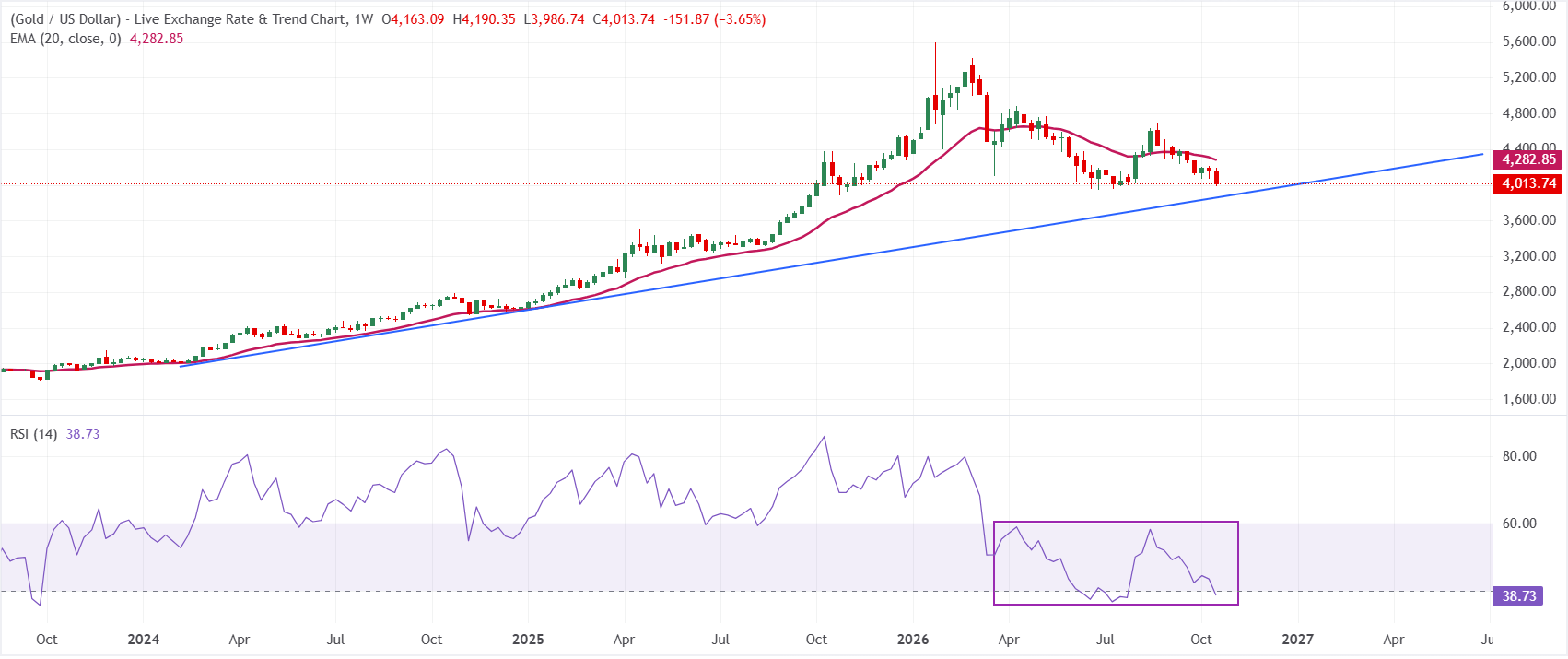
In the weekly chart, XAU/USD trades at $4,014.25, keeping a bearish near-term tone as it holds below the 20-week exponential moving average (EMA) at $4,282.89. The pair is hovering not far above the broken upward trend line, which now offers structural support around $3,873.44, while the Relative Strength Index (RSI) at 38.75 stays in neutral-to-weak territory and hints that downside momentum is still present but not yet capitulative.
On the downside, Societe Generale sees Gold price declining towards the June low at $3,960/3,940 and projections near $3,830 on the breakdown the three-week long $4,066.64-$4,227.90 consolidation. On the topside, initial resistance is aligned with the 20-week EMA at $4,282.89, and a sustained move above this barrier would be needed to ease the current bearish bias and allow XAU/USD to retrace higher.
(The technical analysis of this story was written with the help of an AI tool. Know more.)
Gold FAQs
Gold has played a key role in human’s history as it has been widely used as a store of value and medium of exchange. Currently, apart from its shine and usage for jewelry, the precious metal is widely seen as a safe-haven asset, meaning that it is considered a good investment during turbulent times. Gold is also widely seen as a hedge against inflation and against depreciating currencies as it doesn’t rely on any specific issuer or government.
Central banks are the biggest Gold holders. In their aim to support their currencies in turbulent times, central banks tend to diversify their reserves and buy Gold to improve the perceived strength of the economy and the currency. High Gold reserves can be a source of trust for a country’s solvency. Central banks added 1,136 tonnes of Gold worth around $70 billion to their reserves in 2022, according to data from the World Gold Council. This is the highest yearly purchase since records began. Central banks from emerging economies such as China, India and Turkey are quickly increasing their Gold reserves.
Gold has an inverse correlation with the US Dollar and US Treasuries, which are both major reserve and safe-haven assets. When the Dollar depreciates, Gold tends to rise, enabling investors and central banks to diversify their assets in turbulent times. Gold is also inversely correlated with risk assets. A rally in the stock market tends to weaken Gold price, while sell-offs in riskier markets tend to favor the precious metal.
The price can move due to a wide range of factors. Geopolitical instability or fears of a deep recession can quickly make Gold price escalate due to its safe-haven status. As a yield-less asset, Gold tends to rise with lower interest rates, while higher cost of money usually weighs down on the yellow metal. Still, most moves depend on how the US Dollar (USD) behaves as the asset is priced in dollars (XAU/USD). A strong Dollar tends to keep the price of Gold controlled, whereas a weaker Dollar is likely to push Gold prices up.
Author

Sagar Dua
FXStreet
Sagar Dua is associated with the financial markets from his college days. Along with pursuing post-graduation in Commerce in 2014, he started his markets training with chart analysis.