The bull market isn't over: Silver setting up for next leg higher
There’s not a lot of bullishness in the silver market right now.
After surging to just over $120 per ounce in January, silver corrected and has lost more than half its value.
Given the metal's trajectory over the last 10 months, bearishness is understandable. But as technical analyst Jesse Colombo pointed out in a recent Substack article, many investors delivering silver’s last rites today only started paying attention as silver neared that $120 peak.
“They piled in near the very top, just weeks or even days before silver peaked at $121, only to lose interest when it corrected, as all overheated assets eventually do. Then they simply moved on to what they believe is the latest and greatest hot asset, whether it’s an overvalued and overhyped AI stock, a new cryptocurrency, or whatever else the lemmings are currently piling into.”
Colombo believes these investors have completely missed the big picture.
“Naturally, most of those same investors had practically no interest in silver when I foresaw the bull market beginning in early 2024, when it was still trading in the $20s. Now that silver has cooled off, they are once again nowhere to be found.”
And Colombo thinks they are about to miss out on “the next powerful leg of this bull market.”
“This is the time to be paying close attention and accumulating while it is still quite cheap. The next move is going to take most investors by surprise, and they will only want to pile back in once silver is overheated again and all over the news.”
A cup of Silver
Colombo said he has been following a “silver bull market roadmap” for the past couple of years. That roadmap is a massive cup-and-handle pattern that's been forming since the 1960s.
A cup-and-handle pattern is an extremely bullish technical indicator.
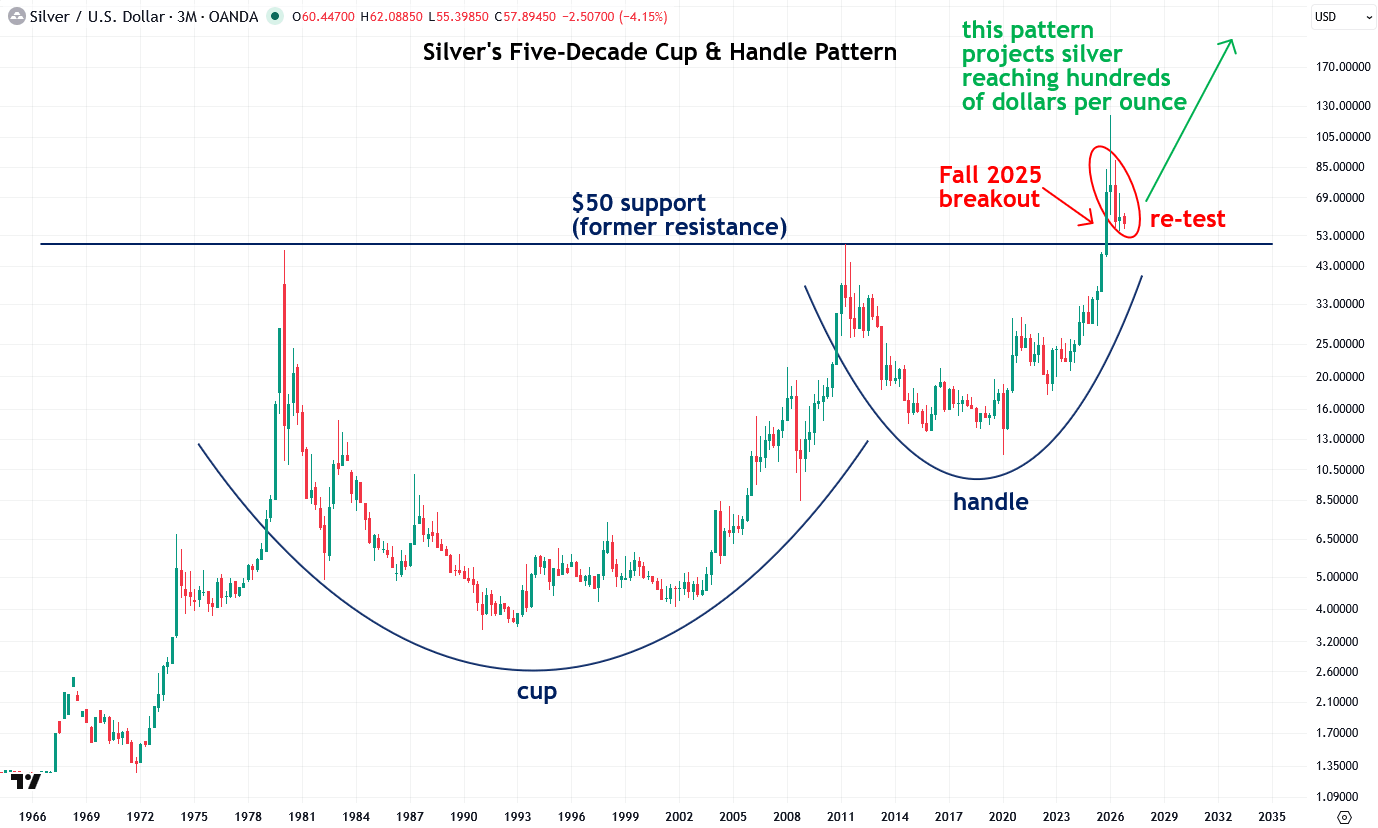
As Colombo noted, this decades-in-the-making pattern “projects the metal reaching hundreds of dollars per ounce following a breakout.”
That breakout occurred when silver finally surged through $50 last October.
That $50 level served as a firm resistance level for decades. Silver hit that level twice: the first time in the 1980s, and then again nearly two years after the Great Recession. Colombo said that now that silver broke this resistance, history tells us silver is poised for a massive run higher.
“Although silver has since cooled off, the breakout remains very much valid and in play, and I see the next powerful leg higher beginning soon once this necessary cooling-off period is complete.”
After the breakout, Colombo warned that silver was due for a “healthy cooling-off period,” but it would not mark the end of the bull market.
“I continue to stand by that view today.”
Colombo noted that the “relative strength index (RSI)” tracks sentiment in the silver market. The RSI clearly shows that silver became extremely overheated and overbought in late 2025 and early 2026.
Today, the RSI has moderated, revealing that silver is closer to oversold. Colombo said this indicates, “the worst of the correction is behind us and that anyone calling for a sharp crash from here has the odds stacked against them.”
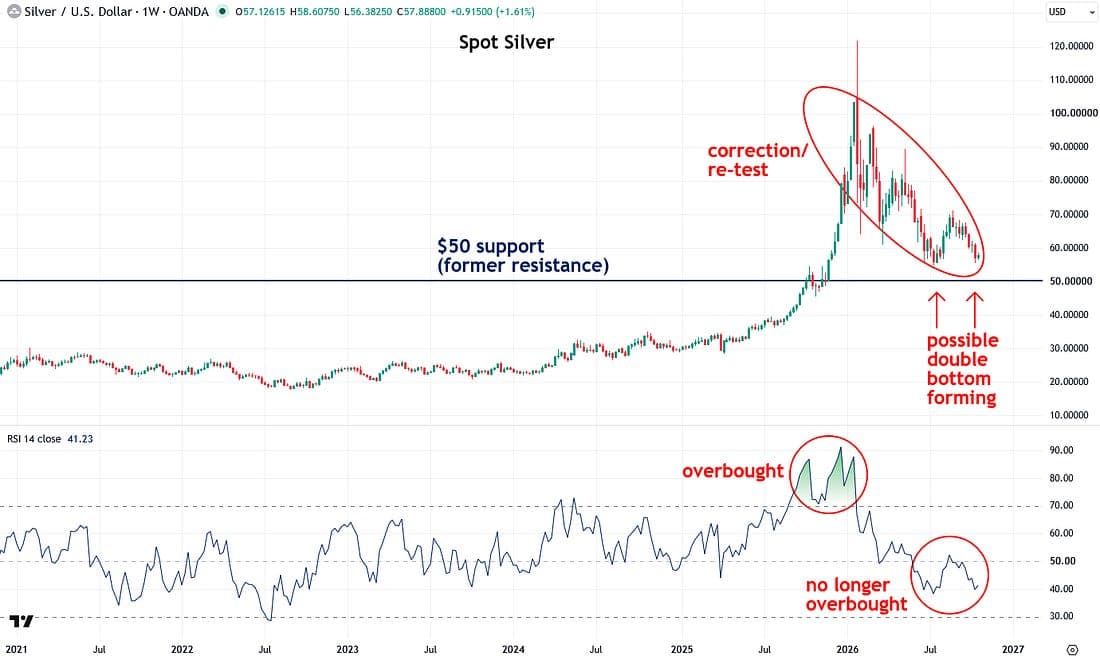
Colombo noted that silver has held the $50 support level throughout the correction.
“This means silver’s breakout remains fully intact and in play as long as it continues to hold above $50, which has now become a key support level.”
Colombo pointed out that silver appears to be forming a “double bottom.” We might see a final flush that pushes silver below $50 before it ultimately bottoms and then off on the next leg higher. But he said this isn’t his “base-case expectation.”
“There is no hard-and-fast rule that says silver must precisely touch the $50 support level before its correction can come to an end.”
The gold-silver ratio is another key technical indicator for silver. This ratio tells you how many ounces of silver it takes to buy an ounce of gold at the current spot price. For instance, a ratio of 70-1 means it takes 70 ounces of silver to buy an ounce of gold.
In the modern era, the gold-silver ratio has averaged between 40-1 and 60-1. When it rises far above that level, it tends to snap back to the mean as silver prices rise and close the gap.
Colombo notes that the gold-silver ratio is currently in a triangle pattern, a common occurrence when asset prices pause and consolidate.
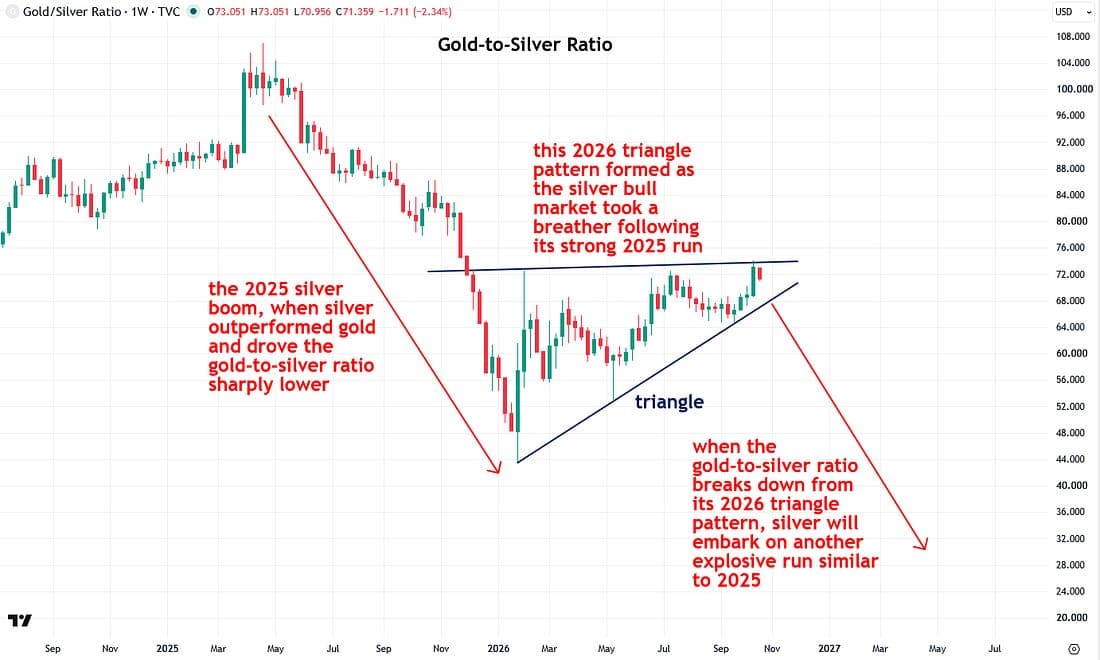
“In technical analysis, triangle patterns often act as continuation patterns, meaning that once the necessary consolidation or cooling-off period has run its course, the original trend resumes in the same direction, setting the stage for a repeat of the prior move.”
Colombo said that when this pattern breaks down, he expects it will kick off the next phase of the bull market. At that point, silver will likely surge back to its record high of $121 and beyond.
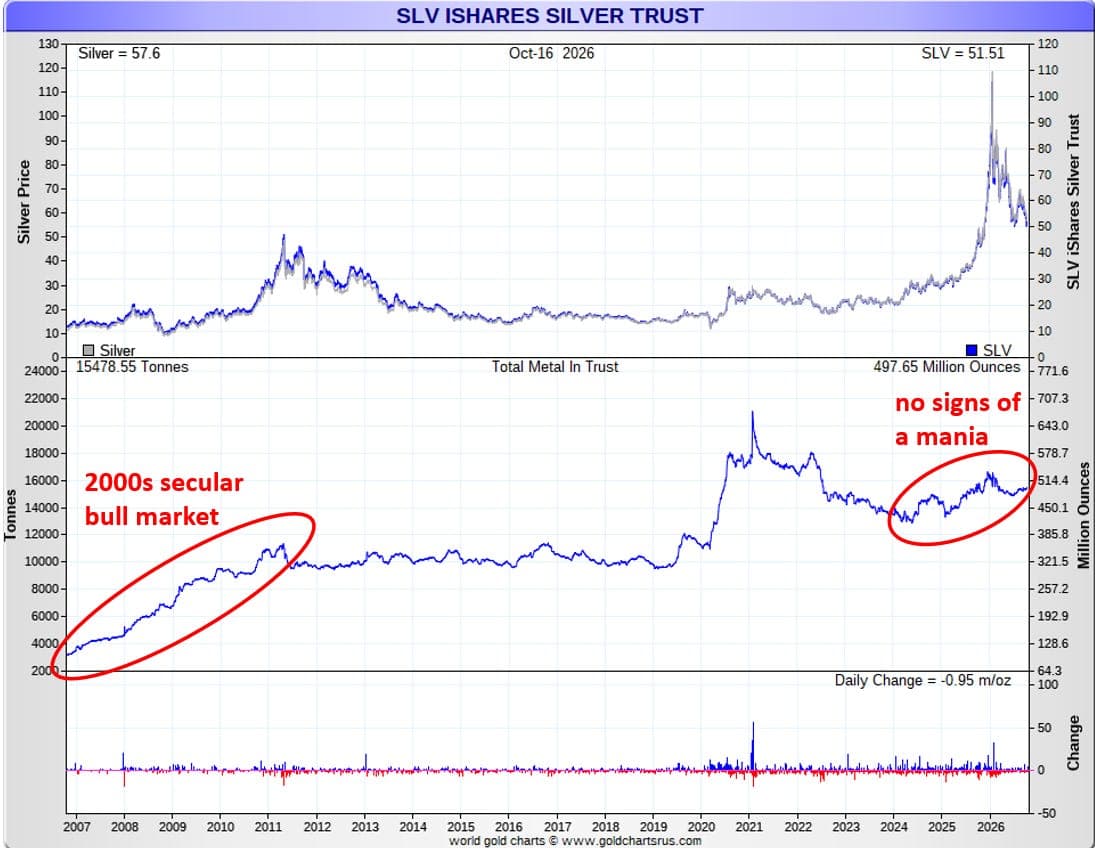
Finally, Colombo said that the fact we never saw true silver mania grip the market supports his belief that this is a short-term correction, not a top and a pending multi-year bear market. He noted that iShares Silver Trust reported a “lukewarm” 30 million ounce increase in silver holdings even as the price increased sixfold.
“That kind of lukewarm interest from American investors is simply not what you would expect to see during a true bubble mania immediately before a violent collapse and years of declining prices. My bet, however, is that the real mania still lies ahead of us and will begin to unfold once silver surpasses its January peak of $121, ultimately taking the metal into the hundreds of dollars per ounce.”
Colombo also noted that American Silver Eagle sales “fell off a cliff” during those years.
“To me, this is further confirmation that silver’s long-term bull market did not end in January 2026. There simply was not enough mainstream investor participation to mark a true secular peak.”
Colombo concludes, asserting that “mainstream investors are notoriously fickle, and that seems to be especially true when it comes to silver.”
“They tend to take an interest only after silver is already posting explosive gains, pile in too late just before a correction, and then blame silver when they lose money, claiming that it is a bad investment. The reality is that the problem is not silver or silver miners, but their own poor timing and investing behavior.”
Colombo said that this correction presents a buying opportunity.
“The time to pay close attention and accumulate is when silver seems boring, and investors are giving up on it, because that is when it is setting up for its next leg higher. I sincerely believe that is where we are today. The 2026 correction has tested investors’ patience, but those who stayed the course will be richly rewarded when silver’s next powerful leg higher begins.”
To receive free commentary and analysis on the gold and silver markets, click here to be added to the Money Metals news service.
Author

Mike Maharrey
Money Metals Exchange
Mike Maharrey is a journalist and market analyst for MoneyMetals.com with over a decade of experience in precious metals. He holds a BS in accounting from the University of Kentucky and a BA in journalism from the University of South Florida.