Gold Price Forecast: XAU/USD focuses on daily close below $2,330 and US ISM PMI
- Gold price mires in over two-week lows near $2,325 amid the Middle East optimism.
- The US Dollar eases with US Treasury bond yields, as the mood stays upbeat.
- The daily RSI returns below the 50 level, as Gold price eyes acceptance below the key 50-day SMA support at $2,330.

Gold price is licking its wounds while trading close to over two-week lows of $2,321, setting off the week on cautious footing. Gold price fails to find inspiration from broadly softer US Dollar and negative US Treasury bond yields.
Israel-Hamas developments, US ISM PMI in focus
Gold price is feeling the pull of gravity, courtesy of the risk-on market mood, following a late rebound in the US stocks and some optimism surrounding the Israel-Hamas conflict. Markets are digesting the latest developments on the Middle East geopolitical situation after US President Joe Biden on Friday outlined a three-stage ceasefire plan aimed at de-escalating the conflict between Israel and Hamas.
Hamas welcomed US President Biden's cease-fire proposal for Gaza, affirming its readiness to deal positively with any proposal that offers a permanent cease-fire. Israeli Prime Minister Benjamin Netanyahu, however, rejected the idea of a permanent ceasefire, maintaining his firm stance on Israel’s conditions for ending the war.
Despite Israel’s rejection, Hamas’s positive response is keeping market participants hopeful about the potential easing of tensions between the two. The extended risk rally keeps the downward pressure intact on the safe-haven Gold price.
Further, markets also cheer encouraging China’s S&P Global Caixin Manufacturing PMI data, which improved from 51.4 in April to 51.7 in May, beating the estimated 51.5 figure. The fastening pace of recovery in the country’s manufacturing sector added to the overall economic optimism.
Looking ahead, if risk-on flows accelerate, the US Dollar and the Gold price could come under renewed selling pressure, although a strong US ISM Manufacturing PMI could save the day for the Greenback buyers. However, Gold price could still remain at the mercy of sellers.
Gold price failed to find any relief from a softer-than-expected US monthly Core Personal Consumption Expenditure (PCE) Price Index on Friday.
Attention now turns toward this week’s US employment data, which will offer fresh hints on the timing of the first interest rate cut by the US Federal Reserve (Fed).
In the meantime, the focus will remain on the developments between Israel and Hamas and the US ISM Manufacturing PMI on Monday.
Gold price technical analysis: Daily chart
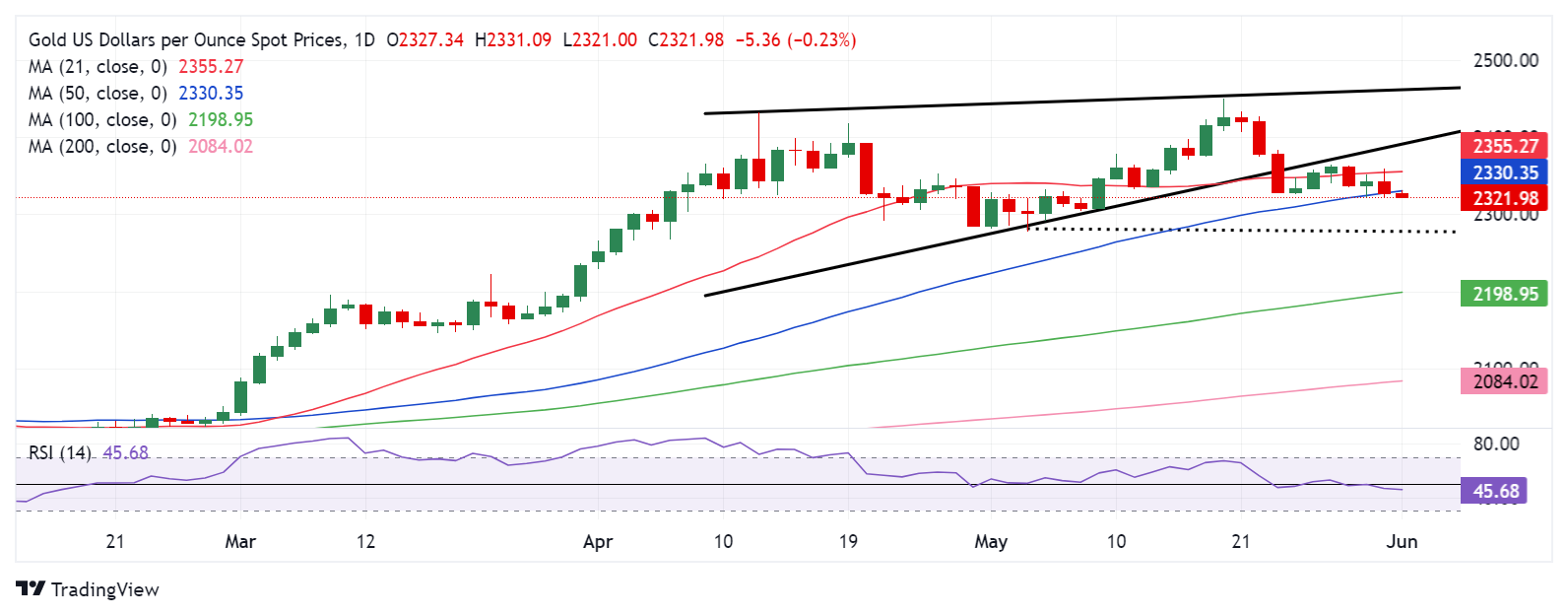
As observed on the daily chart, the Gold price has breached the key 50-day Simple Moving Average (SMA) support at $2,330 early Monday.
However, Gold sellers need a daily candlestick closing below the latter to confirm a sustained breakdown.
The 14-day Relative Strength Index (RSI) is edging lower below the midline, suggesting that sellers are likely to retain control in the near term.
The next downside target for Gold price is seen at the $2,300 level, below which a drop toward the May 3 low of $2,277 will be in the offing.
Alternatively, any rebound would need acceptance above the 21-day SMA at $2,355. Further up, the May 24 high of $2,364 will come into play.
A sustained move above that level will fuel a run toward the rising wedge support-turned-resistance, then at $2,391.
Gold FAQs
Gold has played a key role in human’s history as it has been widely used as a store of value and medium of exchange. Currently, apart from its shine and usage for jewelry, the precious metal is widely seen as a safe-haven asset, meaning that it is considered a good investment during turbulent times. Gold is also widely seen as a hedge against inflation and against depreciating currencies as it doesn’t rely on any specific issuer or government.
Central banks are the biggest Gold holders. In their aim to support their currencies in turbulent times, central banks tend to diversify their reserves and buy Gold to improve the perceived strength of the economy and the currency. High Gold reserves can be a source of trust for a country’s solvency. Central banks added 1,136 tonnes of Gold worth around $70 billion to their reserves in 2022, according to data from the World Gold Council. This is the highest yearly purchase since records began. Central banks from emerging economies such as China, India and Turkey are quickly increasing their Gold reserves.
Gold has an inverse correlation with the US Dollar and US Treasuries, which are both major reserve and safe-haven assets. When the Dollar depreciates, Gold tends to rise, enabling investors and central banks to diversify their assets in turbulent times. Gold is also inversely correlated with risk assets. A rally in the stock market tends to weaken Gold price, while sell-offs in riskier markets tend to favor the precious metal.
The price can move due to a wide range of factors. Geopolitical instability or fears of a deep recession can quickly make Gold price escalate due to its safe-haven status. As a yield-less asset, Gold tends to rise with lower interest rates, while higher cost of money usually weighs down on the yellow metal. Still, most moves depend on how the US Dollar (USD) behaves as the asset is priced in dollars (XAU/USD). A strong Dollar tends to keep the price of Gold controlled, whereas a weaker Dollar is likely to push Gold prices up.
Author

Dhwani Mehta
FXStreet
Residing in Mumbai (India), Dhwani is a Senior Analyst and Manager of the Asian session at FXStreet. She has over 10 years of experience in analyzing and covering the global financial markets, with specialization in Forex and commodities markets.