Gold Price Forecast: XAU/USD eyes best month in 14 years as US government shutdown looms
- Gold’s record rally appears relentless, mainly driven by the rush for safe havens as Q3 draws to an end.
- US Dollar stalls its downside, but a partial US government shutdown looms amid an imminent Fed rate cut in October.
- Technically, Gold risks a correction amid extreme overbought conditions on the daily chart.
Gold flirts with record highs at around the $3,850 level early Tuesday, heading for the best month in 14 years.
Gold cheers US government shutdown risks, Fed easing bets
With the third quarter of 2025 and the month of September drawing to a close, Gold has gained as much as 12% during the month, with buyers capitalizing on a sustained rush to safety amid a looming partial government shutdown in the United States (US).
US fiscal concerns remain a drag on the US Dollar (USD), especially after Vice President JD Vance noted that "I think we're headed to a shutdown.”
His comments came after US President Donald Trump and his Democratic opponents appeared to make little progress at a White House meeting aimed at averting the shutdown beyond a Tuesday midnight deadline (Wednesday 4 GMT).
Additionally, Gold continues to benefit from increased expectations of a US Federal Reserve (Fed) interest rate cut next month, with markets now pricing in about a 90% chance of such a move, according to the CME Group’s FedWatch Tool.
On Monday, St. Louis Fed President Alberto Musalem said he was open to further rate cuts but the Fed must be cautious and keep rates high enough to continue to lean against inflation, per Reuters.
Meanwhile, ongoing geopolitical tensions between Israel and Hamas and Russia and NATO nations keep underpinning the sentiment around the traditional store of value, Gold, while traders also weigh the latest Trump tariff talks.
Trump slapped 10% tariffs on imports of softwood timber and lumber, as well as 25% levies on kitchen cabinets, vanities and upholstered wood products to shore up domestic manufacturing. The tariffs are set to apply from October 14, with some increases targeted to take effect from Jan. 1, according to a proclamation he signed on Monday.
Mostly upbeat PMI readings from China also help Gold prolong its record run. China’s official NBS Manufacturing PMI rose to 49.8 in September versus 49.6 expected and 49.4 previous, while the Non-Manufacturing PMI eased a bit to 50 in the same month.
The private RatingDog Survey, showed that the country’s Manufacturing PMI edged higher to 51.2 in September, compared to August’s 50.5. China is the world’s top yellow metal consumer.
Looking ahead, concerns over a potential partial US government shutdown will likely cushion any downside in Gold fuelled by the month- and quarter-end flows.
Markets also remain wary about the publication of the US labor data in the event of a government shutdown on Wednesday.
The US Labor Department confirmed on Monday that its statistics agency would suspend economic data releases, including the closely-watched monthly employment report for September, if the shutdown occurs.
Gold price technical analysis: Daily chart
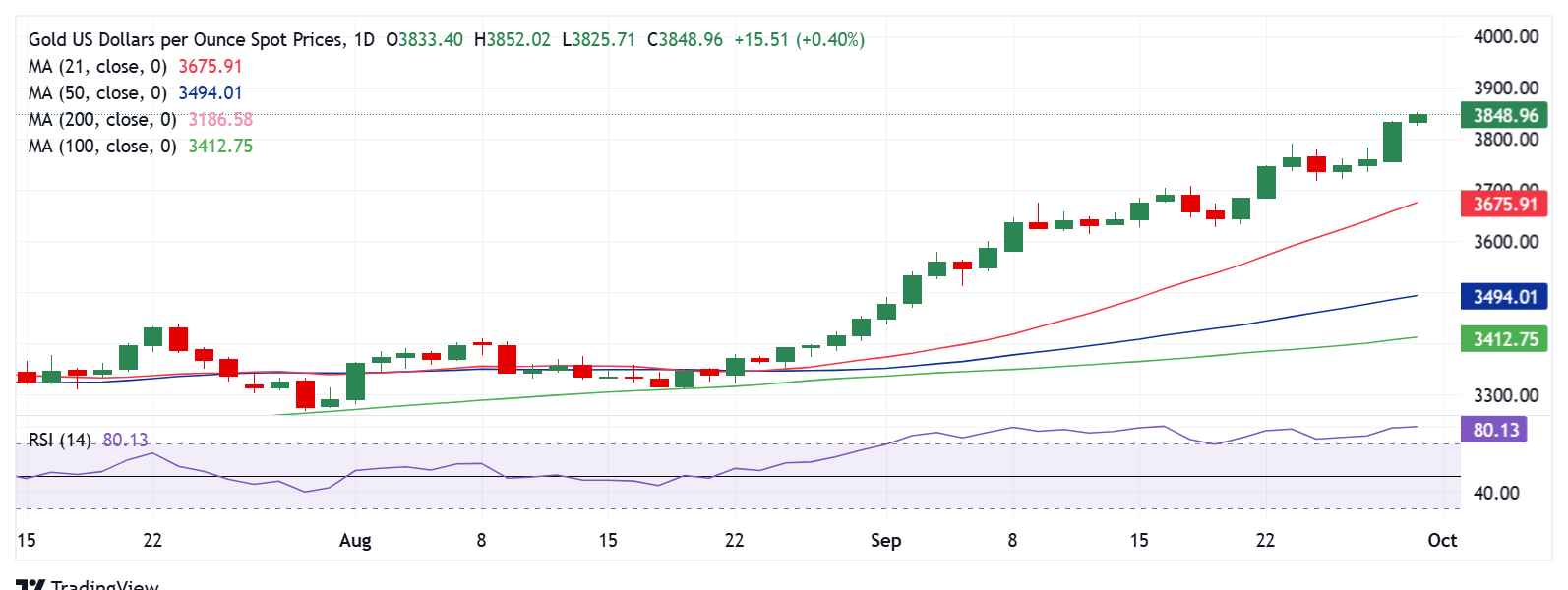
Technically, buyers could turn cautious as the 14-day Relative Strength Index (RSI) moves deeper within the extreme overbought region.
The leading indicator currently trades above 80, suggesting buyers’ exhaustion could set in sooner (than later).
However, if buyers refuse to give up, acceptance above the $3,850 psychological level on a daily closing basis is critical.
The next topside hurdle is located at the $3,900 barrier as the hunt for the $4,000 mark picks up steam.
On the flip side, any retracement pullback could test the initial support at $3,800, below which the previous day’s low of $3,757 will be threatened.
Deeper correction could target the September 24 low at $3,718, followed by the $3,700 round level.
Gold FAQs
Gold has played a key role in human’s history as it has been widely used as a store of value and medium of exchange. Currently, apart from its shine and usage for jewelry, the precious metal is widely seen as a safe-haven asset, meaning that it is considered a good investment during turbulent times. Gold is also widely seen as a hedge against inflation and against depreciating currencies as it doesn’t rely on any specific issuer or government.
Central banks are the biggest Gold holders. In their aim to support their currencies in turbulent times, central banks tend to diversify their reserves and buy Gold to improve the perceived strength of the economy and the currency. High Gold reserves can be a source of trust for a country’s solvency. Central banks added 1,136 tonnes of Gold worth around $70 billion to their reserves in 2022, according to data from the World Gold Council. This is the highest yearly purchase since records began. Central banks from emerging economies such as China, India and Turkey are quickly increasing their Gold reserves.
Gold has an inverse correlation with the US Dollar and US Treasuries, which are both major reserve and safe-haven assets. When the Dollar depreciates, Gold tends to rise, enabling investors and central banks to diversify their assets in turbulent times. Gold is also inversely correlated with risk assets. A rally in the stock market tends to weaken Gold price, while sell-offs in riskier markets tend to favor the precious metal.
The price can move due to a wide range of factors. Geopolitical instability or fears of a deep recession can quickly make Gold price escalate due to its safe-haven status. As a yield-less asset, Gold tends to rise with lower interest rates, while higher cost of money usually weighs down on the yellow metal. Still, most moves depend on how the US Dollar (USD) behaves as the asset is priced in dollars (XAU/USD). A strong Dollar tends to keep the price of Gold controlled, whereas a weaker Dollar is likely to push Gold prices up.
Author

Dhwani Mehta
FXStreet
Residing in Mumbai (India), Dhwani is a Senior Analyst and Manager of the Asian session at FXStreet. She has over 10 years of experience in analyzing and covering the global financial markets, with specialization in Forex and commodities markets.