Gold Price Forecast: XAU/USD extends rally as US debt concerns continue to drag US Dollar
- Gold price rises to near $4,550 amid continued underperformance by the US Dollar.
- Mounting US debt concerns have improved Gold’s safe-haven appeal.
- The Fed is expected to leave interest rates unchanged in the September meeting.

Gold price (XAU/USD) is up 0.65% at around $4,550 during the early European trading session on Friday, the highest level seen in over 11 weeks. The precious metal capitalizes on a weak US Dollar (USD), which has been hit hard, as the Treasury’s decision to double down on long-term debt buybacks has amplified market concerns over escalating borrowing costs and the growing fiscal strain from the government’s ballooning debt.
As of writing, the US Dollar Index (DXY), which gauges the Greenback’s value against six major currencies, trades 0.1% lower at around 98.73. The USD Index is closer to its three-month low of 98.55 posted on Thursday.
A lower US Dollar makes the Gold price a favorable risk-reward bet for investors.
The announcement of faster US debt-repayment plans led to a sharp plunge in US bond yields and the US Dollar. However, there has been a strong recovery in Treasury yields, but the Greenback continues to face the heat.
Financial markets doubt that US Treasury Secretary Scott Bessent’s aggressive bond-buyback plan is enough to contain higher borrowing costs, but seem confident that to be vulnerable for the US Dollar.
US Treasury buybacks seen risking confidence in Dollar assets
Analysts at MUFG argue that if, as Scott Bessent suggests, policymakers are serious about addressing market concerns, then the US Treasury “could play a key role here by of course addressing the ever-expending fiscal deficit with fiscal consolidation.”
However, they add that “we all know that’s not going to happen,” and warn that the latest buyback announcement, combined with the “FIMA report comment to Japan following intervention,” risks proving “counter-productive” by leading to “reduced appetite for either holding US assets (UST bond sales) or reduced appetite for exposure to the US dollar (dollar selling) or both.” MUFG concludes that “even if the Treasury buy-back plan does contain yields, the US dollar now remains more vulnerable to the downside on the fact that yields are potentially lower.”
Gold’s next move largely relies on Fed’s policy actions
Strategists at GoldSilver Central have said that “Gold's upward trajectory would be determined by what the Federal Reserve (Fed) decides to do next and how those policies impact market rate expectations”, Reuters reports.
This shifts all focus to Fed Chairman Kevin Warsh’s speech at the Jackson Hole Symposium, which is scheduled for August 27-29.
However, history shows that the Fed Chairman is not a fan of delivering so-called “forward guidance” on the monetary policy.
Meanwhile, the CME FedWatch tool shows that the Fed is anticipated to leave interest rates unchanged in the September policy meeting.
Gold Technical Forecast
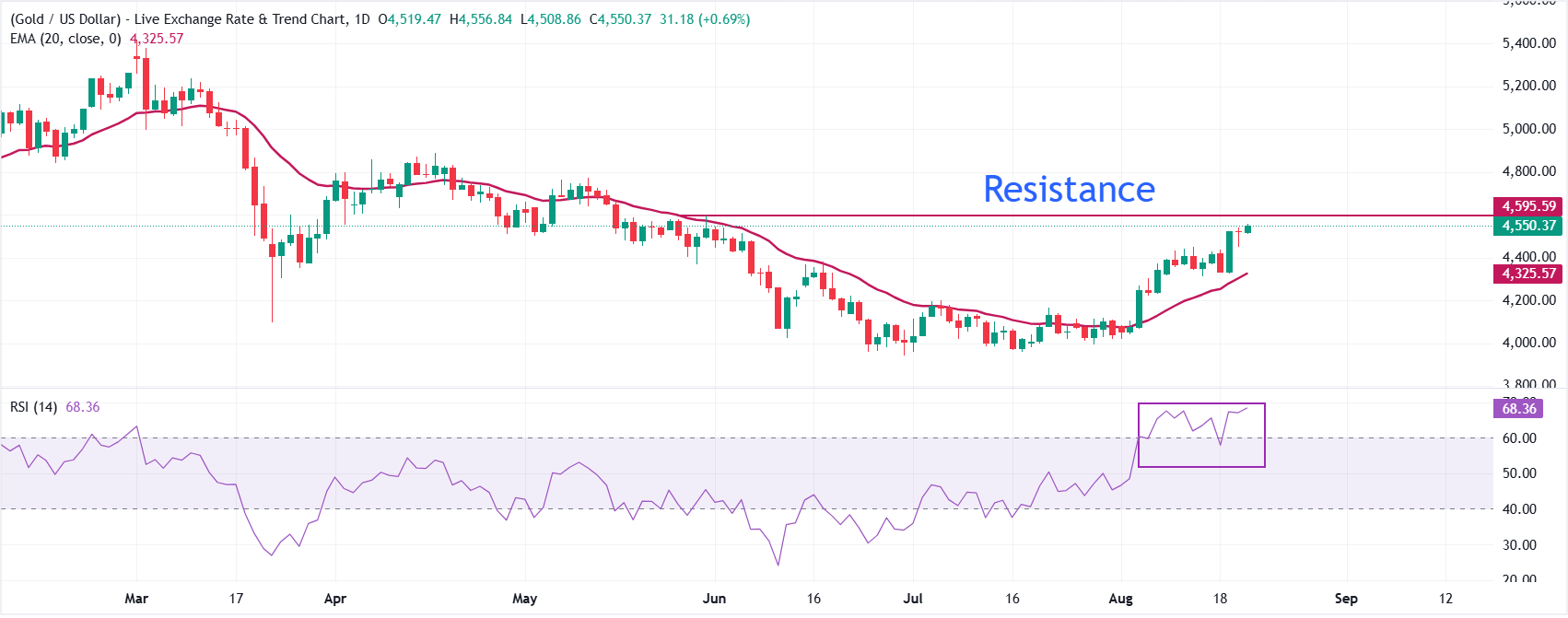
In the daily chart, XAU/USD trades at around $4,550, extending its advance well above the 20-day exponential moving average (EMA) at $4,325.64 and reinforcing a bullish near-term bias. The distance between spot and the EMA suggests a strong upside extension rather than a balanced trend, while the Relative Strength Index (14) at 68.39 flirts with overbought territory, hinting that bullish momentum remains firm but increasingly stretched.
On the downside, initial support is seen at the 20-day EMA around $4,325.64, which should act as the first dynamic floor on any corrective pullback. Looking up, the precious metal could extend its advance towards the May 29 high at $4,595.34.
(The technical analysis of this story was written with the help of an AI tool. Know more.)
Gold FAQs
Gold has played a key role in human’s history as it has been widely used as a store of value and medium of exchange. Currently, apart from its shine and usage for jewelry, the precious metal is widely seen as a safe-haven asset, meaning that it is considered a good investment during turbulent times. Gold is also widely seen as a hedge against inflation and against depreciating currencies as it doesn’t rely on any specific issuer or government.
Central banks are the biggest Gold holders. In their aim to support their currencies in turbulent times, central banks tend to diversify their reserves and buy Gold to improve the perceived strength of the economy and the currency. High Gold reserves can be a source of trust for a country’s solvency. Central banks added 1,136 tonnes of Gold worth around $70 billion to their reserves in 2022, according to data from the World Gold Council. This is the highest yearly purchase since records began. Central banks from emerging economies such as China, India and Turkey are quickly increasing their Gold reserves.
Gold has an inverse correlation with the US Dollar and US Treasuries, which are both major reserve and safe-haven assets. When the Dollar depreciates, Gold tends to rise, enabling investors and central banks to diversify their assets in turbulent times. Gold is also inversely correlated with risk assets. A rally in the stock market tends to weaken Gold price, while sell-offs in riskier markets tend to favor the precious metal.
The price can move due to a wide range of factors. Geopolitical instability or fears of a deep recession can quickly make Gold price escalate due to its safe-haven status. As a yield-less asset, Gold tends to rise with lower interest rates, while higher cost of money usually weighs down on the yellow metal. Still, most moves depend on how the US Dollar (USD) behaves as the asset is priced in dollars (XAU/USD). A strong Dollar tends to keep the price of Gold controlled, whereas a weaker Dollar is likely to push Gold prices up.
Author

Sagar Dua
FXStreet
Sagar Dua is associated with the financial markets from his college days. Along with pursuing post-graduation in Commerce in 2014, he started his markets training with chart analysis.