Gold Price Forecast: XAU/USD downside remains compelling whilst below 50 DMA
- Gold price falls for the second day in a row as US Dollar regains poise after Friday’s sell-off.

- Investors stay cautious ahead of key inflation data from China and the United States.
- Gold price looks to $1,910 on a sustained move below $1,925 amid a beairsh daily RSI.
Gold price is extending the previous decline toward the three-week low of $1,926 early Tuesday. A fresh risk-aversion wave seems to be acting as a tailwind, reviving the safe-haven demand for the United States Dollar (USD), as traders eagerly await China’s and US inflation data for a fresh directional impetus in the Gold price.
Risk sentiment to play a pivotal role ahead of key inflation reports
Following the mixed United States labor market data-led sell-off in the US Dollar, the Greenback regained the upside traction against its major peers at the start of the week, capitalizing on the market’s anxiety ahead of the key inflation data releases from both China, as well as the US.
The US Dollar also cheered the hawkish commentary from US Federal Reserve (Fed) Governor Michelle Bowman alongside the US Treasury bond yields. Bowman said at an event in Atlanta on Monday, "I will be looking for evidence that inflation is on a consistent and meaningful downward path as I consider whether further increases in the federal funds rate will be needed, and how long the federal funds rate will need to remain at a sufficiently restrictive level.”
According to the CME Group's FedWatch Tool, around 86.5% of market participants expect the central bank not to hike interest rates in September. Investors continue to remain hopeful of a final Fed rate hike this year, awaiting Thursday’s Consumer Price Index (CPI) data from the United States to confirm any expectations of a Fed rate hike going forward. Resurgent demand for the US Dollar knocked Gold price back toward multi-month troughs.
So far this Tuesday’s trading, investors are flocking to safety in the US Dollar amid escalating geopolitical risks between China and Japan over Taiwan. Japan's Liberal Democratic Party's Aso said that “in Taipai, we are moving from peacetime to times of turbulence.” “Japan has continued to say that peace and Taiwan Strait are important for regional stability,” Aso added.
Meanwhile, concerns over China’s economic recovery intensified after the country’s fell 14.5% in July on an annual basis while imports tumbled 12.4%, the latest data from China Customs showed on Tuesday. The Greenback remained supported following the Chinese trade figures, keeping Gold price on the back foot. The downside in the Gold price, however, appears capped, courtesy of a sluggish performance in the US Treasury bond yields across the curve.
Attention now turns toward Wednesday’s Chinese CPI and Producer Price Index (PPI) data, as traders await further signs of deflation in the world's second-largest economy. Traders will also take cues from the sentiment on Wall Street and Fedspeak, in the absence of top-tier US economic data releases this Tuesday.
Gold price technical analysis: Daily chart
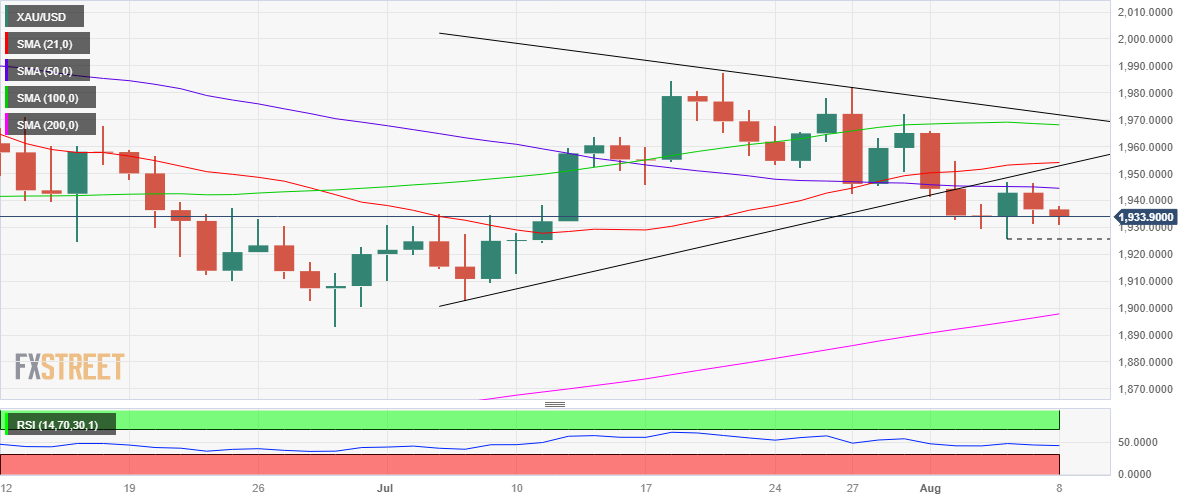
Gold price continued to face rejection at the flattish 50-Daily Moving Average (DMA) at $1,945, reinforcing selling interest toward the three-week lows of $1,926.
Immediate support is seen at the $1,930 level. Further south, a sustained break below the multi-week low of $1,926 is needed to extend the downtrend toward the $1,910 demand area.
The 14-day Relative Strength Index (RSI) indicator edges lower below the midline, suggesting that the path of least resistance for Gold price appears to the downside.
On the flip side, acceptance above the 50 DMA at $1,945 is critical to unleashing additional recovery toward the bullish 21 DMA at $1,954. The next relent upside barrier is envisioned at $1,961, which is the triangle support-turned-resistance.
Author

Dhwani Mehta
FXStreet
Residing in Mumbai (India), Dhwani is a Senior Analyst and Manager of the Asian session at FXStreet. She has over 10 years of experience in analyzing and covering the global financial markets, with specialization in Forex and commodities markets.

















