Gold Price Forecast: XAU/USD defends $3,300, but for how long?
- Gold price holds its rebound from three-week troughs early Tuesday.
- The US Dollar stalls its uptrend ahead of day 2 of US-China trade talks; awaits data, Fed.
- Technically, the path of least resistance for Gold price appears to the downside.

Gold price is struggling to extend the previous bounce from three-week lows of $3,302 even as sellers take a breather ahead of mid-tier US data due later this Tuesday.
Gold price comes up for air ahead of key US event risks
Gold buyers try their luck as traders attempt to take profits on their short positions, repositioning themselves before the critical US second-quarter Gross Domestic Product (GDP) data and the US Federal Reserve policy announcements scheduled on Wednesday.
Markets have turned cautious, digesting the recent US trade deals with its major allies, while slightly disappointed as day 1 of the US-China trade talks in Stockholm ended without any outcome. Talks are set to continue on Tuesday.
Reports are doing the rounds that the US-China trade truce could extend for another quarter.
This, alongside a pause in the US Dollar’s (USD) uptrend seems to be offering some comfort to the bright metal.
Further, Gold price draws support from the revival in its demand as a hedge against inflation, amid a spike in Oil prices, after Trump threatened a new deadline of 10 or 12 days for Russia to make progress toward ending the war in Ukraine or face tougher sanctions on oil exports.
However, it remains to be seen if Gold price extends Monday’s late rebound as the USD could likely regain its bullish momentum on US economic optimism and trade deals progress.
On Monday, the US Dollar caught a fresh bid wave against its major competitors, as the Euro (EUR) witnessed an intense sell-off on the market’s realization that terms of the trade deal between the US and the European Union favored the former and hardly lifted the economic outlook of the bloc, per Reuters.
France and Germany were quick to condemn the trade deal with the US, citing that the bloc had caved in to US President Donald Trump demand with an unbalanced deal that imposed a blanket 15% tariff on EU goods.
Gold price technical analysis: Daily chart
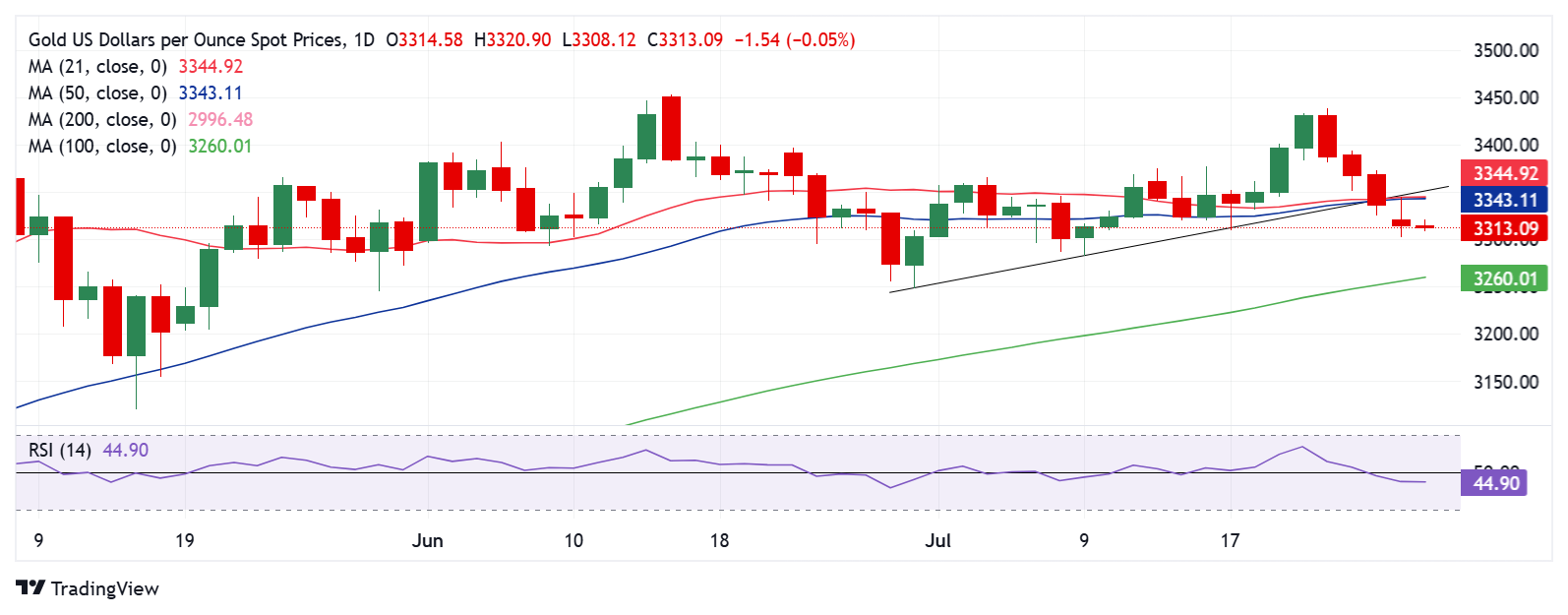
The daily chart shows that Gold price remains exposed to downside risks, especially after Monday’s extension below the critical rising trendline support at $3,342.
The 14-day Relative Strength Index (RSI) stays below the midline, currently near 45, justifying the bearish potential.
Gold price could retest the three-week lows of $3,302, below which the July 9 low of $3,283 will be tested.
The last line of defense for Gold buyers is placed at the June 30 low of $3,248.
On the flip side, recapturing the strong support-turned-resistance near $3,345 on a daily closing basis is critical for initiating a meaningful recovery.
That level is the confluence of the rising trendline resistance, 21-day Simple Moving Average (SMA) and the 50-day SMA.
The next topside hurdle is seen at the $3,380 static resistance en route to the $3,400 mark.
Fed FAQs
Monetary policy in the US is shaped by the Federal Reserve (Fed). The Fed has two mandates: to achieve price stability and foster full employment. Its primary tool to achieve these goals is by adjusting interest rates. When prices are rising too quickly and inflation is above the Fed’s 2% target, it raises interest rates, increasing borrowing costs throughout the economy. This results in a stronger US Dollar (USD) as it makes the US a more attractive place for international investors to park their money. When inflation falls below 2% or the Unemployment Rate is too high, the Fed may lower interest rates to encourage borrowing, which weighs on the Greenback.
The Federal Reserve (Fed) holds eight policy meetings a year, where the Federal Open Market Committee (FOMC) assesses economic conditions and makes monetary policy decisions. The FOMC is attended by twelve Fed officials – the seven members of the Board of Governors, the president of the Federal Reserve Bank of New York, and four of the remaining eleven regional Reserve Bank presidents, who serve one-year terms on a rotating basis.
In extreme situations, the Federal Reserve may resort to a policy named Quantitative Easing (QE). QE is the process by which the Fed substantially increases the flow of credit in a stuck financial system. It is a non-standard policy measure used during crises or when inflation is extremely low. It was the Fed’s weapon of choice during the Great Financial Crisis in 2008. It involves the Fed printing more Dollars and using them to buy high grade bonds from financial institutions. QE usually weakens the US Dollar.
Quantitative tightening (QT) is the reverse process of QE, whereby the Federal Reserve stops buying bonds from financial institutions and does not reinvest the principal from the bonds it holds maturing, to purchase new bonds. It is usually positive for the value of the US Dollar.
Author

Dhwani Mehta
FXStreet
Residing in Mumbai (India), Dhwani is a Senior Analyst and Manager of the Asian session at FXStreet. She has over 10 years of experience in analyzing and covering the global financial markets, with specialization in Forex and commodities markets.