Gold Price Forecast: XAU/USD could test 50-day SMA support ahead of US CPI on Thursday
- Gold price meets with a fresh supply after Friday’s post-NFP two-way volatile price swings.
- Diminishing odds for a more aggressive Fed policy easing exert pressure on the XAU/USD.
- A softer risk tone could help limit losses ahead of the US consumer inflation on Thursday.

Gold price (XAU/USD) comes under some renewed selling pressure on the first day of a new week and drifts back closer to over a two-week low touched in the aftermath of the better-than-expected US monthly jobs data on Friday. The popularly known NFP report showed that the US economy added 216K new jobs in December as against the 170K anticipated and the previous month's downwardly revised reading of 173K. Additional details showed that the Unemployment Rate remained unchanged at 3.7% and the annual wage inflation, as measured by the change in the Average Hourly Earnings, climbed to 4.1% from 3.9% in November. The data points to a still-resilient US labor market and gives the Federal Reserve (Fed) more headroom to keep rates higher for longer, which remains supportive of elevated US Treasury bond yields and is seen undermining the non-yielding yellow metal.
That said, the Institute for Supply Management (ISM) reported that business activity in the US services sector, which accounts for more than two-thirds of the economy, slowed considerably in December. In fact, the ISM Non-Manufacturing PMI fell to its lowest level since May and came in at 50.6 for December, down from 52.7 in the previous month. Adding to this, a measure of services sector employment plunged to 43.3 last week and registered its lowest reading since July 2020. This reaffirmed market bets that the Fed could start easing its monetary policy as early as March. Moreover, the current market pricing indicates a cumulative of five 25 basis points (bps) rate cuts for 2024, which holds back the US Dollar (USD bulls from placing fresh bets. Apart from this, a generally weaker tone around the equity markets might lend some support to the safe-haven Gold price.
Meanwhile, the recent comments by Fed officials raised uncertainty over early interest rate cuts and might keep a lid on any meaningful recovery for the XAU/USD in the absence of any relevant market-moving economic data from the US. Richmond Fed President Thomas Barkin last Wednesday expressed confidence that the economy is on its way to a soft landing and said that rate hikes remain on the table. Dallas Fed President Lorie Logan noted on Saturday that the US central bank may need to continue raising its short-term policy rate to keep a recent decline in long-term bond yields from rekindling inflation. Traders now look to a scheduled speech by Atlanta Fed President Raphael Bostic for some impetus, though the focus will remain on the US consumer inflation figures on Thursday.
Technical Outlook
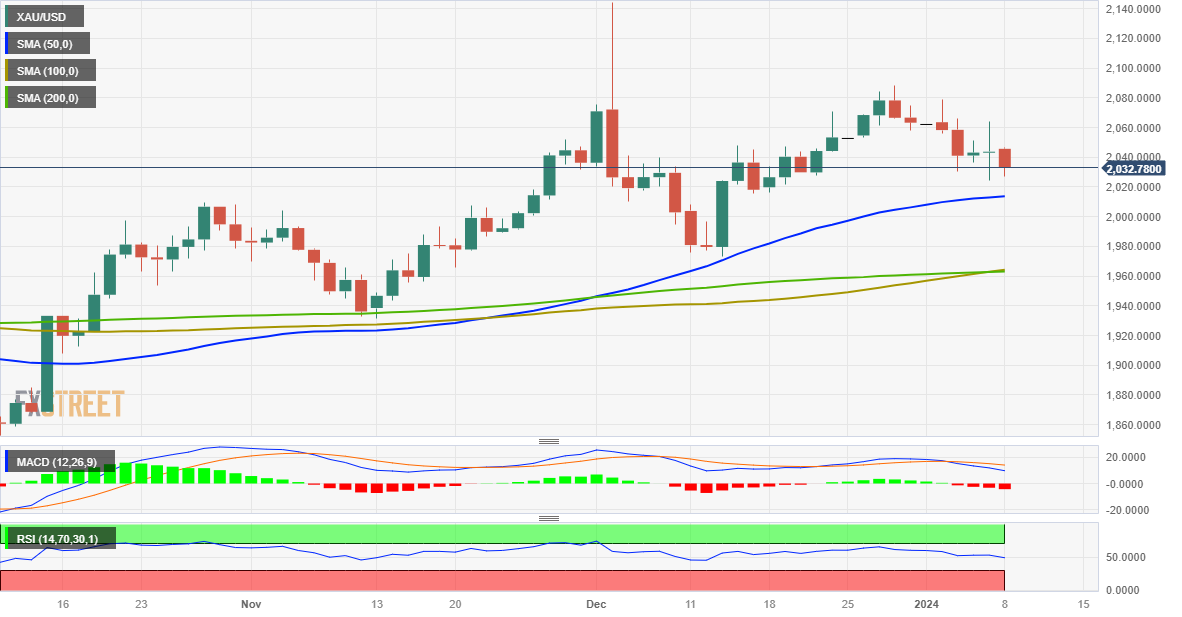
From a technical perspective, some follow-through selling below the $2,024 area, or over a two-week low touched on Friday, will expose the 50-day Simple Moving Average (SMA) support near the $2,012-$2,011 region. This is closely followed by the $2,000 psychological mark, which if broken decisively will be seen as a fresh trigger for bearish traders and pave the way for deeper losses. The Gold price might then accelerate the slide towards the $1,988-1,986 intermediate support en route to the December swing low, around the $1,973 area and the $1,962 confluence, comprising the 100- and 200-day SMAs.
On the flip side, the $2,044-$2,045 zone now seems to act as an immediate hurdle, above which the Gold price could climb back to the post-NFP peak, near the $2,064 region. Any subsequent move-up might continue to attract fresh sellers and remain capped near the $2,077 area. That said, a sustained strength beyond will negate any near-term negative outlook and allow bulls to aim back to reclaim the $2,100 round figure.
Author

Haresh Menghani
FXStreet
Haresh Menghani is a detail-oriented professional with 10+ years of extensive experience in analysing the global financial markets.














